

Will Kerala farmers benefit from soaring coconut prices?
Mail This Article


Some historians say 'Kerala' got its name from 'Kera', or the coconut tree', widely seen in the region. Yet, the state is facing a peculiar situation with many households lacking even a coconut tree, and the coconut becoming a pricey commodity that not all can afford.
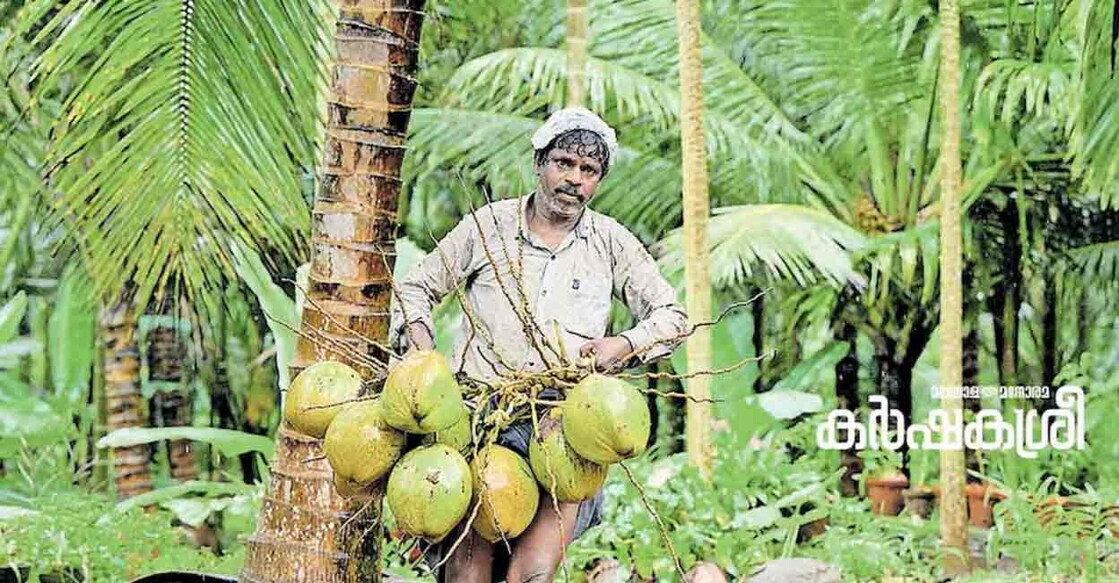
Consider this: Coconuts, sold for ₹15 to ₹20 apiece until two years ago, are now selling at ₹45 to ₹50. A farmer with 40 coconut trees and 25 coconuts per tree can make ₹50,000 if he markets all 1,000.
The demand for coconuts has made the situation rosy for farmers. The irony, however, is that most farmers do not have that many coconut trees. The yield, too, is very low. The high price of coconut has forced even those with coconut trees to cut short on the ingredient in their kitchens.
The minimum annual yield from a tree is 50 to 80 coconuts, meaning one can make ₹2,500 to ₹4,000 from a single tree. If the well-looked-after tree could produce an average of 120 to 150 coconuts, the farmer can make at least ₹5,000 annually even if the price dips to ₹35 apiece. Such a scenario will spur the state's economy.
Will it happen? The farmers will be open to the challenge of growing coconut trees if their produce can bring consistent returns. The question, however, is how long will coconut carry the high price tag?
To understand the market possibility, a knowledge of the circumstances that have led to the current price hike is necessary. Multiple factors have spurred the price of coconut.
Dip in production
Statistics reveal that there has been a decline in the production of coconut. The overall production of coconut in India in 2021 was 2,07,360 lakh, with Kerala contributing 69,420 coconuts. The production slid to 2,03,970 in the country in 2024-25, and Kerala, too, showed a corresponding dip by producing 56,120 coconuts.

The Deputy Director (Statistics) of the State Coconut Development Board, Richy Rachel Mathew, said the coconut production in Kerala showed a slight improvement in 2024-25 compared to the previous year despite a dip in the overall national production. The final statistics for the 2024-25 are yet to be published. The situation in other coconut-producing countries is also similar.
Agricultural Economist Dr Jayashekhar S of the Central Plantation Crops Research Institute (ICAR) said a World Bank study had predicted a 25 per cent reduction in the global production of coconuts. This is due to the high temperature from the 2023 El Niño phenomenon.
The hike in the coconut price was not sudden. Indications were seen during the peak COVID-19 period. With markets closed due to the pandemic-induced lockdown, farmers dried the piled-up coconuts into copra. The price did not spike for a couple of years as the copra reached the market. This explains the lower price of coconut between 2022 and 2024. The dip in price and the consequent dip in revenue made farmers ignore coconut farming. Inadequate fertilisation and pest control further affected the production.
As the copra ran out of stock and the production declined, the available yield could not meet the market demand, fuelling a price hike.
Coconut production is facing multiple challenges in Kerala. Apart from climate change, pests and diseases, farmers' lackadaisical attitude due to a decline in prices, shortage of manpower to harvest coconuts, and the menace of wild animals contributed to the decline in coconut production. Additionally, the Coconut Development Board cited the increasing whitefly infestation in South Indian affecting the production.
In Kerala, red palm weevils and rhinoceros beetles are the major villains in coconut groves. Though several mechanisms are available to control these pests, a comprehensive approach covering all coconut trees in each plantation has not been implemented.
Kerala's hilly areas, like Kuttiyadi, face another threat, an arboreal one. Troops of monkeys that raid plantations leave trees without coconuts. Production loss due to wild animals is an area that needs a serious study.
The state has followed a scheme to replace low-yield coconut trees with high-yield ones. However, it seems the scheme failed to fuel production. It is high time that the authorities studied the outcome of the scheme.
Farmers opined that the promotion of dwarf coconut trees turned counterproductive. Most dwarf and hybrid saplings were destroyed due to various diseases and pest infestations.
Spike in industrial use
Coconuts, once exclusively used for cooking, are now being converted into value-added products. There are several establishments producing desiccated coconut, chips, packed tender coconut, and coconut milk/powder. Additionally, there is an overseas demand for huge quantities of coconut oil, required for the production of oleochemicals, especially, lauric acid.
The price of coconut shells, too, is going north, thanks to the increased production of activated carbon. Coconut shells, sold for ₹9 a kilogram in 2024, are now selling for more than ₹32. Coconut shell charcoal has also become expensive, with the price touching ₹95 a kilogram from ₹35. Still, there is a shortage of charcoal.
Demand for tender coconut
Post-COVID, the demand for tender coconut skyrocketed in the country. Kerala sends tender coconut to North Indian and North-Western states. The number of tender coconut processing units, too, increased. Tender coconut sales have become common in all districts in Kerala, as people have started buying them.
Deepthi Nair S, Director (Marketing) of the Coconut Development Board, said 18 per cent of the total production is reaching the market of tender coconuts. Farmers, too, are happy, since bulk buyers directly harvest them. Gujarati businessmen have realised the profitability of tender coconuts, and they are now into largescale coconut farming. A team from Gujarat flew down to Kochi recently to study coconut farming. They plan to export tender coconuts to the Middle East by sea.
Export demand
Export statistics reflect the demand for coconuts in the international market. India exported coconut and allied products worth ₹4,349.03 crore in the 2024-25 financial year, registering a year-on-year growth of 25 per cent. Earlier, the annual growth was only 12 per cent to 14 per cent.
Deepthi Nair said activated carbon, coconut oil, raw coconut, coconut shell charcoal, copra, and desiccated coconut are the products that are being exported, thanks to the ever-increasing Malayali diaspora. Additionally, awareness about the health benefits of coconut, too, added to the increased exports. Despite Kerala reeling under high coconut prices, exporters have been reaping profits. Exports of non-edible byproducts such as activated carbon and coir, too, have increased.
India is now exporting activated carbon to the tune of ₹15,000 crore a month. In short, the single crop has an export value of USD 100 crore.
Will the price dip?
The current high price of coconut and allied products is not constant. Considering the bitter experience of vanilla and cocoa farming, there are concerns that the high price may eventually backfire. Industries and households will look for cheaper alternatives if the prices remain high. If the new generation develops a taste for different cuisine, they need not return to the traditional one, where coconut is ubiquitous.
Reports have already emerged of several small-scale coconut-related establishments facing closure. "The European oleochemical industries may use alternatives if we cannot provide them coconut oil for a justifiable price,: entrepreneur Ubais of Aluva said.
"The European market is rejecting palm oil from Malaysia and other countries, following the European Union Deforestation Regulation. Instead, they are using coconut oil. If the price is not controlled, we will lose the market," he warned.
Market observers felt that coconut prices would return to a justifiable range in two to three months.
Meanwhile, reports said about increased productivity in major centres. If farmers, encouraged by the high prices, return to coconut farming, better yields could be harvested in two to three years. However, the price should be controlled.
There is a growing demand for coconuts in all countries. China is in talks with Indonesia for a bulk purchase of coconut. Reports said the move is to counter the health issues faced by the younger generation in China. Unconfirmed reports said coconut processing centres in Indonesia are facing a shortage of coconuts.
How to reap benefits?
Though the prices of coconut and allied products are expected to come down, it is widely expected that the prices will settle in a profitable range. Hence, farmers should try to increase production, and compete in the international market. Coconut farming is now tied to the international market, and the opportunity should be grabbed with both hands.
Coconut Development Board's Chief Development Officer Dr. B. Hanumanthe Gowda said the Board has several projects to encourage coconut farming. Ideally, farmers should opt for local varieties of coconut saplings rather than chasing hybrid or dwarf varieties susceptible to pest attacks.
Kerala has mostly small-time farmers, having around 10 cents to grow coconuts, and hence, proper care is often not provided to the trees. Clusters and Coconut Production Collectives formed to address the issue are not active now. It is advisable that expert farmers care for the trees in each cluster, and others share revenue with them.
Decrease in production
J Jnanasharavanan, a young farmer at Meenakshipuram in Palakkad, said coconut production in both Kerala and Tamil Nadu decreased by 60 per cent to 70 per cent. Jnanasharavanan, who has a coconut farm on 36 acres, said he, too, is facing a dip in production, despite following scientific methods. The young man is farming with the help of his father Jagadeesan, a recipient of the 'Kera Kesari' award.
Jnanasharavanan said he used to get 124 coconuts per tree in 2023-24, which dipped to an average of 43 in 2024-25. He felt that climate change had affected the crop. The scorching heat in the summer of 2024, followed by untimely rain that affected pollination, coupled with whitefly infestation and fungal infection, too, led to a decreased yield.
 Add as a preferred source on Google