

What is Kummattikkali? Thrissur to come alive as Kummatis roam about for Onam
Mail This Article


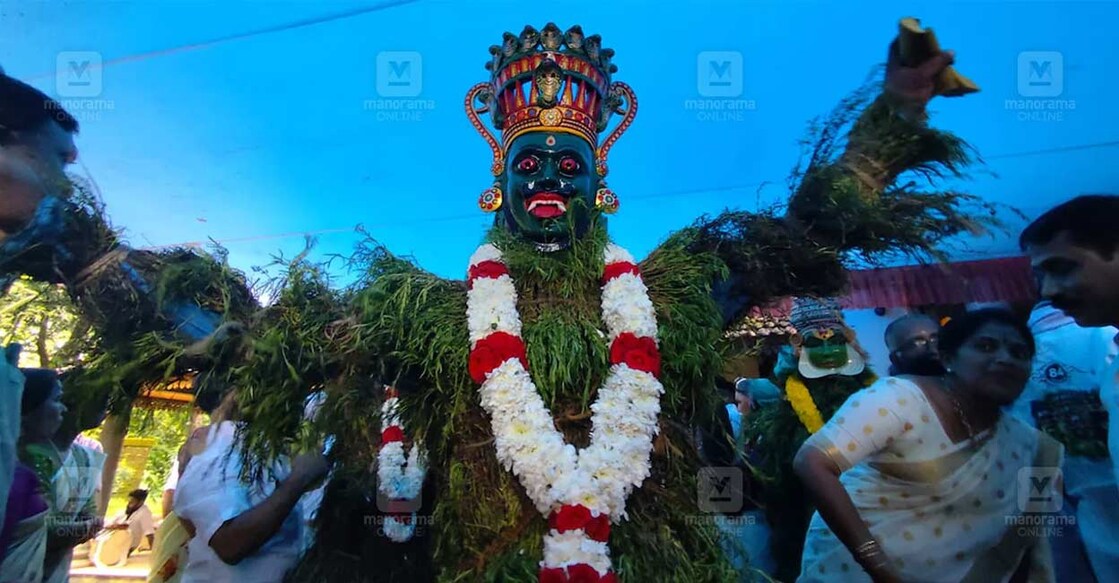
Thrissur: The Onam season in Thrissur also heralds the arrival of the Kummatis. Draped in Parpadaka ( dried Bermuda grass) grass and wearing wooden masks, they move through neighbourhoods, dancing to the rhythm of traditional percussion, accompanied by colourful kavadis.
As the city and its surroundings gear up for Onam, Kummati groups across the region are preparing to infuse the celebrations with their unique energy, accompanied by a variety of percussion instruments and folk art forms. Alongside the traditional Kummati strongholds, cultural organisations and clubs are also joining in to keep the tradition alive while also adding their own creative variations to the festivities.

Story behind the Kummatti tradition
Kummatis, who reach out to the people during the Onam seasons have been part of Thrissur’s cultural fabric for generations. Their electrifying presence, with bodies covered with grass, floral garlands around their necks and faces hidden behind masks, indeed transforms streets into festive stages. The most significant among the masks is the `Thalla' face.
In earlier times, masks were crafted from areca palm leaves. Lightweight but fragile, they were soon replaced by sturdier wooden masks, though these could weigh as much as 4 kg. And before wooden masks became popular, metal masks were also in useDancers, fuelled by a rush of adrenaline, would cover more than five kilometres despite the heavy gear. Originally, the Onavillu was the only accompanying instrument, but over the years, chenda, shinkarimelam and nagaswaram have joined in, adding to the grandeur.
Today, Kummati performances are even more elaborate, often featuring art forms reminiscent of Theyyam, mythological floats and kavadis. According to legend, Kummati represents a troupe of demons sent by Lord Shiva to entertain his devotees. Another story says Shiva’s followers danced in varied disguises to please Ganapathy after the Kiratham, with Ganapathy himself joining in and this ritual evolved into the Kummati tradition.
A `grassroots challenge'
The biggest hurdle facing Kummati today is not expense but the shortage of parapadaka (Bermuda) grass, once abundant in the region. Each performer needs nearly half a sack, but the grass is now sourced from places like Palakkad. Although tradition calls for the use of fragrant Bermuda grass, in some places colourful costumes have taken its place, prompting purists to lament the loss of authenticity. With scarcity limiting participation, only a few can continue the practice in its original form.
The ancestral home of Kummati
Among Thrissur’s many Deshakummatis, the Kummati of Kizhakkumpattukara ‘Desham’ (village) stands out with a legacy spanning decades, earning it the title of Kummati’s “Tharavadu” (ancestral home). Today, Kummati is performed in three main categories, namely Vadakkumuri, Thekkummuri and Prithvi. In Thekkummuri, some performers have carried on the tradition for over 40 years.
The costs of preparing masks, arranging percussion and staging performances often run into lakhs. While the Thrissur Corporation extends small grants, most groups rely on community donations collected from households in their respective `Deshams'.
 Add as a preferred source on Google