

Swollen river took Idukki man's 14-seater traveller, left behind scrap pile
Mail This Article


For 49-year-old Santhosh from Koottar in Idukki, it was supposed to be just another rainy night on October 17. After finishing his daily chores, he went to bed early — unaware that he would be wading through floodwater a few hours later, helplessly watching his livelihood being swept away.
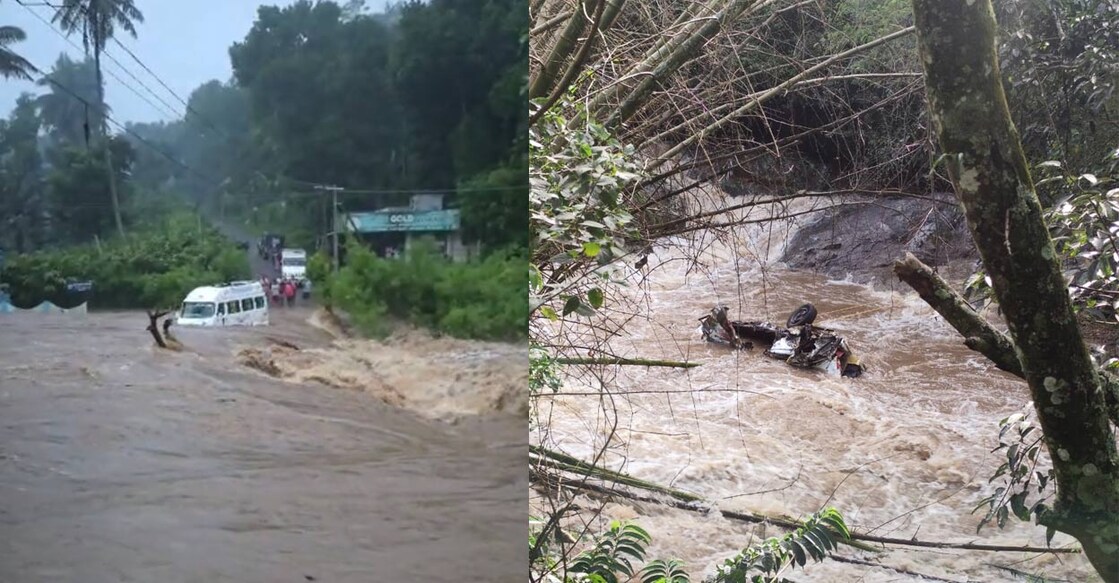
Around 9 pm, Santhosh had parked his traveller van, named Vinayaka, near the Koottar river, just a few metres from his home. But by 3 am the next day, the phone calls started coming in. Neighbours warned that the water in the river had risen alarmingly. “When I reached the spot, the bridge was already underwater. The van had started sinking,” he recalls.
With help from a few locals, Santhosh tried tying the vehicle to a nearby tree using thick ropes. “We couldn’t even go close to it. The water had reached above the wheels, and the current was too strong,” he says. By 3.30 am, half of the vehicle was submerged. Still, he hoped the rain would ease by dawn.
But nature had other plans. “Around six in the morning, the current strengthened again. The water lifted the van off the ground — a four-tonne vehicle — and swept it away. We could only stand there and watch,” Santhosh says.
About 500 metres downstream, the vehicle got trapped in a deep pothole in the river. By then, it was mangled beyond recognition. “All I could recover later were cracked tyres and broken chassis parts,” he says.

For Santhosh, the loss was deeply personal. “I’ve been taking care of that traveller for the last three years. I used to park it at the same spot every day. No one ever imagined the water could rise this high — even during the 2018 floods, it hadn’t reached such a level,” he says.
The van, a 2014 model, belonged to Bhuvanendran, another Idukki native. But Santhosh managed everything — maintenance, paperwork, and trips. He also helped run another vehicle, a 35-seater minibus. “Three of us depended on these vehicles — me, Rajakrishna Menon, and Ajesh. Now one is gone, and so is part of our income,” he adds.
The spot where the traveller was parked was considered safe. “It’s right in front of the SBI branch at Koottar junction, under CCTV surveillance. I always felt secure leaving the vehicles there,” Santhosh says. That night, Ajesh had parked the minibus near his home — a decision that, in hindsight, saved it from being washed away.
When the rain finally stopped, Santhosh spent an entire day trying to salvage the remains. “Even the fire and rescue team couldn’t pull it out. The crane services gave up. Finally, with two tractors and an earthmover, we managed to drag it ashore using ropes. The first rope snapped — the second worked,” he says.
But what they retrieved was no longer a vehicle. “The seats, glass, and body panels were all gone. It had moved just 500 metres, but the force of the current crushed everything,” Santhosh says quietly. Now, after completing the insurance formalities, the remains of Vinayaka will be sold for scrap. “Our living turned to scrap overnight. There’s nothing else we can do,” he says.
Local ward member P D Pradeep says the rains were the heaviest the region had seen in years. “The Koottar river swelled after the Parekkadayar and Vandanmedar rivers joined. The bridge there also collapsed, cutting off access to nearby areas. People in the Pampadumpara and Karunapuram areas now have to travel 4–5 km to reach the next bridge,” he explains.
Santhosh, who lives with his parents and two daughters, also drives a school bus for a nearby institution. He has been behind the wheel for over two decades, driving jeeps, buses, and travellers. “During the COVID-19 pandemic, the traveller we ran under a local community was sold off when trips stopped. Vinayaka gave me a fresh start — and now, that’s gone too,” he says.
 Add as a preferred source on Google