

Court bars Teltumbde from attending Hortus, makes his voice heard online
Mail This Article


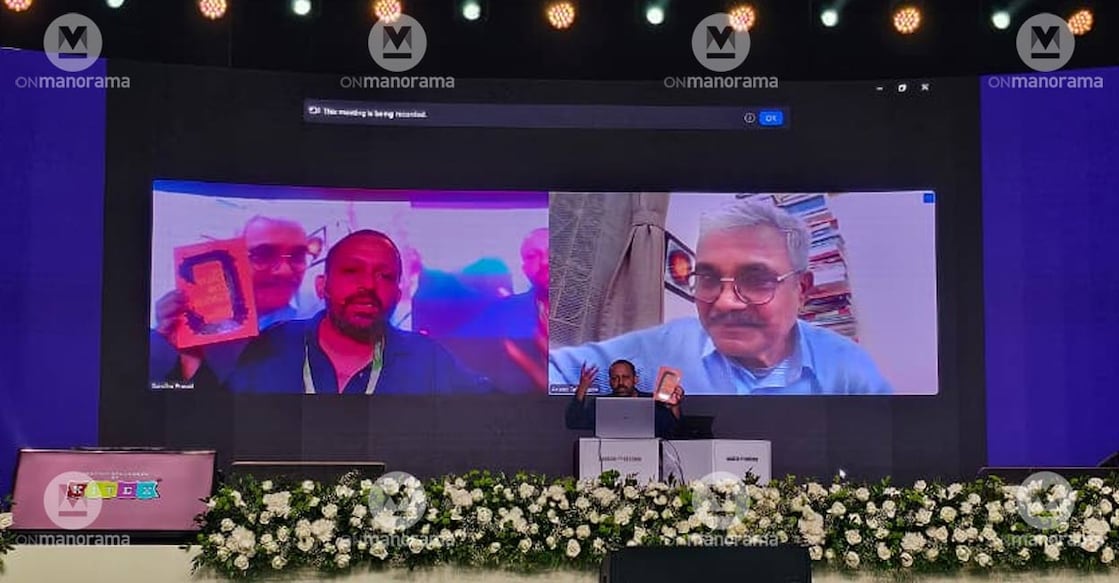
Kochi: At the Manorama Hortus, the stage was set for two speakers, but only one chair was occupied. Writer S Anand sat alone, while the face of renowned scholar and activist Anand Teltumbde looked down from a large screen behind him.
“He is everywhere, but not here,” S Anand told the audience, explaining the "unfortunate turn of circumstances."
Teltumbde, currently out on bail in the NIA's Elgar Parishad-Bhima Koregaon case, had initially been granted permission by the court to travel to Kochi to attend Hortus. However, just two days before the event, that permission was withdrawn. Anand described this as a reflection of the “vindictive nature of the state,” noting how the system often leaves thinkers and activists “high and dry.”
Despite the digital distance and technical glitches, Teltumbde’s voice came through clearly on one critical subject - the Caste Census. While many in India see the census as a solution to inequality, Teltumbde, in the discussion which revolved around his latest book, Caste Con Census, offered a warning: counting heads is not the same as liberating them.
Teltumbde began by looking back at history. He explained that while caste always existed in India as a brutal, local reality, the British colonial administration changed how it worked.
By counting and classifying people in the late 19th century, the British “froze” fluid social identities into rigid government boxes.
“The British decreed this categorisation... simply to understand the population,” Teltumbde explained. But the result was that “every caste got its place in a hierarchy,” creating deep divisions that remain today.
The most surprising part of the conversation was Teltumbde’s scepticism about the current demand for a caste census. While opposition parties argue it will bring social justice, Teltumbde fears it could be used to dismantle reservations.
His argument is simple: upper castes and the wealthy might refuse to list their caste.
“The billionaires are not going to register their caste... they would say ‘I am casteless'. Meanwhile, the poor and marginalised will register to claim benefits," he said.
He warned that this could give the state a weapon. They could look at the data and claim that inequality is gone among the general population, using that as an excuse to abolish reservations entirely. “It would facilitate the argument of the regime that caste reservation has done enough, and it can be abolished," Teltumbde said.
Anand steered the conversation toward another problem: privatisation. He pointed out that cities like Pune now have dozens of private universities where reservation laws don't apply.
If the government stops funding public schools and hospitals, what is the value of fighting for a slice of the pie?
Teltumbde agreed, noting that the reservation policy would never succeed without empowering people. He said that true equality comes from capacity building, giving everyone equal access to high-quality education and healthcare, not just giving a few people seats in a crumbling government system.
During the Q&A, an audience member asked if the caste census would lead to a “social revolution,” as some politicians claim. Teltumbde was blunt. He said political parties are confusing social justice with simple election math.
“They do not mean something like sharing the wealth of the country,” Teltumbde said. He pointed out that true change would require land reforms and wealth redistribution, but political parties are only interested in “arithmetic consideration” to win votes.
The session ended with a call to reality. S Anand reminded the audience that the “annihilation of caste” is a long, difficult road. It requires more than just ticking a box on a census form.
“This book puts dynamite to the Vedas and Shastras, which teach inequality,” Anand said, referring to Teltumbde’s work. He urged the audience to read and reflect, noting that while Teltumbde was barred from attending in person, his ideas could not be contained by state borders.

 Add as a preferred source on Google