

In a CPM stronghold, an armless Congress worker battles ‘authoritarian’ politics
Mail This Article


Kannur: When Aneesh George (41), a booth-level officer, ended his life in Kannur’s Kankol-Alappadamba Grama Panchayat on November 16, the Congress and Leader of Opposition V D Satheesan accused the CPM of having harassed and threatened the BLO. Vyshak K (31) -- the one-man resistance of the Congress party in the panchayat was asked to mount an attack on the Marxist party.
He takes on the mighty CPM in election after election as the booth agent of the Congress, ignoring violent threats, vandalism, and even a kidnapping attempt. “My son is alive because he has no arms. That’s all I have to say,” says his mother, Geetha K.
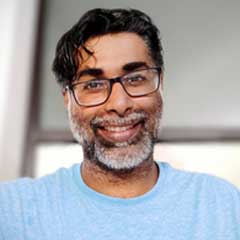
Vyshak was born with a congenital condition called bilateral amelia, the complete absence of both upper limbs. But the condition is not his only armour. Vyshak is also an artist, and the effortless strokes he creates with his left foot are widely followed on social media and featured on the portal of the Mouth and Foot Painting Artists (MFPA). “Any attack on me will draw attention,” he says.
The Congress, in a last-minute reshuffle, fielded Vyshak as its candidate in Ettukudukka ward, replacing the party’s mandalam secretary, Shiju. From the outside, it looks like a no-contest. The CPM holds all 14 wards of Kankol-Alappadamba. The panchayat itself sits cocooned at the centre of a belt of similar ‘party gramams’ -- Kayyur-Cheemeni in Kasaragod district, and Karivellur-Peralam, Eramam-Kuttur, Peringome-Vayakkara and Payyannur municipality in Kannur.
But Vyshak says he enjoys the quiet backing of people who, in his words, have lived under "CPM’s authoritarianism", a phrase he repeats throughout the interview. When asked for an example, the family points to their own past.
Vyshak’s parents, Geetha and Balakrishnan, were once loyal CPM workers. They ran a small roadside restaurant and a poultry shed in Ettukudukka, and Balakrishnan also drove an autorickshaw.

In 2005, when Congress leader Ramesh Chennithala reached Payyannur Gandhi Park as part of his ‘Kerala Chaitanya Yatra’, Balakrishnan happened to be in town to buy vegetables for the restaurant. Out of curiosity, he joined the crowd to hear Chennithala speak. “Those days, Chennithala was a firebrand leader,” says Vyshak, who was then in Class VI.
What they didn’t know was that Payyannur Network, a newly launched local channel, captured Balakrishnan standing in the crowd. It aired on TV that evening. “Not many houses had cable TV then. We had no idea,” says Geetha.
By the next morning, their poultry shed had been torched, and the restaurant vandalised. “They didn’t burn the restaurant only because the building belonged to a CPM leader,” she says. “That day, I stopped buying Deshabhimani,” says Geetha, referring to the CPM’s newspaper. “We lived in fear for a long time. Now I’ve lost that fear.”
Soon after the Chennithala event, Balakrishnan was allegedly framed in a sexual assault case. He says the local auto drivers’ union, under CPM influence, issued a letter banning him from the Ettukudukka auto stand and its surroundings. In a public corner meeting, CPM leaders allegedly urged people to beat him with sandals and not hire his auto.
“A man and a woman hired my auto from Payyannur. On the way back, the man pushed the woman out. Initially, I wasn’t even named in the case, but after CPM leaders intervened, I was made an accused,” says Balakrishnan. “I had to go into hiding for 20 days.”
He later secured bail, the case collapsed, and he took the union’s ban letter to the High Court and had it revoked. The woman who filed the complaint and Vyshak are now close friends, Geetha says.
Ideological differences
Though Geetha and Balakrishnan are disillusioned with the CPM today, they still identify as communists at heart, says Vyshak. “But I drifted away in school. I couldn’t accept their ideology of control.”
Until Class IV, at the Ettukudukka AUP School, he knew only of CPM as a political party. But it was there he learned to draw and write with his foot. “My drawings were better than my handwriting,” he laughs.
High school in Cheemeni opened a new world of politics, the Congress and its students’ wing, the KSU. “I was reading a lot then, and I started opposing the CPM ideologically,” he says.
For his undergraduate studies, he joined Payyannur College and contested the union elections on a KSU ticket. Later, during his post-graduation at the Co-operative Arts & Science College in Madayi, he was elected the union general secretary. Today, he is the Youth Congress mandalam president of Kankol-Alappadamba.
The fear is real
How real is the fear of the CPM here? While Vyshak was being interviewed, the Congress mandalam secretary, Shiju, walked into the house. He declined to come on camera. “I’m a rubber tapper. I leave for work early in the morning, alone. I can’t take risks,” he said. “Vyshak always has someone with him because he can’t drive.”
Around the same time, his neighbour Padmanabhan dropped by. But at the sight of the camera, he began to retreat. “Don’t film me. They hacked my leg once. I don’t want to lose my head,” he said. Geetha insisted he not be recorded. “He suffered a lot. He couldn’t work for months after the attack,” she says. Padmanabhan’s leg healed with a pronounced curve, and he walked away with a limp.
In the Lok Sabha election, Vyshak was Congress candidate Rajmohan Unnithan’s booth agent when suspected CPM workers allegedly tried to kidnap him before he entered the school. “As soon as my sister dropped me off at the school, two men approached me asking if I intended to sit as a booth agent. When I said yes, they tried to lift me from under my arms. But because I have no arms or even a shoulder stump, their grip slipped. They did not expect that. That split second helped me escape into the booth,” he says.
His sister raised an alarm and tried to film the men. She later realised the tyres of her scooter had been slit. “She pushed the scooter back home,” he says. Inside, Vyshak was threatened, so he left the booth before the polling ended. “They threaten to hack my legs. I shot back, saying I know how to survive even without legs. I have got into politics without fearing the consequences. My only aim is to bring a small change to their authoritarian ways.” There has been no action on his police complaint yet.
Issues, protests and solutions
Vyshak says the CPM has been under pressure from within ever since four polluting units began operating in the panchayat. A rubber latex company in Ettukudukka (Ward 1) has been spreading a persistent stench in the neighbourhood. A flex-printing unit in Kundayam Kovval (Ward 11) was shut down after it dug a pit and dumped waste ink and chemicals, contaminating several wells downhill during the rains and leaving many ill. “When we organise people and protest, the CPM will swoop in, hijack it, and offer some stop-gap fix,” he says.
Once, Vyshak questioned CPM booth agent Rafeeq -- also the development committee chairman of Ettukudukka ward -- on why the party was protesting against companies it had itself helped set up. “He grabbed my collar. If people hadn’t pulled him away, there would have been trouble,” he says.
A month ago, a strong, acrid smell drifted from a fish-processing unit in the panchayat. “We had protested against the unit before, too. But this time the CPM too joined the protest because it’s election season,” says Vyshak. “People can see through them. So we’re hoping for some churning in favour of the UDF this time.”
BLO’s death and investigation
Vyshak says the late Ettukudukka BLO, Aneesh George, was a quiet man unfamiliar with all the houses in the ward. “So he would ask me to accompany him while distributing SIR forms,” he says, referring to the Special Intensive Revision of electoral rolls for next year’s assembly polls.
“Twice I went with him. On the third day, he called to say that the CPM had threatened him for taking me along,” says Vyshak. “I have the recording of that call.”
On November 10, Vyshak wrote to the District Collector, alerting him that the BLO was under pressure. “The Deputy Tahsildar called to say I could accompany Aneesh only if a CPM representative also came along. Then he closed the complaint,” Vyshak says.
On November 16, Aneesh returned home from church around 9.30 am and took his life. “That same day, the CPM held a camp to help people fill out the enumeration forms. Neither Aneesh’s family knew about it, nor was I aware. They brought in a BLO from another ward to take the class,” Vyshak says.
 Add as a preferred source on Google