

Activist moves court against CPM’s AKG Centre, seeks prime land reclaimed for Kerala University
Mail This Article


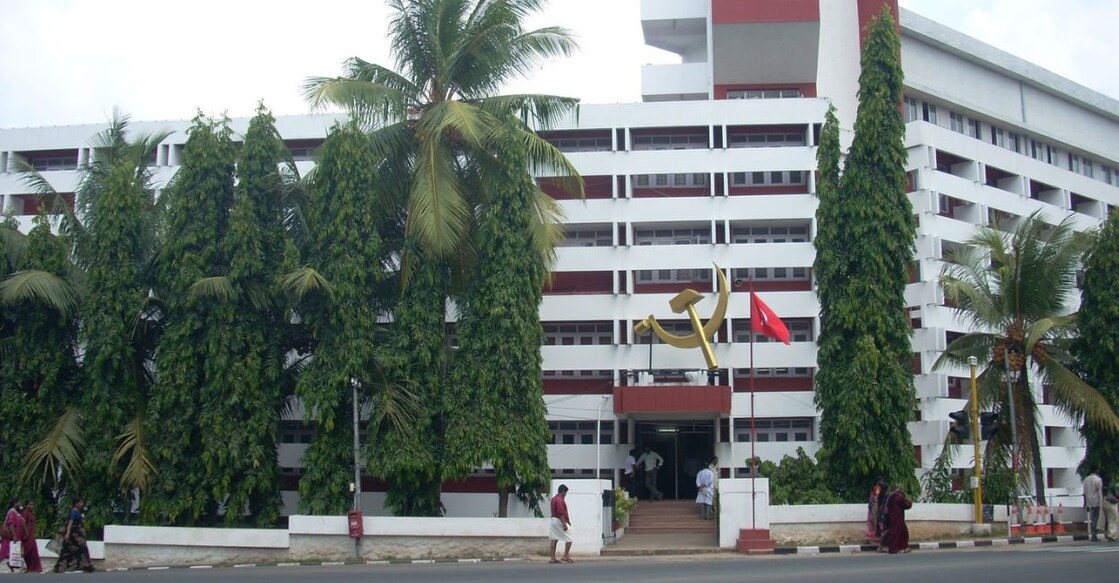
If LDF MLA and former Transport Minister Antony Raju was convicted last week in a 35-year-old evidence-tampering case, the CPM has to now brace for another legal battle that was in the making for nearly 50 years. A writ petition has been filed in the Kerala High Court over its possession of the AKG Centre for Research Studies at Palayam, in the heart of Thiruvananthapuram. The case challenges AKG Centre's claim over 56.12 cents of prime land, questioning the very legality of the government assigning the land to the CPM-controlled institution.
The dispute over the AKG Centre dates back to 1977, the year Marxist leader A K Gopalan died, and when the then A K Antony government purportedly assigned a plot from the University of Kerala to set up a research centre in his memory.
The petition has been filed by R S Sasikumar, former Joint Registrar of the University of Kerala and an education activist, seeking directions to reclaim land that was originally vested with the university. Sasikumar contends that neither the CPM nor the AKG Centre, controlled by the party, has legal ownership of the land, despite the premises functioning for decades as the CPM’s state headquarters until April 2025.
The legality of the AKG Centre was sharply questioned in the Assembly as early as 1988 by the Congress. The then E K Nayanar government defended the centre with what opposition members described as evasive answers and repeatedly stonewalled demands for an inquiry. The transcripts of that Assembly debate, where the government refused to table the land assignment order, form part of Sasikumar’s petition.
Soon after the demise of AK Gopalan, a committee was formed by E K Nayanar, to set up a memorial research centre in his name.
The CPM has claimed that during the A K Antony government’s tenure, two government orders dated August 20 and 25, 1977, assigned 34.408 cents of land to the AKG Memorial Research Centre. Sasikumar, however, contends that the crucial order dated August 20, 1977, is untraceable in official revenue records. He has relied on RTI replies from these offices to substantiate his claim.
In the 1988 Assembly debate, the LDF government also refused to table either the application seeking land or the assignment order, instead daring members to “go to court” if they wanted to see the documents. “Now I’m in court. Let’s see if we can actually find that government order,” said Sasikumar, who is also chairman of the Save University Campaign Committee, a whistleblower group focused on higher education.
RTI replies annexed to the petition complicate the CPM’s position. Records from the Central Survey Office show that the AKG Centre occupies 56.12 cents across two survey numbers -- 21.59 cents and 34.53 cents -- adjacent to the Kerala University Senate House campus. The Vanchiyoor Village Officer has confirmed that both parcels are recorded as government puramboke (revenue land) in the Basic Tax Register, with no thandaper number and no evidence of land revenue payment. The Revenue Department has stated that since the land is puramboke, no land tax has ever been collected. The Thiruvananthapuram Corporation shared a document indicating that the building tax has been waived for the AKG Centre.
During the 1988 Assembly debate, the LDF government maintained that the centre stood on 34.408 cents. Sasikumar said the CPM later claimed that the University Syndicate had assigned an additional 15 cents to the AKG Centre. “The Syndicate has no power to alienate university land; only the government does. Even if that claim of 15 cents is accepted, there is still encroachment of at least 6.71 cents of university land,” he said. “My petition seeks reclamation of the entire 56.12 cents because the CPM chose to run its party office on the land.”
Sasikumar said, though no official document is available in the public domain on assigning land to AKG Centre, a book -- 'History of the University of Kerala' by former Registrar and historian A Sreedhara Menon -- records that only 15 cents were given to the AKG Centre in 1977. “Even for that 15 cents, no mutation was done. I suspect AKG Centre avoided getting the land transferred to its name officially because it was occupying more land than it was assigned,” he said.
The Assembly exchanges of 1988, now reproduced in the petition, reveal the political tightrope the LDF government walked. The E K Nayanar government fielded the then Food and Civil Supplies Minister E Chandrasekharan Nair to defend the CPM. He repeatedly cited the assignment condition that the land be used for a “suitable memorial for AKG comprising a research centre, library and conference hall”. When asked by the then Haripad MLA Ramesh Chennithala and the late Udma MLA K P Kunhikannan whether the CPM’s party office was permitted on the premises, Nair said an “office” was allowed. When the Opposition MLAs insisted on knowing if the office meant the CPM office, Nair said he was leaving the interpretation to individual members, triggering uproar in the House.
When opposition MLAs accused the government of evasion, Nair went further, arguing that a CPM party office would “not be incompatible with the memory of AKG”. Countering the government, Cherthala MLA Vayalar Ravi and Kunhikannan said a "research centre" built on public land and with funds raised from local self-government institutions could not be converted into the private property of a political party. “None of these questions would have arisen if the CPM had bought land and built a memorial with its own funds,” Ravi said.
When Oommen Chandy, referring to a complaint filed by Cherian Philip, asked for a resurvey of University of Kerala land to check possible encroachment, Minister Nair said that only the university could seek such a resurvey. Sasikumar said Cherian Philip later made the same complaint to Prof John Vergis Vilanilam after he took charge as Vice-Chancellor in 1992. “Prof Vilanilam deputed an engineer to assess the land. But when the engineer went to the AKG Centre with survey chain links, he was manhandled and forced to turn back,” claimed Sasikumar.
Crucially, when K Karunakaran demanded that the government table the land application and assignment order, Minister Chandrasekharan Nair declined. “It is not a good practice to table all government orders in the House,” he said, adding that the documents could be produced if a court or the Speaker directed it. The order was never tabled.
“When the UDF came to power later, it did not pursue the issue,” Sasikumar said. “So I decided to approach the high court for what appears to be a top-secret government order. It took me two years to get all the documents and RTI replies to move the court,” he said.

When the matter came up before Justice C Jayachandran on Tuesday, January 6, the court directed the registry to convert the writ petition into a Public Interest Litigation and list it before a Division Bench.
The petition argues that the AKG Centre is not a recognised research institution of the University of Kerala and that the land, whether assigned or not, has been grossly misused as a political and organisational hub of the CPM, in violation of statutory conditions. It alleges illegal possession of more than 55 cents of university land and government puramboke, without lawful authority or valid approvals.
The challenge over the old AKG Centre comes even as the CPM’s new AKG Centre -- a nine-storey headquarters on Raghavan Road built for ₹30 crore and inaugurated in April 2025 -- faces a separate ownership dispute in the Supreme Court. Together, the cases place renewed judicial scrutiny on how the party acquired, retained and used public land in Kerala’s capital.
 Add as a preferred source on Google