

Tirur Sub Collector pitches major Kerala reforms, suggests Malappuram bifurcation
Mail This Article


Aligning with a long-standing demand raised by several Muslim organisations in Kerala, Dilip K Kainikkara, the Sub Collector of Tirur, has suggested the bifurcation of Malappuram district.
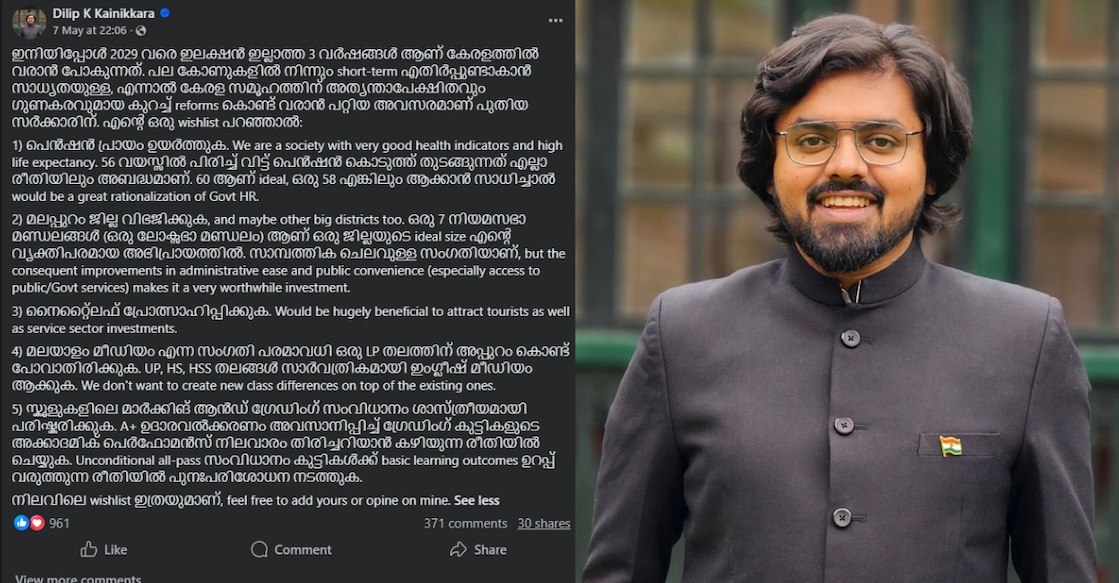
In a Facebook post outlining his “wishlist” for reforms in Kerala, Dilip said the state is entering a three-year period without elections until 2029, offering the government an opportunity to introduce structural reforms that may face short-term resistance but could prove beneficial in the long run.
Among the proposals, he called for the division of Malappuram and possibly other large districts, arguing that the ideal size of a district should be around seven Assembly constituencies, roughly equivalent to one Lok Sabha constituency.
“Though it would involve financial expenditure, the resulting improvements in administrative efficiency and public convenience, especially access to government services, would make it a worthwhile investment,” he noted.
The proposal comes amid renewed demands for district reorganisation in Kerala. Recently, the Muslim Youth League sought the bifurcation of Malappuram and proposed a new district with Tirurangadi as its headquarters.
Earlier this year, the Samastha Kerala Jam'iyyathul Ulama (EK faction), an influential body of Sunni Islamic scholars, also passed a resolution calling for the reorganisation of districts in Kerala, including Malappuram, citing population growth and increasing administrative challenges.
Dilip’s reform wishlist also included raising the retirement age in government service. Pointing to Kerala’s high life expectancy and health indicators, he argued that retirement at 56 was no longer practical.
“We are a society with very good health indicators and high life expectancy. Forcing people to retire at 56 and then paying pensions for decades is irrational in every sense. Sixty would be ideal, but even raising it to 58 would be a major rationalisation of government human resources,” he wrote.
Another proposal was the promotion of nightlife to attract tourists and boost investments in the service sector.
In the education sector, Dilip advocated limiting Malayalam-medium instruction largely to the lower primary level, while making English-medium education universal at the UP, high school and higher secondary levels. “We should not create new class divisions on top of the ones that already exist,” he said.
He also called for scientific reforms in the school marking and grading system, criticising the “liberal awarding” of A+ grades and urging a system that better reflects students’ academic performance and learning outcomes.
