

Float when it floods: Why amphibious homes are the future of climate-resilient housing in Kerala
Mail This Article


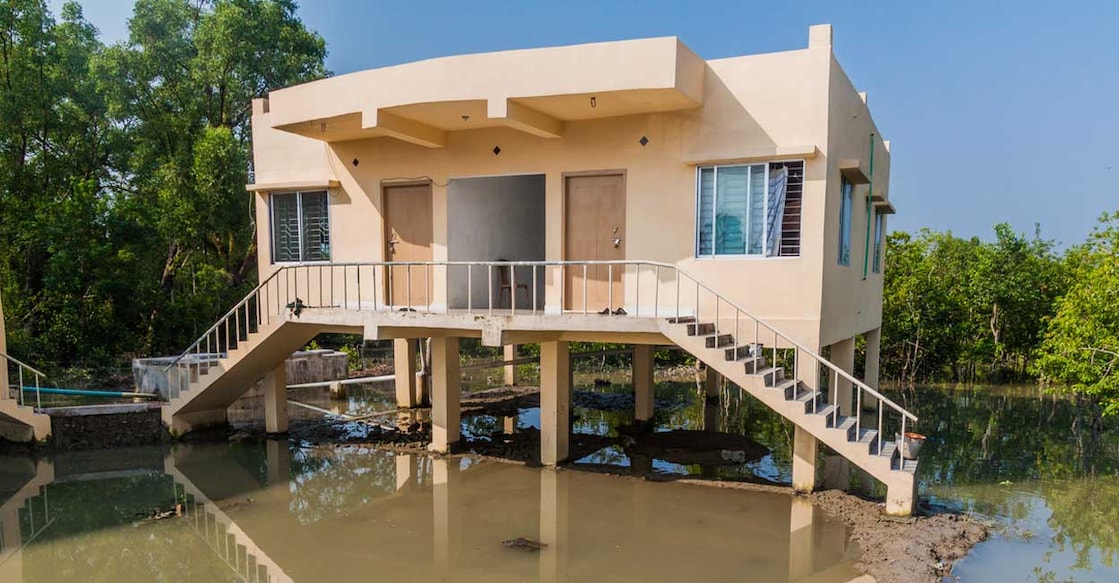
Kerala is no stranger to the devastating fury of monsoons. Since the catastrophic floods of 2018, the state's weather patterns have become increasingly erratic, with cloudbursts, flash floods, and landslides turning into a grim annual reality. Even homes built with millions of rupees are no longer safe from nature's wrath. As traditional construction struggles to cope, a revolutionary architectural solution is gaining traction: amphibious houses that literally rise with the floodwaters.
Popularised in flood-prone nations like the Netherlands and the UK, amphibious homes are designed to exist harmoniously on both land and water. Unlike houseboats, they function as normal ground-based residences under everyday conditions. However, when floodwaters rise, the entire structure floats upwards, keeping the interiors, furniture, and residents completely safe and dry. Once the water recedes, the house settles back into its original position.
The British and Dutch blueprints
In the UK, amphibious homes have become a major architectural attraction, particularly along vulnerable riverbanks. Built with lightweight timber frames and pitched roofs, these structures are set inside wet docks. When water fills the dock, the house floats on a principle similar to a buoyant canister. Robust steel guide posts anchor the house, allowing it to move vertically up and down without drifting away. Crucially, utility systems such as electricity, water, and sewage are designed with flexible connections that remain fully operational even when the house is afloat.
Bringing the innovation to Kerala
This climate-resilient building technique is incredibly well-suited for Kerala's low-lying regions like Kuttanad, which grapple with waterlogging for several months a year. While still a novelty in India, forward-thinking local architects are leading the charge. Ernakulam-based innovators Nanma Gireesh and Ben K George studied these structures extensively in the Netherlands and Poland before adapting the technology for the local terrain.
They successfully constructed a prototype in Kuravilangad, Kottayam. The system utilises a heavy, hollow concrete foundation built over a ground-level beam. Surrounding the structure are four guiding concrete pillars. If water rises, the hollow foundation acts as a giant float, gliding smoothly up the pillars to keep the living quarters well above the flood level.
How Archimedes protects your home
The technology relies heavily on Archimedes' principle of buoyancy. Corner rings fitted with specialised roller bolts are attached to the foundation and wrapped around the guiding pillars. As the water level climbs, the rollers glide smoothly up the pillars, preventing the house from tilting or swaying. The foundation is custom-engineered based on the soil moisture and local geography, making it equally effective in coastal areas prone to sea erosion. With construction costs hovering around ₹2,500 per square foot, and successful models already standing in places like Bharananganam near Pala, amphibious housing offers a practical, long-term shield against Kerala's climate challenges.
