

Alappuzha-Changanassery road submerged again despite ₹671 crore flood-mitigation revamp
Mail This Article


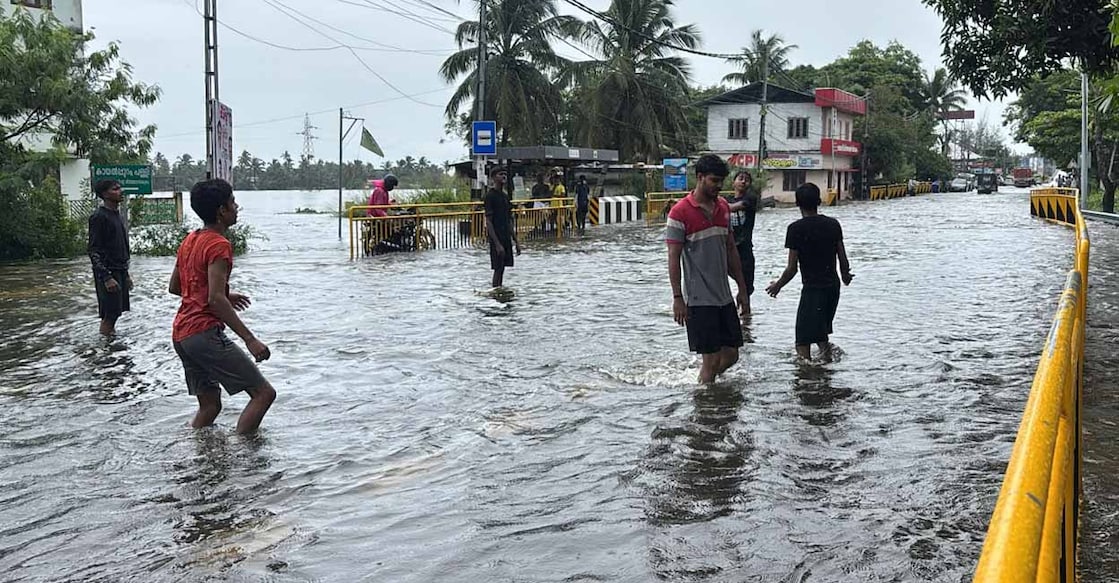
The pride of Kuttanad, the newly revamped Alappuzha-Changanassery (AC) Road, has once again succumbed to monsoon fury. Marketed as a "flood-free" corridor after a massive multi-crore overhaul, severe waterlogging has returned to plague commuters, raising serious questions about the design and execution of the project. Currently, several sections are so deeply submerged that only tractors and heavy vehicles can successfully navigate them.
The latest bout of flooding began at the Poovam section, just east of the Kidangara bridge. Within days, the waterlogging spread further west to the Mankombu Block Junction. While the water levels at Poovam have receded slightly along a one-kilometre stretch, allowing lighter vehicles to tentatively pass, the threat remains high with meteorological departments warning of more heavy downpours. Local residents point out that this is not a one-off incident; the same stretch was underwater last year as well. Many express frustration, recalling that initial plans for the reconstruction featured a flyover at Poovam to bypass low-lying spots, but it was dropped for unexplained reasons. Locals argue that the raised road remains insufficient to withstand the region's unique hydrology.
A perfect storm of design and nature
The primary cause of flooding at Poovam is the powerful eastward surge of water through the AC canal near the Kidangara East bridge, which pushes immense volume onto the road. Unfortunately, there are no alternative drainage outlets to channel this water away from the Poovam area.
Meanwhile, the crisis at Mankombu Block Junction—situated between the Mankombu Onnamkara flyover and the main Mankombu flyover—was triggered by a major bund breach at the Mula Pongampra paddy fields. The breach has not only ruined local crops but also inundated the highway, restricting movement to heavy transport vehicles only. Repairing the breached bund is a time-consuming process. History is repeating itself here: a similar bund breach before the road's renovation had brought traffic to a complete standstill for nearly a month. A flyover was also proposed for this bottleneck during the planning phase but was ultimately shelved.
A mixed bag for the ₹671.66 crore project
This is not the first time the newly upgraded road has faced criticism. Three years ago, waterlogging was reported at the Parakkal section in Kottayam district. At the time, authorities blamed a delay in clearing and opening the culverts constructed for the project. However, the subsequent submergence of sections without such drainage issues indicates deeper systemic flaws.
To be fair, the project has not been a complete failure. Several chronically flood-prone zones along the 24-kilometre stretch have successfully remained dry this season thanks to the increased elevation of the road. However, these successes are overshadowed by the recurrent failures at Poovam and Mankombu.
The extensive 24-kilometre reconstruction, which includes a post-construction maintenance period, was executed at a cost of ₹671.66 crore. The contract was awarded in 2020 to the Uralungal Labour Contract Co-operative Society (ULCCS), which executed the work in partnership with an Azerbaijani firm. While the engineering was meant to secure Kuttanad's arterial link against the worst of Kuttanad's seasonal floods, the reality on the ground suggests that the battle against water is far from won.
