

'Kallanum Bhagavathiyum' actor Mokksha on her Kerala connection, cinema journey and life beyond the screen
Mail This Article


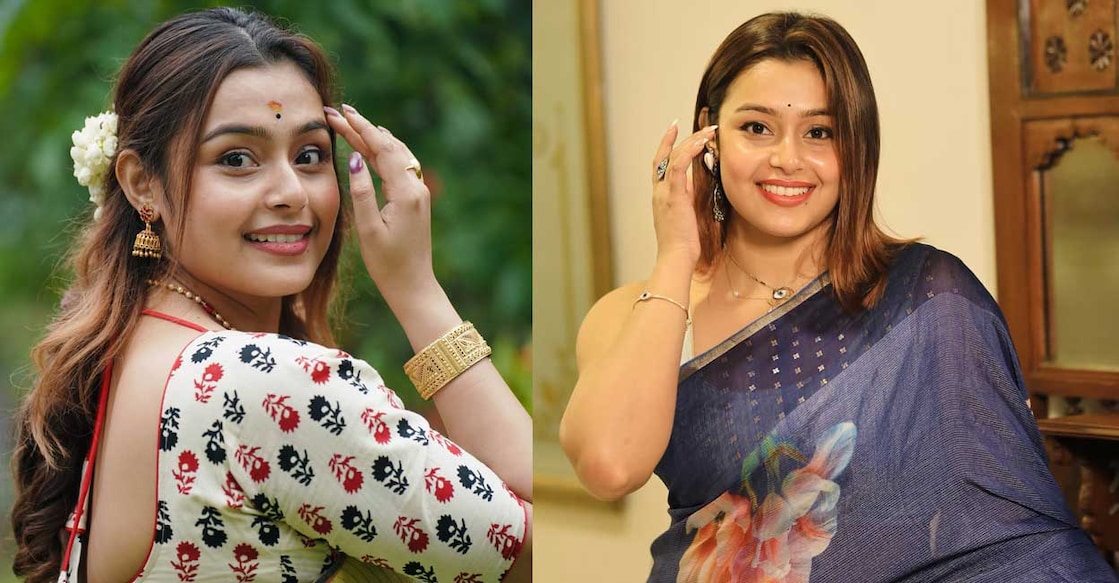
Mokksha’s journey into cinema has taken her across five languages and several different worlds. A trained classical dancer, former teacher and psychology graduate, the actor has worked in Bengali, Telugu, Tamil, Malayalam and Kannada films. Malayalam audiences may recognise her best as the divine character in the 2023 fantasy comedy ‘Kallanum Bhagavathiyum’ and as Meenu Teacher in the Tamil film ‘Gatta Kusthi 2’.
Born Preetha Sengupta in Kolkata, Mokksha grew up in a family with a strong literary and cultural background. Her parents encouraged her interests in music, painting, classical dance and theatre, but wanted her to build a solid educational foundation before pursuing a career in entertainment.
In 2022, she adopted the name Mokksha, changing the spelling with an additional ‘K’ following numerological advice. Despite receiving film offers early in life, she chose to prioritise academics. She pursued a BSc in Psychology Honours and later enrolled in a postgraduate programme, though her growing film commitments eventually prevented her from completing it.

Her first professional experience came in education. At 19, she began working part-time as a dance teacher at St Augustine's Day School in Barrackpore, becoming the youngest member of the teaching staff. She says both psychology and teaching later proved useful when she began working as an actor.
“Psychology helped me understand people and emotions, while teaching taught me patience and communication,” she says.
Her entry into cinema, however, was not something she had meticulously planned. Having performed on stage and acted in theatre from childhood, she made her film debut in a supporting role in a Bengali production. She later attended acting workshops and studied the work of filmmakers such as Satyajit Ray, Ritwik Ghatak and Mrinal Sen to understand their approach to natural and behavioural acting.
In 2020, she took on her first lead role in the OTT film ‘Karma’.
Since then, Mokksha has steadily moved beyond Bengali cinema, describing herself as a “creative migrant” who crossed linguistic boundaries in search of greater artistic freedom. Her journey eventually brought her to South Indian cinema, where she found opportunities across multiple industries.
Finding a second home in Kerala
Among the places she has worked, Kerala has developed a special place in Mokksha’s heart. Her association with the state grew stronger after ‘Kallanum Bhagavathiyum’, which introduced her to a wider Malayalam audience.
The warmth she received from Malayalis, she says, made Kerala feel like a second home. She has travelled across the state and counts Fort Kochi, Thrissur, Kannur, Alappuzha, Kumbalangi and Thiruvananthapuram among her favourite places.
One of her fondest memories is travelling to Kannur with family friends Sagina and Suji to watch a Theyyam performance late at night.
She has also developed a taste for Kerala’s food. A pescatarian who eats fish and eggs, Mokksha particularly enjoys Malabar cuisine, including Thalassery fish biryani and Kozhikode delicacies. Traditional sadhya, mambazha pulissery and meen pollichathu are among her other favourites
“I am truly a Malayali girl now,” she says. Her connection with Kerala recently took on a more spiritual dimension when she performed Bharatanatyam at the Guruvayur temple courtyard. The recital was organised under the guidance of Qatar-based Dr Sushedima Susan Master and Guru Sucharita Majumdar.
Mokksha had visited Guruvayur twice before but had never managed a proper darshan because of tight travel schedules. This time, with the assistance of Devaswom committee members, she was able to perform and later visit the temple.
Her recital included a Bharatanatyam piece depicting Radha’s longing for Krishna, followed by a Shiva Tandavam incorporating the Ashtabhairava Stotram and the Shiva Stuti popularised by ‘Kantara’.
The experience left her emotional. After the performance, she changed into a traditional Kerala set mundu and returned to the temple for darshan at around 8.30 pm. She recalls feeling the smiling presence of Guruvayurappan in her heart.
The visit also attracted some attention online after photographs showed her wearing footwear inside the temple premises. Mokksha clarified that she was wearing specialised, lightweight footwear made from eco-friendly jute, rather than ordinary shoes or slippers.
She said she had been dealing with a minor foot infection after several days of intensive rehearsals. With Onam programmes and a Kannada film shoot coming up, she had chosen to take precautions to avoid aggravating the injury.
As someone who has worn the traditional chilanka since childhood, Mokksha says she would never intentionally disrespect a temple.
Choosing roles over numbers
Mokksha is now approaching her career selectively, choosing roles based on the character and its impact rather than the number of films she can add to her filmography.
Her upcoming projects include the Malayalam film ‘Mouma’, scheduled for release in September, and another action film. In Kannada cinema, she will play a social activist and dancer in the directorial debut of the son of actor Upendra. She also has a Tamil project in the pipeline and plans to produce a classic Bengali film under her own banner.
The languages may change, but Mokksha says her larger ambition remains the same: to bring memorable characters to life and build a body of work that lasts beyond individual films.
For an actor who began as Preetha Sengupta in Kolkata and found herself moving across languages and industries, the journey is still very much in its early stages.
