

Manorama News Conclave 2026 concludes with focus on Kerala’s growth, politics and future
KEY EVENTS
Mail This Article


Kochi: The Manorama News Conclave 2026 concluded in Kochi on Saturday after a day of wide-ranging discussions on Kerala’s evolution, growth prospects and the changing nature of Gen Z politics. Experts from various fields shared their perspectives on the challenges facing the state and the opportunities that lie ahead.
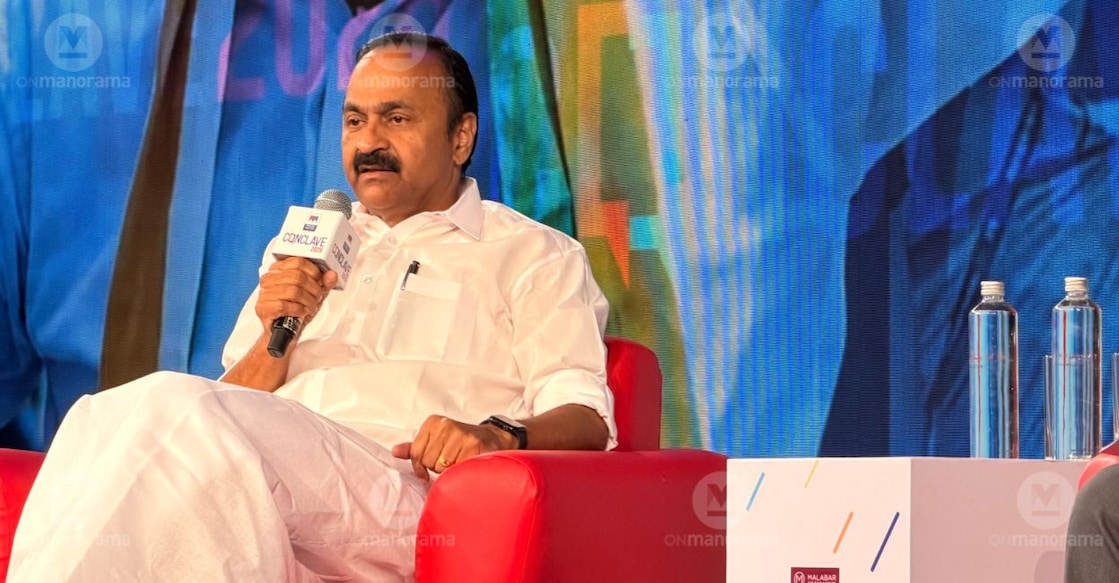
Chief Minister V D Satheesan, who delivered the closing address, said Kerala’s growth had stagnated over the past 15 years despite its achievements in health and education.
Speaking at the day-long forum, Satheesan said the state was facing serious financial challenges and could not continue managing its finances through compromises. He warned that the current approach was not sustainable in the long run.
“We have many challenges ahead, and Kerala’s financial position is poor. So far, everything has been managed through compromises, but this cannot continue indefinitely and will eventually collapse,” he said.
The conclave, themed ‘Kerala @70’, brought together political leaders, policymakers, industry representatives, experts, artists and other prominent voices to discuss the state’s future and the wider changes shaping the country.


The event began with Union Civil Aviation Minister Kinjarapu Rammohan Naidu inaugurating the conclave at the Lulu Bolgatty International Convention Centre. He announced the Union government’s plan to build 100 new airports across the country over the next 10 years, saying the aim was to make the common man a participant in India’s aviation growth.
Kerala’s economic future and the challenge of retaining its educated workforce emerged as recurring themes through the discussions.
Industries and Commerce Minister P K Kunhalikutty said Kerala’s long-standing Leftist image had contributed to a perception that the state was not business-friendly, affecting investment, employment and industrial growth. At the same time, he argued that Kerala’s educated and digitally skilled population could become the state’s biggest advantage in the next phase of development.
“Kerala’s greatest resource is not oil or gold, but our brains,” Kunhalikutty said.
He said the state could position itself as a destination for talent in the age of artificial intelligence by creating the right opportunities. Addressing youth migration, he added that the UDF government was planning policy changes aligned with the priorities of Gen Z and intended to use AI to speed up their implementation.
The question of how young people view politics also came up during the session ‘Generation Unscripted: Dreams, Disruptions and the New Language of Success’. Perambra MLA Fathima Thahiliya said Gen Z was increasingly making political choices around specific issues rather than traditional ideological affiliations.
She also pointed to the importance young people place on respect and personal freedom, particularly in deciding where and how they want to live. “How many young people get a respectful atmosphere in their own homes? That is why many of them step outside and seek the kind of lifestyle they want. The new generation places great importance on being treated with respect,” Thahiliya said.
Politics was also examined from a different perspective by actor and MLA Ramesh Pisharody, who argued that it had evolved more slowly than other aspects of Kerala society over the past seven decades.
“Politics largely remains where it was decades ago — in its structure, symbols and even the way it is presented. Since Independence, protests have often been seen as a measure of leadership, rather than the ability to solve issues without seeking public attention,” he said.
Pisharody also questioned whether technological progress had been accompanied by a similar evolution in human thinking. He said outdated narratives could continue to gain traction through new-generation media.
“In that sense, we are moving backwards,” he said. The state’s political future also came under scrutiny, with CPM general secretary M A Baby identifying the growing influence of the BJP as his biggest concern. He also expressed apprehension over the rise of minority communalism and questioned whether the Congress could effectively safeguard secular values.
“The growth of the BJP is what worries me most when I think about the future of Kerala. Alongside it, minority communalism is also gaining ground in the state,” Baby said.
Climate resilience was another concern raised at the conclave. Ecologist C K Vishnudas said Kerala had built considerable expertise in disaster management through its response to disasters over the past decade, but stressed that early warning systems needed to be strengthened as climate-related risks increase.
The role of business in Kerala’s development was highlighted by Malabar Group chairman M P Ahammed, who identified trust as the foundation of a successful enterprise.
“Trust is essential for success in any business. It cannot be built overnight. If we want to earn trust, we must be willing to give it first. Once that trust is established, businesses can overcome challenges,” Ahammed said.
The conclave also looked beyond Kerala’s immediate economic and political concerns. Chief of Naval Staff Admiral Krishna Swaminathan stressed the growing link between economic growth and maritime security, underlining the Indian Navy’s role in protecting India’s interests and maintaining stability in the Indian Ocean.
“India believes in a strong Navy that not only protects our national interests but also anchors and promotes stability across the Indian Ocean,” he said.
Launched in 2017, the Manorama News Conclave has brought together political leaders, experts, artists and other prominent voices for discussions on issues ranging from happiness and freedom to the idea of a new India.
