

Age is just a number for these Wayanad men who conquered peaks after retirement
Mail This Article


Kalpetta: What began as a way to stay active during the Covid-19 lockdown has taken two senior citizens from Wayanad to some of the world’s most challenging mountain destinations.
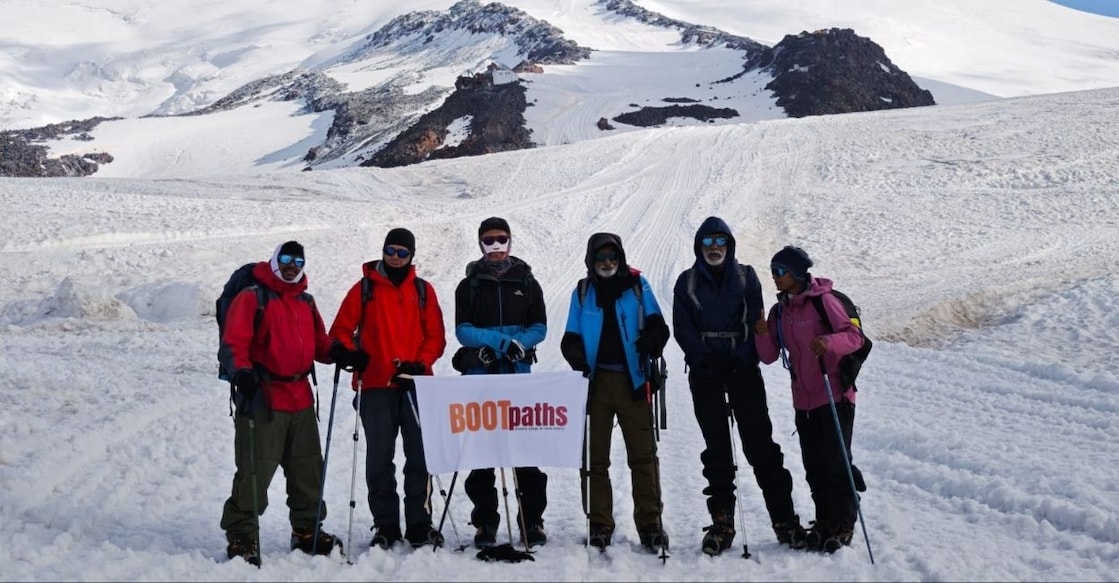
T J Mars, 74, a native of Kavummandam, and M P Muraleedharan, a native of Kenichira, began mountaineering training after the age of 60 and have since trekked across the Himalayas and other mountain ranges, reaching the Everest Base Camp, Annapurna Base Camp, Mount Kilimanjaro in Tanzania and Mount Elbrus in Russia.
At 5,895 metres, Kilimanjaro is the highest peak in Africa, while Mount Elbrus, at 5,642 metres, is the highest peak in Europe. According to Boot Paths, a Wayanad-based trekking group, Mars has become the oldest Indian to conquer Mount Elbrus. He has also become the second oldest Indian to trek Mount Kilimanjaro at 5895 meters height.
At an age when many people settle into a quieter and more confined life after retirement, the two men continue to dream of conquering peaks across the world. Talking to Onmanorama, Mars said his mountaineering journey began during the Covid period, when a group of youngsters working at the Wayanad Collectorate formed a trekking group called Globe Trekkers.
“Later, they decided to include senior citizens in the group. A trial trek was organised at Cheengeri Hills in 2021, and I joined it at the age of 70. From then onwards, there was no looking back. Now, it is difficult for me to sit idle when so many peaks are beckoning from across the globe,” Mars said.
He soon found a trekking companion in Muraleedharan, a retired Health Services employee from Kenichira. The two took part in several treks in Wayanad, including expeditions to the Brahmagiri Mountains and Banasura Peak, honing their skills and building the endurance needed for more demanding missions.
In 2024, a selected team from the group trekked to the Everest Base Camp. In 2025, they travelled to Mount Kilimanjaro, and in 2026, their expedition took them to Mount Elbrus.
The Elbrus expedition was particularly demanding, Mars recalled. “The temperature was around minus 20 degrees Celsius, and there were steep stretches where we had to climb while holding on to ropes,” he said.
The team left Mumbai on August 7 and flew to Tbilisi, the capital of Georgia. From there, they travelled by road to Terskol in Russia, the nearest town to Mount Elbrus.
The team began its summit attempt at midnight and reached the 5,642-metre summit early in the morning.
“Summit attempts are usually started around midnight because trekking during the night is less tiring. It is also important to begin the descent early and reach a safer altitude before evening, when strong icy winds can make the descent more difficult,” he said.
During the Kilimanjaro expedition, the team travelled first to Kenya, as flights from Bengaluru to Tanzania were considerably more expensive. After spending a few days in Kenya, they travelled to Moshi, the town closest to Kilimanjaro, before beginning the trek.
“Kilimanjaro is different from many other peaks. In other expeditions, we trek for days through mountains and valleys before reaching the summit. At Kilimanjaro, the mountain stands right before you, towering into the sky, and you begin the ascent almost immediately,” Mars said.
For Muraleedharan, who has completed more than 130 treks in the Himalayas and other mountain ranges, including in Sri Lanka, Elbrus was the toughest expedition so far. “During the descent from Elbrus, icy winds greeted us. There were moments when I felt I was facing death. Thank God, I returned safely,” he said.
Kilimanjaro, he added, was comparatively easier because there was less snow during the climb.
The expeditions come with a considerable financial burden. “Finding the money is the first thing we have to do. Once that is arranged, the rest will follow,” Mars said.
He finances his adventures through income from his coffee-powdering unit and spice business. Muraleedharan uses his salary and savings to fund his expeditions.
The Elbrus expedition cost them around ₹4 lakh, while the Kilimanjaro expedition cost more than ₹2 lakh, they said.
Both men credit their families for encouraging their adventurous pursuits. Mars's son Giljith is settled in Canada, while his daughter Jasmine is also well settled. His wife Rosa was initially unhappy about his trekking activities. “Later, when I became known and the media started covering my expeditions, she also began to feel proud of what I was doing,” he said.
Muraleedharan's children, Amal, an IT engineer, and Greeshma, have never opposed his passion for trekking. His wife, Girija Bhai, also encourages him.
The achievements of the two senior trekkers have also brought recognition to ‘Boot Paths’, which emerged from the earlier ‘Globe Trekkers’ initiative.
“Our motto is to make trekking accessible to everyone, irrespective of age and gender,” said G J Aghina Soorya, co-lead of the Elbrus expedition, along with group leader Seshadri S.
“When we approached insurance companies for coverage for senior trekkers, many of them refused because of their age. But we managed to make the expedition happen,” she said, adding that training for each major mission begins about six months in advance.
