

Analysis | Why Kerala's Congress govt wants to keep VIPs' corruption cases top secret & quell RTI pleas

Mail This Article


When the Oommen Chandy-led UDF government issued an order exempting the T (Top Secret) branch of the Vigilance and Anti-Corruption Bureau (VACB) from the Right to Information (RTI) purview in 2016, it was alleged that it was part of a move to stem the flow of information on vigilance probes against ministers and officials ahead of the Kerala Assembly elections.
The bar bribery scam and the solar case had hovered over the UDF government then. While the VACB gave a clean chit to the then Finance Minister K M Mani in the bar bribery case, the government still had reasons to shield sensitive information with the VACB, especially as the front geared up for the elections.
Strange timing
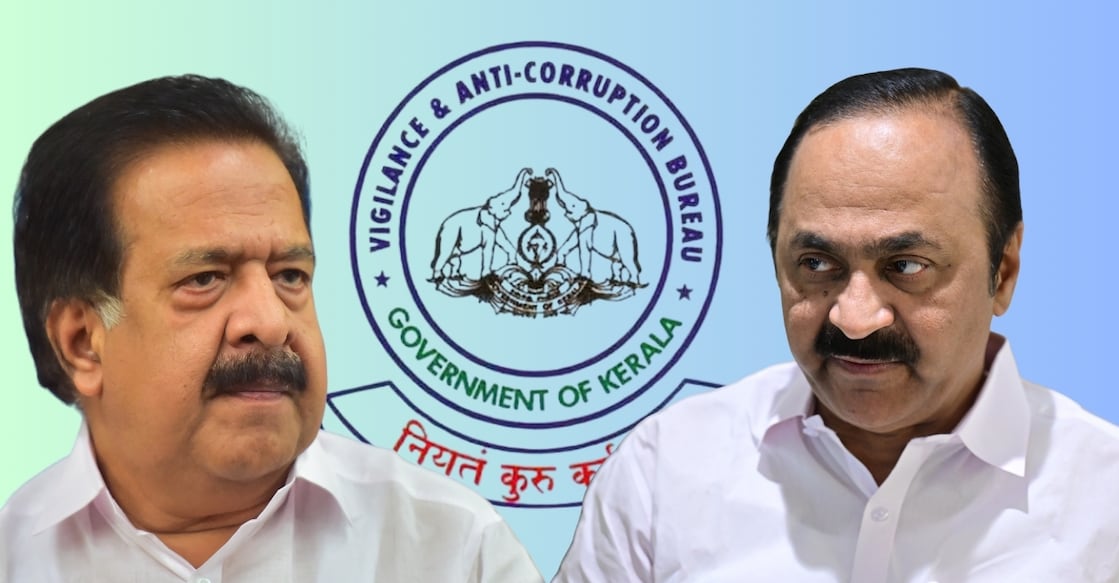
This is why the timing of the latest order from the UDF government, taking two top secret sections of the VACB out of the RTI ambit, piques interest. The Vigilance had already cleared Chief Minister V D Satheesan of corruption in the Punarjani housing scheme, which the CPM had vehemently used to hound him. Satheesan, for all his easy, charming eloquence on transparency, has been adamant about not uttering a word on his controversial chopper ride. Even questions on the helicopter ride in the ongoing Assembly session remain unanswered.
If at all a corruption complaint is filed with the VACB on the chopper issue, the High Court has already ordered that no information on an ongoing inquiry shall be furnished by the VACB. The UDF went ahead with the order while the Congress has been riven by a rift over the government's purported soft stand towards former Chief Minister Pinarayi Vijayan in the CMRL-Exalogic case.
When the dissent over the decision to go for a preliminary inquiry became uproarious, the KPCC chief was even forced to issue a gag order on public statements. The HC is set to consider Pinarayi's appeal against the vigilance FIRs in the CMRL bribery case on Monday. With the latest order in effect, if the file is moved to the T sections, no query can be filed under the RTI. However, even without this order, no information could be accessed otherwise for a probe in progress.
The order to exempt the T1 and T2 sections of the VACB from the provisions of the RTI Act was issued by the General Administration Department on October 22. The T1 section deals with high-level, sensitive vigilance investigations, secret inquiries and maintenance of high-security files, while the T2 section pertains to source reports, coordination of surprise inspections, and collection and analysis of intelligence-related information.
The government had earlier exempted eight institutions/organisations of the State Intelligence and Security Organisations from the purview in 2006: Special Branch CID, Crime Branch CID, District Special Branches, District and Crime Record Bureaux, Police Telecommunication Unit, Confidential Branch in Police HQ, State and Regional Forensic Labs, and State and District Finger Print Bureaux.
Legal hurdles
RTI specialists, former information commissioners and legal experts flag serious technical flaws in the government notification. “The government showed unnecessary haste in issuing this order. The Assembly session is in progress, and yet it enforced the order through an extraordinary gazette. As per the rule, every notification under sub-section 4 shall be laid before the legislature. It has not been done in this case. The State Information Commissioner was not consulted. Generally, information on an investigation in progress need not be furnished via RTI; with this order, they have ensured that even after the completion of the inquiry, the report will not be made available in the public domain,” said A A Hakkim, former State Information Commissioner.
“The fundamental legal question is whether Section 24(4) can be invoked to impose a blanket restriction on information that is otherwise not exempt from disclosure under Sections 8 and 9. An exemption notification should not be interpreted in a manner that defeats the safeguards expressly incorporated into the RTI Act or undermines its fundamental objective of transparency and accountability,” he added.
Section 8, which deals with exemption from disclosure of information, provides that information relating to personal data, the disclosure of which has no relationship to any public activity or interest or would cause unwarranted invasion of privacy, need not be disclosed unless the Information Officer is satisfied that the larger public interest justifies the disclosure of such information.
K V Sudhakaran, former Information Commissioner, said the latest order can only be seen as an attempt to dilute the RTI. “I remember an instance when a former DGP was denied a copy of his own complaint in a case, citing that the file was moved to the T section. That's where it becomes dangerous. There is no way you can avail information once it is buried in the T section,” said Sudhakaran.
HCs don't agree
Across the country, High Courts have struck down attempts by state governments to exempt the VACB from the RTI Act. In June 2022, the Orissa High Court said that the state's Vigilance department cannot be completely exempted from the RTI Act. Barely two weeks ago, the Madras High Court also issued a similar ruling. Both courts upheld the proviso to Section 24(4), which explicitly states that the exemption does not apply to information relating to allegations of corruption and human rights violations.
The Himachal Pradesh High Court, in May 2026, also stayed a government notification that excluded the VACB from the ambit of the RTI Act. The court observed that the VACB was notified as a department for investigation of corruption and economic offences, and the notification itself showed that the bureau was not an intelligence or security organisation to which the exemption under Section 24(4) was applicable.
The LDF government had issued a notification in 2022 rescinding the 2016 order, which exempted the T branch from the RTI Act. This was also informed to the Kerala High Court. “It is strange that an order cancelled by the LDF government is now being reintroduced by the UDF. This is an attempt at culling transparency,” said Advocate K Sandesh Raja, who had represented the Indian Association of Lawyers in the case filed against the 2016 order.
