

Mumbai’s dark divide or its deep unity?
Mail This Article


Mumbai, the erstwhile Bombay! It is doubtful whether any Indian city has to its credit so many labels. Both good and bad ones.
The country’s financial capital is also nicknamed the City of Dreams, the Bollywood Capital, the City That Never Sleeps, and Maximum City. As the much-clichéd saying goes, ‘You can take someone out of Mumbai, but you can't take Mumbai out of them,’ referring to the energy and dynamism the city leaves behind.
On the downside, Mumbai is notorious for being an epicentre of sex work, having the world's largest slums, severe traffic congestion, and more.
Forget the labels for a moment. Let’s dip into the life of Mumbai – into one of its inherent paradoxes, something shocking and strange to an outsider.
Stark contrasts
Landing in Mumbai serves as an immediate reminder of what the city has long been known for – the stark coexistence of abject poverty and extreme affluence. Seconds before touching down on the runway, passengers glimpse a telling scene: the Annawadi slum surrounded by posh hotels, while a line of gleaming private jets idles on the airport apron, ready to whisk away their ‘very special’ guests.
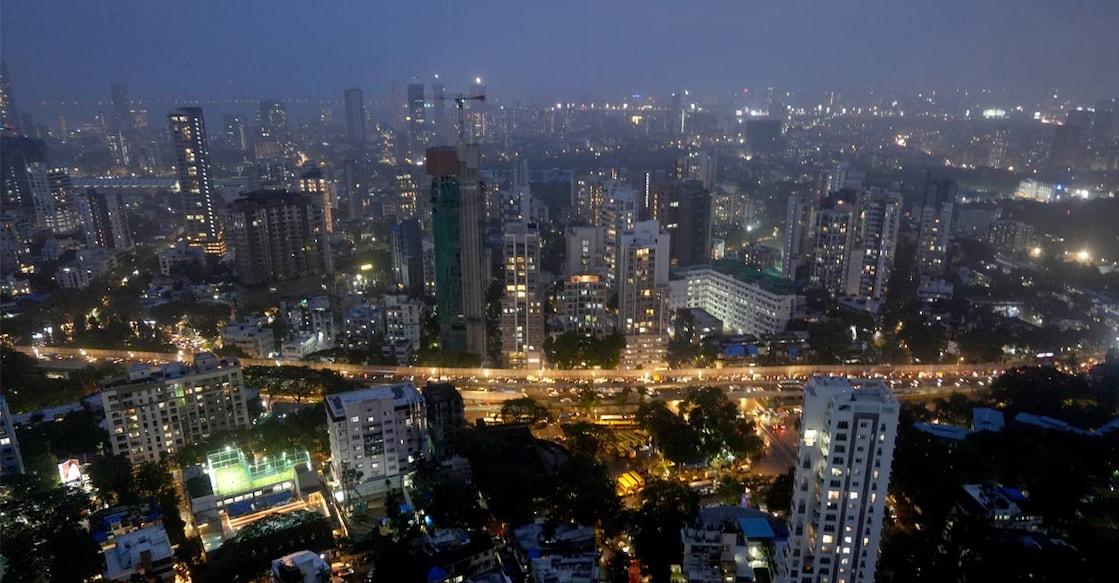
A ride from Chhatrapati Shivaji Maharaj International Airport to Malabar Hill via the Western Express Highway is indeed a glimpse into Mumbai’s glitter and grit. One can see both expensive high-rises – some in use and others under construction – standing side by side with slum clusters, including Dharavi. From the balconies of many such luxurious high-rises, the view is not of glittering skylines or lush green expanses, but of poor families trapped in squalid hovels.
Even on Altamount Road near Malabar Hill – the so-called Billionaires’ Row, home to some of the super-rich, including Mukesh Ambani’s 27-storey Antilia – one can still find pockets of slums.
Yet what connects Mumbaikars – the residents of the ‘great Indian megapolis’, including both the ultra-rich and the poor – is a shared dream and aspiration for growth.
Where else in the world can one find taxi drivers – many of them slum dwellers – taking pride in showing passengers the ultra-luxurious homes of “their own” billionaires? This sense of belonging persists despite a widespread belief that most billionaires do little to help the poor – with the notable exception, many would say, of the late Ratan Tata.
Woven into Mumbai’s local legend, the fairy-tale-like rise of the Ambanis stands as one of the city’s most enduring inspirations. During his childhood, Mukesh Ambani and his seven-member family – including his grandparents – lived in a one-room chawl in Mumbai's Kabootar Khana area, with no separate kitchen, and a single common toilet shared by a hundred occupants on the same floor.
As argued in Manu Joseph's latest book, 'Why the Poor Don't Kill Us: The Psychology of Indians', an average person views Ambani’s Antilia with hope, as it is “a shrine to a commodity that they thought they, too, could amass.”
Bustling economies
In Mumbai, slums are not just an inheritance from the past. The city’s new-age, upmarket townships are also not immune to their presence.
While wandering through Hiranandani Gardens in Powai – one of the city’s most upscale, Western-style residential townships, often featured in Bollywood songs and TV commercials – one can still find people living under tarpaulin sheets along the streets, right next to high-rises that house celebrities and bear fancy European names.
In Mumbai, it is estimated that nearly half of the population lives in slums or informal settlements lacking basic amenities, where life is marked by desperate survival. A recent study using high-resolution satellite imagery shows that the land area occupied by slum structures decreased by approximately 8.6 per cent between 2005 and 2022, with its share of the city's total land area falling from about 8 per cent to 7.3 per cent.
While it's true that the quality of life for slum dwellers is at rock bottom, there's another economic story to be told.
Mumbai’s slums are not just cramped places where residents live in dirt and squalor; they are also centres of recycling, leather, textile, and many other industries. The largest of its kind, Dharavi, for instance, is also a thriving economic powerhouse, contributing around ₹8,300 crore annually to the city's economy.
Surprising as it may sound, Dharavi is one of the leading hubs for manufacturing and selling leather goods. One can even spot a brand named ‘Dharavi’ selling leather bags near its production unit, a popular stop for foreign tourists visiting the slum as part of guided tours.
It is common for those going to the US and Europe to buy ‘authentic, handcrafted’ leather garments from select shops in Dharavi. Since 2016, dharavimarket.com, an online marketplace, has been selling products that it proudly states are ‘designed in Dharavi’, and it has seen a significant increase in its social media presence.
A few months ago, Rahul Gandhi visited Dharavi’s leather artisans while addressing the impact of slum redevelopment projects on the industry. The Opposition Leader specifically met with Chamar Studio, run by a Dalit artisan who developed an alternative recycled rubber material from waste tyres.
Slum dwellers who succeed in business often move to the tranquil top floors of the city’s high-rises – a symbol of success – while retaining their production units in Dharavi and focusing on expanding their enterprises.
These selective instances of prosperity have fostered the illusion that opportunities for greater economic success are available to all. Even poor Mumbaikars believe that, with hard work and perseverance, anyone can become rich one day.
It’s this shared sense of hope and striving for opportunity that binds Mumbai’s haves and have-nots together.
What Mukesh Ambani thinks while gazing at the stunning Arabian Sea from his balcony, and what an enterprising slum dweller dreams while looking at the distant dot of Antilia, could be the same: to grow towards brighter horizons.
Mutual needs
Mumbai turns out to be an unparalleled social experiment due to the ‘deep connection’ between people across all ends of the wealth spectrum.
“True, Mumbai offers comfortable living only to a small segment of its population, while the vast majority endures dismal conditions. However, there exists a tacit social contract – a shared understanding that ‘we need each other’ – embedded in the psyche of the rich, the middle class, and the poor alike,” says Shaji M Shankar, author and senior LIC executive, who lived in Mumbai for nearly a decade and did volunteer work among slum dwellers during the Covid-19 pandemic.
Nothing better illustrates this interdependence than the specialized role played by housemaids – mostly slum dwellers or chawl residents and ‘neighbors’ to Mumbaikars living in high-rises.
In most middle-class families, household chores are performed by different maids on a task-by-task basis – sometimes as many as five or six. The person who prepares the wheat flour for chapati in the morning is not the one who rolls it into a round shape and fries it in the evening!
In the same manner, cleaning the floor and washing clothes are usually done by different maids. One can even find specialist maids who focus solely on preparing evening snacks for children.
This creates a win-win situation: Mumbai’s middle-class households spend less by hiring multiple specialists, while maids earn more by focusing on specific tasks across homes.
“The way Mumbaikars break down household chores into specialised tasks, and how enterprising maids meticulously turn this into an efficient and highly productive enterprise, is nothing short of phenomenal. It’s exactly what Adam Smith, the father of modern economics and a key proponent of the division of labour, once envisioned in his idea of a productive society,” an economist friend remarked with a sarcastic laugh.
It’s worth noting here that Mumbai’s Dabbawala system, which has existed for over 100 years to deliver and return lunch boxes with home-cooked meals, records just one mistake per 16 million transactions, according to some estimates. This is recognised in management studies as a Six Sigma level of efficiency.
A working model? Yes, but…
Just because something works in society efficiently doesn’t mean it’s a model worth pursuing. No matter the economic rationale, slums remain an inhuman and unacceptable way of life in the modern world.
Numerous monsoon seasons have shown that the slum areas in Mumbai are highly vulnerable to severe flooding, as was recently evidenced by the record rains that lashed the city on August 18.
Massive efforts are currently underway to realise a slum-free Mumbai. The ongoing slum redevelopment in Mumbai under the Slum Rehabilitation Authority, involving private developers, is a major initiative in this regard. This business model essentially involves generating land by clearing slums and constructing high-rises – some designated for rehousing the displaced residents, and others intended for commercial sale.
The ambitious ₹95,790-crore Dharavi Redevelopment Project is a pivotal initiative, spearheaded by the Maharashtra government and the Adani Group, aiming to transform Asia's largest slum into a contemporary urban centre with all facilities.
Efforts aside, reimagining a Mumbai beyond the stark coexistence of sublime wealth and abject poverty is the first step toward building a more just and inclusive financial capital of India.
(Social anthropologist and novelist Thomas Sajan and US-trained neurologist Titto Idicula, based in Norway, write on politics, culture, economy, and medicine)
 Add as a preferred source on Google