

Bihar 2025: The return of the familiar
Mail This Article


One of India’s biggest electoral cliffhangers is now over.
The JD(U)-BJP-led National Democratic Alliance (NDA) has emerged victorious in the Bihar Assembly polls, which witnessed intense political drama. The NDA’s retention of power against the opposing Mahagathbandhan in the core Hindi heartland marks a pivotal moment in Indian elections.
Rarely in recent history has an assembly election generated as much curiosity, tension, and uncertainty across India as Bihar’s. Even several TV channels from Kerala sent reporters to Patna, who then travelled across Bihari villages to capture the election fervour.
The 2025 assembly elections witnessed historically high polling rates, indicating that many Biharis returned from other Indian states to vote.
What makes the 2025 Bihar elections so captivating, even in a state long defined by polarised politics and led by the same chief minister – Nitish Kumar – for nearly two decades?
No triangular battle
Since the 2000s, Bihar’s elections have primarily been a contest between the Janata Dal (United), under Nitish Kumar, and the Rashtriya Janata Dal (RJD), led by Lalu Prasad Yadav’s family. Both parties have, at different times, aligned with major national parties such as the BJP and the Congress, as well as various smaller regional allies.
This time, Bihar’s traditionally bipolar political landscape witnessed a twist-the emergence of the Jan Suraaj Party, led by India’s only strategist-turned-politician Prashant Kishor. The entry of this third force into the fray had prompted many election pundits to predict a triangular contest.
Prashant Kishor, popularly known as PK, has become a household name in Bihar after undertaking a 3,000-km padyatra across villages, claiming to meet people, understand the ground realities, and finalise a blueprint for Bihar’s development.
Jan Suraaj had put forth a five-point agenda: providing quality education, curbing youth migration by increasing employment opportunities, and providing economic security for the elderly, women, and farmers.
The poll results unequivocally suggest that Kishor, hailing from a higher-caste Bihari background, failed to convert the large crowds at his election rallies into actual votes.
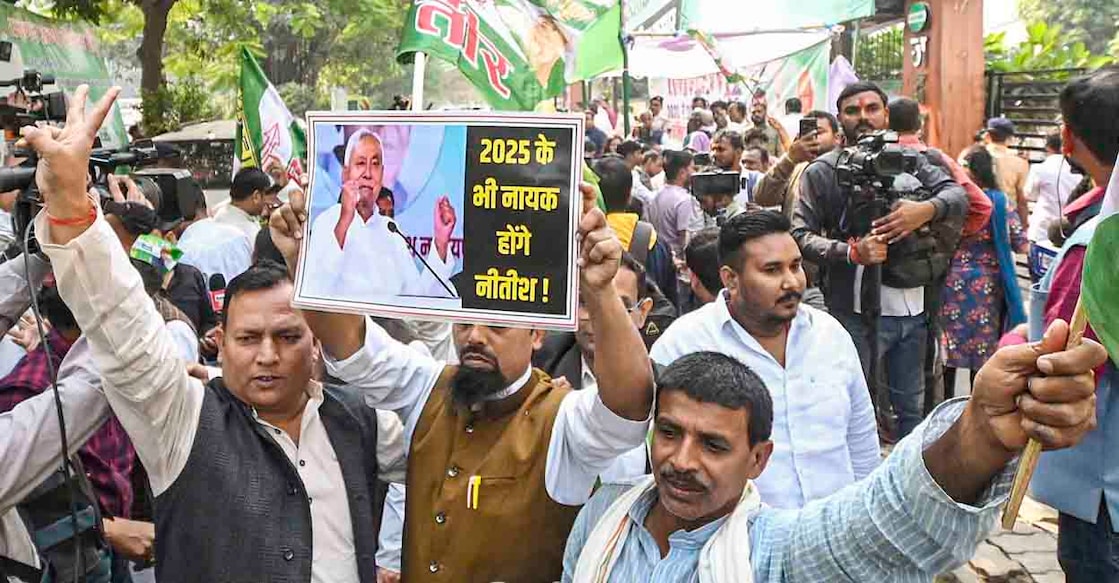
Nitish Kumar remains the towering leader in Bihar for a variety of reasons, particularly among women, and the RJD-Congress alliance will have to wait longer to win the election.
Congress, which had 19 seats in 2020, was reduced to a single digit, further denting the leadership's authority to lead the opposition alliance.

Dark realities
What do the 2025 election results mean for Bihar’s future – a state long considered among the least developed in India? Any discussion about the future of Bihar must take into account the state’s long history of economic stagnation and underdevelopment.
All those who have travelled through Bihar would agree on a simple truth: Vast numbers of its people endure some of the harshest living conditions on earth. A journey beyond Patna – one of India’s most ancient cities, which has witnessed significant infrastructural development over the past two decades – reveals the stark poverty and deprivation that have long defined Bihar’s image.
Centuries may have passed, yet many impoverished villagers continue to lead a ‘bare life,’ living in crumbling mud-walled huts alongside their animals, the air heavy with the scent of cow dung – entirely disconnected from the glitz of a globalised India.
Bihar is, in fact, caught in a vicious cycle of political apathy toward development, a stagnant economy, bureaucratic corruption, poor education, inadequate healthcare, and mass unemployment that drives lakhs of young people out of the state.
It’s little surprise that even when opportunities for regional growth appear, Bihar’s economy is not ready to capitalise on them.
A visit to Bodh Gaya – one of the four holiest Buddhist sites, where Gautama Buddha is believed to have attained enlightenment – is highly illustrative.
An international airport in Gaya handles a considerable number of seasonal flights carrying thousands of affluent pilgrims from Buddhist nations. The city is also home to several grand Buddhist monastery complexes that receive financial support from countries such as Japan and Thailand.
Despite its place on the global travel map and its steady flow of tourism revenue, Gaya remains far from the clean, developed city it should be. Just beyond its limits lie villages such as Lohjara, where generations continue to confront the many grim faces of poverty.
Such is the sad state of affairs in the Gaya constituency, despite being represented by key political figures like Jitan Ram Manjhi, a former Chief Minister and current Union minister.
Healthcare in crisis
The healthcare sector is one area that starkly reveals the depth of Bihar’s challenges.
It is worth recalling an unsettling account from a recent conversation with a Malayali friend who works with an NGO in the villages of North Bihar in partnership with the state health department.
Though many medical facilities are available free of cost in Bihar through the public health system, very few people access them due to poor awareness.
At the Health and Wellness Centre she regularly visits, there is no system in place even to record neonatal deaths. She has personally initiated the creation of a register to document infant mortality.
The widespread presence of quacks has kept pregnancy and surgery-related deaths alarmingly common, making the task of bringing people into the public health system even more difficult.
The social worker friend also drew attention to other pressing issues in Bihar, including particularly low school attendance and high dropout rates among girls, as well as the widespread prevalence of early teenage marriages.
New parties, old barriers
Beyond the controversies surrounding the Special Intensive Revision (SIR) of the electoral rolls, the 2025 Bihar Assembly elections have raised a crucial question: How far can a new party that speaks the language of development, such as Jan Suraaj, navigate the deeply polarised political landscape across Indian states?
Nitish Kumar’s return as Chief Minister clearly indicates that the Aam Aadmi Party’s Delhi and Punjab model – where a new entrant captures power by relying on widespread discontent with established parties – has little traction in the Hindi heartland.
The million-dollar question, however, is whether Bihar’s new NDA government will tackle core developmental issues head-on or fall back on easy fixes, such as pre-poll cash transfers, which have once again delivered electoral gains.
(Social anthropologist and novelist Thomas Sajan and US-trained neurologist Titto Idicula, based in Norway, write on politics, culture, economy, and medicine)
 Add as a preferred source on Google