

The hits and misses of Kohli-Shastri combination

Mail This Article
Even as the Board of Control for Cricket in India (BCCI) has invited applications for the post of entire support staff of the national team, the big question is whether Ravi Shastri will be retained as the head coach.
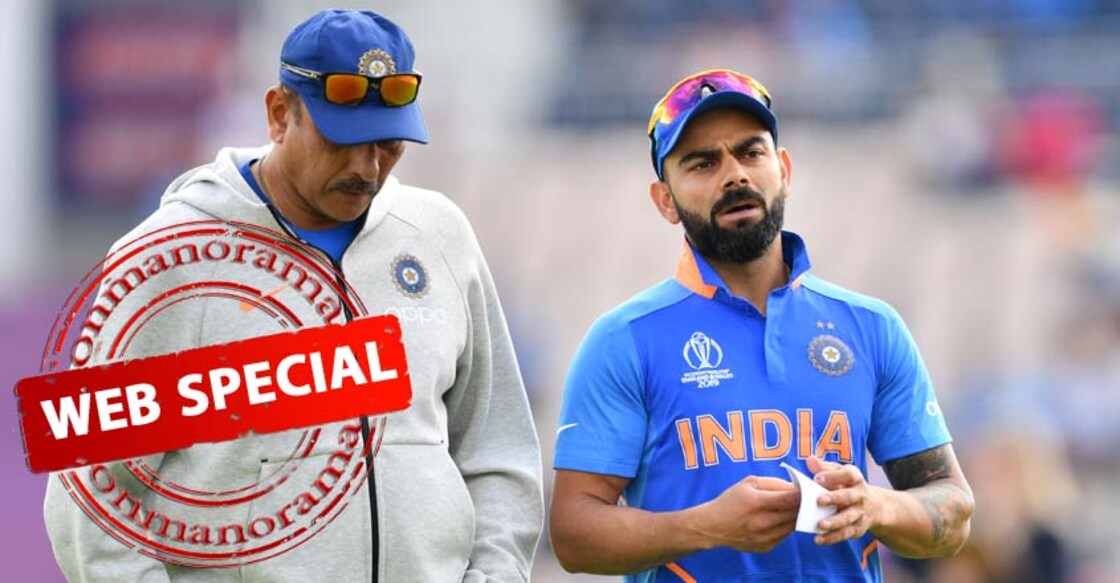
Shastri enjoys a good rapport with captain Virat Kohli and the Indian team has had more good days than bad ones during the duo's two-year term. At the same time it must be said that the think tank has been found wanting on the tactical front in the past two years and for a team blessed with a bunch of quality players India ought to have reaped more success. Onmanorama takes a look at the pros and cons of the Kohli-Shastri combination.
Bold move
First, the positives. The decision to hand out Test debuts to pacer Jasprit Bumrah and young wicketkeeper-bastman Rishabh Pant has been a masterstroke. Bumrah made his debut in the first Test against South Africa at Cape Town in 2018. The Gujarat pacer has not looked back since then. While Bumrah had made heads turn with his exploits in white ball cricket, not many believed that he could last the rigours of Test cricket. Also his unorthodox action and a fear of injury worries would have forced many an expert to take the easy option of preserving him as a specialist for the shorter formats. But Kohli and Shastri felt Bumrah could be lethal in the longer format as well and after 10 Tests, he's blossomed into one of the most feared bowlers across the globe in all formats. He played a key role in India's historic Test series triumph Down Under earlier this year.

Like Bumrah, Pant too was looked up on as someone who could primarily make a name for himself in limited overs cricket. But the unfortunate injury to India's No. 1 Test stumper Wriddhiman Saha coupled with the dismal showing of Dinesh Karthik in the first two Tests during India's tour of England last year fast-tracked Pant's entry into Test cricket. Both Kohli and Shastri were quick to realise that Pant could be a match-winner with the bat while his glovework needs a fair bit of work. Pant grabbed the chance with both hands and has established himself as the first-choice wicketkeeper with hundreds in England and Australia.
Gamble to field two wrist spinners
The decision to play two wrist spinners in one-dayers in order to tackle the problem of failure to pick up wickets in the middle overs too has been a success story of the Kohli-Shastri regime. Left-arm chinaman bowler Kuldeep Yadav and leg-spinner Yuzvendra Chahal were the key to India registering quite a few memorable wins in the 50-over game in the last two seasons. The two set up India's maiden series win in a bilateral ODI series in South Africa in 2018 and also played a big role in the Men in Blue's triumph in the Asia Cup under Rohit Sharma in the UAE last year. However, it must be noted that the opposition teams have succeeded in negating the threat of 'Kulcha' with the passage of time as the just-concluded World Cup revealed.
Biggest problem
Now, the negatives. First and foremost selection has been the biggest issue under Kohli and Shastri. The Indians squandered a golden opportunity to clinch a historic Test series win in South Africa in 2018 primarily due to the self-destructing move to go in with five specialist batsmen. The obsession to play Hardik Pandya and field five bowlers resulted in the proven Ajinkya Rahane warming the bench in the opening two Tests. India lost both the matches and with it the three-match series as well. Equally shocking was the move to drop Bhuvneshwar Kumar for the second Test at Centurion after the Uttar Pradesh player excelled both with the bat and ball in the opener.
The captain and coach continued with this gamble of five specialist batsmen in the following England tour too. The results too were the same as India lost the five-match series in the first four Tests itself. Both the first and fourth Tests were close games and a specialist batsman at No. 6 could have easily tilted the game in India's favour. Thankfully, the Indian think tank ended the experiment of five specialist bowlers in alien conditions starting with the last Test of the England tour.
But poor selections have continued to hurt India. The No. 4 fiasco in the ODI team being the classic case. Neither Kohli nor Shastri had the prudence and foresight to take the English conditions into consideration while trying out players for the crucial slot ahead of the World Cup. A technically sound player like Rahane was dumped after he did fairly well in South Africa. After almost zeroing in on Ambati Rayudu, the team management convinced the selectors to pick rookie Vijay Shankar for the mega event citing his three-dimensional abilities. In the end, after the injuries to Shikhar Dhawan and Shankar, it was Pant who batted at No. 4 in the semifinal loss to New Zealand.
Rigid approach
For all the talk of Shastri being a master tactician, the Mumbaikar has not covered himself with glory. It's common knowledge that Kohli is not the greatest cricketing brain out on a cricket field and he needs valuable inputs from the coach. The biggest obstacle with the Kohli-Shastri combo is that the two have been rigid in their strategies. The decision to shut the door on off-spinner R Ashwin as far as white ball cricket is concerned being a case in point. Ravindra Jadeja has been one player who has defied huge odds to make a stunning comeback into the shorter formats of the game, thanks to his three-dimensional contributions in whatever little opportunity he has got.
The Indian team should be winning more with the kind of talent at its disposal. One should not forget that an away Test series win over a depleted Australia is all what Shastri has to showcase as a major achievement in his tenure. It's precisely this reason which will keep the Indian fans worried ahead of the selection of the next head coach.
 Add as a preferred source on Google