

Beyond the bench: An Ironman jury’s inspiring Triathlon journey
Mail This Article


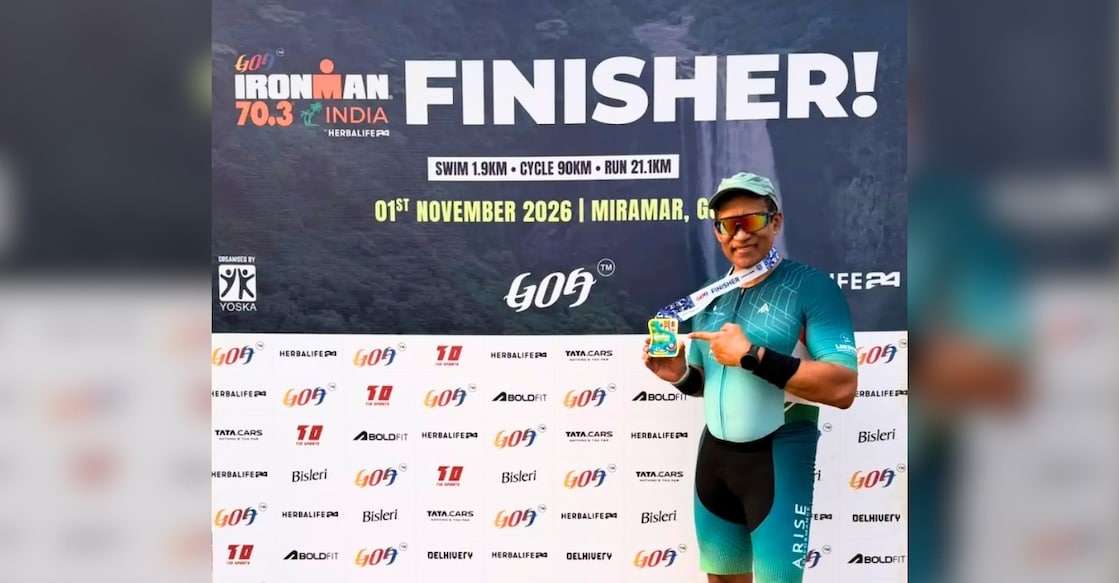
Kochi: In a unique feat, Kerala High Court judge Justice Bechu Kurian Thomas on Sunday completed the Ironman 70.3, also known as the Half Ironman, a triathlon event organised by the World Triathlon Corporation in Goa. The 58-year-old completed the event in 8 hours, 46 minutes and 44 seconds. The event included a 1.9km swim, 90km cycling and a 21.1km run. Justice Thomas opens up to Onmanorama about an inspiring journey of grit toward success.
First steps into Triathlon
I’ve always been a jack of all trades. Sport was something I could never stay away from. Yet ironically, life came full circle, and my profession turned into an endless routine of sitting. In 2024, my son participated in the Ironman triathlon. I watched him train all day - he’s young, full of energy. When I travelled to watch him compete, witnessing his struggle was moving.
I wondered if I could ever attempt it, but I lacked the courage to even consider putting my name down. Over the last two years, my routine had become sedentary. Long hours on the bench at court is an occupational hazard common to almost every judge. Slowly but steadily, one health issue creeps up after another.
What you should read next

We get a summer recess in April, and my family usually takes a week-long vacation. This year, there was no travel planned, and I thought about picking up swimming. It was while swimming that a wild thought struck me, to sign up for the Ironman. It began as an impulse, but before I could talk myself out of it, I went ahead and registered as soon as entries opened.
Balancing sport and jury duty
When the court reopened after the break, making training time was difficult. The only way forward was to cut out all social obligations. I stopped accepting invitations to inaugurate events or attend public functions. I also trimmed my sleep by an hour each night. That stolen hour was dedicated to training. It turned into a gruelling, high-pressure routine. I re-engineered my diet and avoided oily foods. The lifestyle overhaul was comprehensive, and the positive changes were tangible within a couple of months.
Injury setbacks
I have a long history of injuries. A meniscal tear that already required knee surgery, followed by two more tears sustained during a competitive badminton tournament. On top of that, I had suffered an Achilles tendon rupture. An orthopaedic specialist suggested surgery and to opt out of the contest.
I told myself to push ahead. Along the way, I sustained a calf muscle tear. My close friend, Dr Rajesh Simon, advised me to rest and ease back gradually, which I followed. Then, barely four weeks out from the event, I suffered a muscle tear in my shoulder. That set me back considerably, but they are the best teachers.
I often remind myself of words that echo constantly in my mind: Accept the pain, smile at the pain, and embrace the pain. That is the only way you achieve anything worthwhile. Never succumb to the pain; transcend it. That mindset carried me through.
During the race, things unfolded in a way that reminded me of Paulo Coelho’s famous quote - it felt like the entire universe was conspiring to help me see it through. At one stage on the cycling route, the marshals actually unstrapped my timing chip, declaring I had missed the cut-off by one single minute. A moment later, they realised their calculation was wrong, strapped it back on, and yelled, “You have 38 minutes to finish the final cycling stretch!”
It felt like being handed a fresh lease on life. Instantly, an overwhelming surge of energy surged through me. I have never pedalled that fast in my life. Coming down a steep, sweeping curve, I looked at my speedometer and saw I was flying at 56 km/h. It was outright reckless, but fear was eclipsed by single-minded focus. The mind completely overpowered the physical vessel. Cramps that had begun flaring up suddenly vanished.
Given my age, I expected to be completely shattered by soreness and exhaustion. But to my amazement, I felt no debilitating pain. I felt relaxed, comfortable, and energetic.
An Ironman is an exceptionally long, gruelling event that kicks off at daybreak and stretches across hours of isolation. What is the psychological toll?
You are utterly alone from start to finish. Yet, you aren’t racing the person beside you; you are waging a war against yourself - your mind, your doubts, your fatigue. Unless you finish on the podium and punch a ticket to the world championship, all you take home is a modest finisher’s medal. The real reward is proving that your will is stronger than your physical resistance. When you anchor yourself to that purpose, fatigue recedes into the background. The blinding sun and sweltering heat cease to matter. There is only one objective: cross that line.
Any self-doubt?
Constantly. Not just during the race, but every single day throughout six months of training. Thoughts like “Can I pull this off? Is this even realistic?” were relentless. I managed to keep composure during the swim and cycle segments. But the half-marathon pushed me to the brink. By then, your reserves are drained; your muscles are locked up tight, and the humidity is stifling. The body begs you to stop.
Whenever the urge to quit hit me, I broke the challenge down into bite-sized milestones. The 21-kilometre run consisted of three 7-kilometre loops, featuring a steep gradient up toward the Dona Paula circle. Instead of looking at the remaining distance, I bargained with myself: Just run to that bend. Now push up the incline to the roundabout. By stringing together small targets, my body found renewed momentum.
Competing in the 55–59 age category naturally demands meticulous attention to sports nutrition and recovery. How did you manage?
Under extreme physical duress, the stomach simply cannot digest solid food. Yet, you are burning vast amounts of glycogen and need an uninterrupted stream of carbohydrates. That’s where specialised energy gels become essential.
My son formulated a custom, unmarketed energy gel for me. Our trainer evaluated it, gave his stamp of approval, and instructed me to take it at strict 30-minute intervals. If you wait until you feel drained, your glycogen levels plummet, fatigue cements itself, and recovering mid-race is nearly impossible.
Hydration is equally critical. In blazing heat, profuse sweating depletes essential minerals like sodium. Without adequate electrolytes, muscle cramps are inevitable. Early in the race, I drank three glasses of plain water in quick succession, inadvertently diluting my systemic sodium levels, and my legs immediately began seizing up. Fortunately, I realised the error, quickly replenished with electrolytes, and the cramps subsided. Dialling in your nutritional timings is half the battle won in endurance racing.
How suitable is Keralam to host an event of this calibre?
Ever since following the Goa editions, I’ve strongly believed that Keralam is tailor-made to host a world-class triathlon. Cities like Thiruvananthapuram, Alappuzha, Kochi, and Kozhikode have breathtaking topography that could easily stage an event like this.
Take Kochi, for example: Puthuvype offers immense potential. With freshly paved tarmac along the coastline, an open-water swim off the beach, and cycling routes extending around the Vallarpadam Container Terminal corridor, it could become world-class. Of course, it requires immaculate road closures, civic coordination, and police backing, something which Goa executed exceptionally well.
The economic upside is massive. The Goa race drew participants from 32 countries. An event like this puts a state on the international sports-tourism map, injecting vitality into local hospitality, commerce, and wellness culture. More importantly, it sparks an athletic awakening among youth.
What is your advice to young people?
Don’t obsess over the outcome, and don’t let fear of failure paralyse you. Just take the plunge. Once you commit, everything else begins to align. There is no shame in falling short. The six months of clean eating, disciplined waking hours, and conditioning had already revitalised my physical health. Treat every step as an education by learning your biomechanics, mastering nutrition, managing pain, and unlocking the resilience hidden inside you.
Would you ever consider attempting a full Ironman in the future?
A full Ironman is to swim 3.8 km, cycle 180 km, and run a 42.2 km full marathon. The 90 km bike ride alone is backbreaking; 180 km feels unfathomable right now. Given my official workload as a judge, carving out the training volume required for a full distance is virtually impossible. Perhaps after retirement, I might revisit the idea.
