

The final climb to Tapovan Valley from Gomukh
Mail This Article


I’m not a mountaineer. I’m just a traveller who likes to go into the mountains. I climb them, well, if they appear to be within the limits of my physical endurance. I’ve not climbed many. I attempted Agasthyakoodam, Kerala, (6129 feet) only to lose out in the final 1000-2000 feet. But the 28-kilometre trek there was a magical experience. I did climb Scafell Pike, the highest peak in England (3209 feet), with my marathoner nephew Dr Jemy Jose through rain, sleet and winds that nearly swept you off your feet.
I’ve, just for my joy, wandered around for a day in the foothills of Kilimanjaro – dreaming about climbing it. (It takes 7-9 days). I’ve climbed the Uluru rock in Australia a few hundred feet when part of it was open to climbers. It has been closed since, respecting the sentiments of the tribes to whom it is a place of spiritual significance. The Rocky Mountains, the Alps… but you just drive through them, imagining what an amazing thing it must be to even wander amongst them leave alone climb. I also remember the awesome rock faces of Yosemite Valley where I’ve seen climbers clinging like ants – making my legs turn into water. I hope to go to the Everest Base Camp one day. Friends who have been there tell me that the most thrilling part is the small flight from Kathmandu to Lukla - where the trek starts.

The Himalayas are, in a way, within arm’s reach for me. The last time I travelled from Thiruvananthapuram to Badrinath, the experience dumbfounded me. I left Thiruvananthapuram for Delhi by a morning flight; took a connecting flight to Dehradun; set out for Gangotri by car and was in the snow-bound pilgrim town before sunset. It seemed so unreal. Never had I thought that the Himalayas could be as close as what it takes to cover the distance from Thiruvananthapuram to, say, Kasargod by an express train. The trip to Tapovan Valley, however, was another story. It took a few days for my friend Swami Samvidanand and me to do it. For me it was a tough journey. This note is about, what, to me, was the toughest part – the final climb from Gomukh - the mouth of the Gangotri glacier – to the Tapovan Valley (14,640 feet).
Here's the journey up to Gomukh: we took a bus from Haridwar to Gangotri town. It is a teetering-on-the-edge trip of about six hours along mountain paths. Your heart is in your mouth most of the time. In Gangotri we made preparations for the trek including hiring the help of a Sherpa. Next morning we were on our way through the wild and pristine beauty of the foothills. The Bhagirathi river accompanied us on one side. As we progressed, the terrain got rocky and difficult and climbs were steeper. It was bitterly cold when we reached our night-halt, Bhojbasa, at sunset. Even three heavy blankets didn’t help.
The last lap, the following day, was through other-worldly vistas of the mountain peaks, but the terrain is merciless. The 500-meter descent to the Gomukh glacier-mouth is a heart-stopping experience. Swami had warned me that even the smallest pebble rolling down from above could mean a rockfall. Of course, there’s nothing to do if it happens. Gomukh is where the Bhagirathi branch of river Ganga sets out on its long journey, starting as a trickle from the crevices of the glacier-mouth. After about half an hour of sliding, crawling, clambering over rocks and sliding again, you get to the river-bed, and the glacier-face confronts you. It is an expression-less, terrifying creation of cold, ancient ice and you stand frozen. It was nothing like anything I’ve ever seen in my life. Bhagirathi gurgles out of its jaws. I’m puzzled and humbled. The sun is hot and I’m sweating.

You crawl, creep and climb up again to the so-called path – because there really is no path - that leads you to the glacier itself and the crossing point. Again, it is another sliding, slithering and tumbling through an endless universe of rocks all the way to the place where the glacier in all its frightening, grim, grandeur awaits you. I took one look and asked Swami, ‘Is it possible to return?’ He said, ‘No, it’s too late. And this is the final stretch. We’re nearly there.’ I believed him. The naked glacier – it was only September and there was no snow - is a blood-curdling graveyard of stones, small, big, huge and gigantic. The smallest reached up to your knee. Our way lay through them.
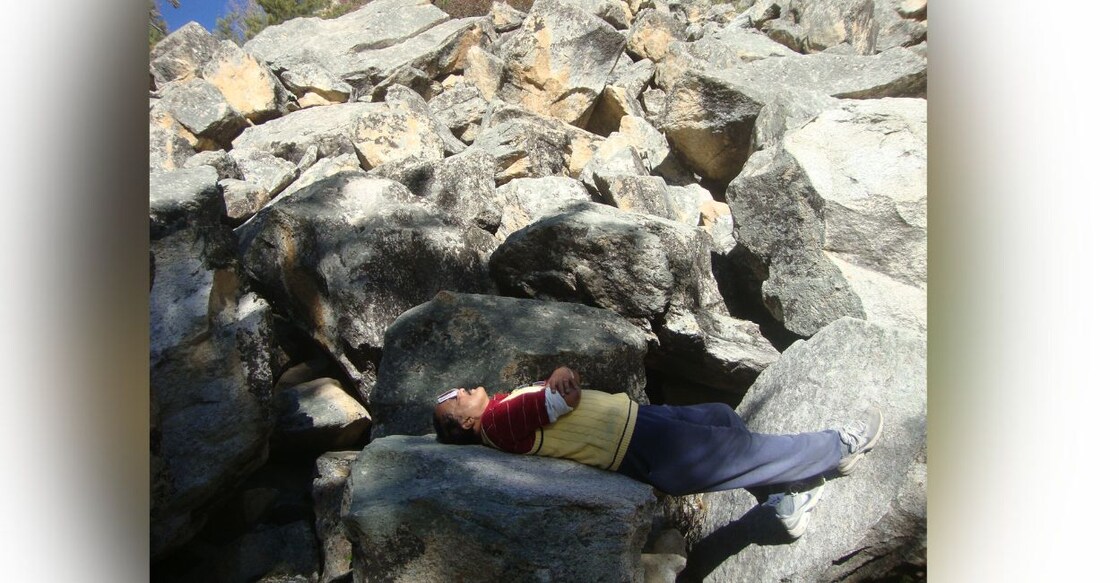
Swami was cool. He had been to Tapovan at least half a dozen times. Sherpa Amar Bahadur had been there perhaps a hundred times, both as guide and as porter, carrying up to 20-30 kilos on his back. They explained to me how treacherous the path was. Because the thin sheet of ice on the ground hid yawning crevices and they could catch you by surprise and you vanished into the millenniums-old, cold, dark bowels of the glacier forever. Bahadur showed the way. Some crevices were many feet across and open like a huge gash. The sound of ice-chunks peeling off the chasm-walls and falling into the eternal cold, and its reverberating echoes were the most terrifying noises I’ve ever heard. The rocks block your way at every step. You side-step some, taking frustrating detours, or climb over some, or wait till Bahadur comes and literally picks you up. Those stones were indeed cruel. I’m a cheerful traveller. I like challenges. But the crossing of the Gangotri glacier-bed was the most crushing bit of travel I’ve ever experienced. I was at the end of my tether.
As we reached the other side of the glacier, I sat down on the ground, sighed in relief and asked Swami, ‘Have we arrived?’. He said, ‘No, just this final bit only.’ And pointed to a mountain whose peak vanished into the darkening evening sky. I was numbed and crushed. I felt like crying. The shadowy shape of the mountain stared at me contemptuously. Like Bilbo Baggins, the unwilling hero of Tolkien’s great novel ‘The Hobbit’, I reproached myself for setting out on this foolhardy journey. Swamy sympathised with me but firmly indicated that if we didn’t reach the Valley before night when below zero temperature set in, we would be in deep trouble.
I got up like a walking dead and began to drag myself up the precipice. Then I realized that the heartless rocks were preferrable to what now confronted me. Because the top soil of the mountain was a mixture of loose gravel and pebbles and with every step I took, I was dragged back two. Even when I crawled, I kept sliding back. Whatever I tried to hold on to, came off. I didn’t know if I was going forward or backward. I just kept going like a robot that had been programmed on a blind mission. I lost all sensation of time as I kept crawling. I looked back once and saw far below the glacier sinking into darkness. I was also aware that above me the moon was shining forth with a brilliance I had never seen before.
Suddenly I saw with a start the extended arms of Amar Bahadur under the moonlight, waiting to pull me up. To my amazement, he appeared to be standing on level ground. He hoisted me up and I collapsed on the cold ground. I had arrived in Tapovan. It took me a while to put together the will to get up. We started our walk into the Valley. The brooding, gigantic shapes of the great peaks Shivling, Meru, Bhagirathi towering into the dark sky surrounded us. By the time we reached the hut-cum-cave of the lady who’s simply known as Mathaji where we hoped to get shelter, they too had disappeared into the night. The cold took over everything.
I only need to add that Tapovan Valley in itself is an arid, rocky, lifeless plain with a stream trickling on one side. Apart from Mathaji, I was told, only three persons live there. One is a young sannyasin who’s known as Mouni Baba. As the name suggests, he doesn’t talk but is friendly and hospitable. We stayed our second night in his hut. Because in Mathaji’s cave, mice were playing football upon my blanket. I’ve nothing against them but this was the first time I was sleeping with them. So, I persuaded Swami to shift. The other two tenants of Tapovan at that time were a lady sannyasin from Karnataka and another Mouni Baba. We didn’t go looking for them.
The cold is the overwhelming reality of Tapovan. And utter silence, occasionally broken by a bird-cry. But above all what humbles and overpowers you are the awesome, magnificent snow-peaks who stand guard over everything, mysterious and inaccessible. They didn’t seem to belong to this earth. Looking at them and thinking what extraordinary secrets they might hold made my head whirr. And finally, it’s the night sky. If you can gather the courage to come out from under the blankets – in any case you have to do it if you wish to pee – and stand outside, freezing and trembling, you’ll see the Milky Way flowing like a heavenly river of crystal light, end-to-end across the pitch-dark sky. That sight alone is worth all the trouble.
Photos by Paul Zacharia and Swami Samvidanand
 Add as a preferred source on Google