

Mattancherry to London: How a 26-year-old Malayali connected diaspora students to tabla
Mail This Article


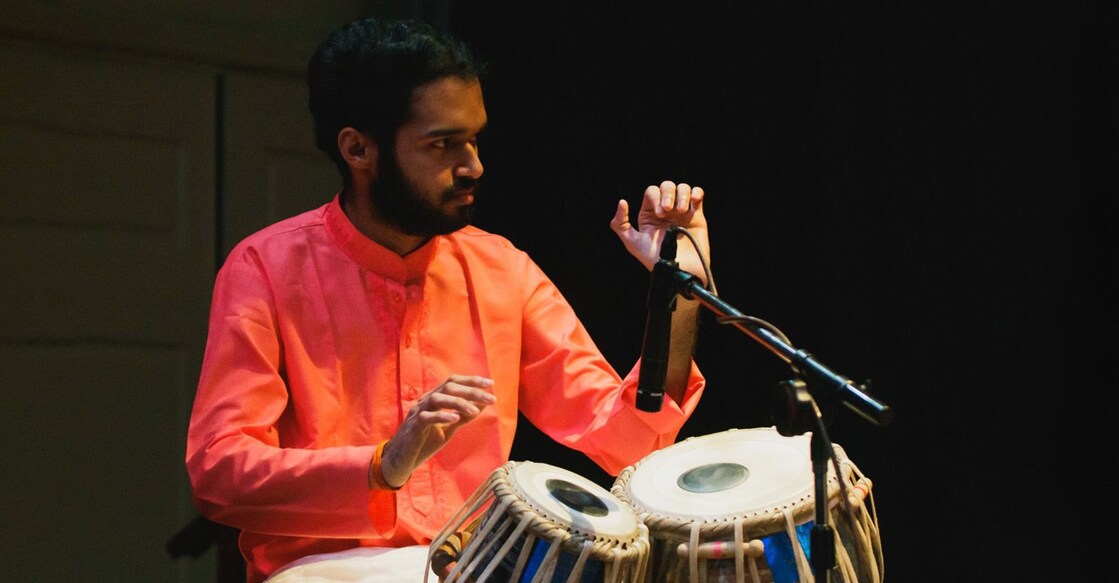
For many young Indians, moving to the UK for higher studies is a familiar story. But not everyone takes with them the responsibility of preserving and passing on an Indian classical art form to the next generation. That’s exactly what 26-year-old Jnanesh Kamath from Kochi did, turning his years of tabla training into a cultural bridge for British-born Indians eager to reconnect with their roots.
Belonging to the Konkani community in Kochi, Jnanesh’s love for the tabla began at the age of four. “There is a Vittobha temple in Mattancherry. I used to go there with my parents, and many Hindustani singers and musicians would perform there. That’s where my fascination with the tabla began. My father soon enrolled me for training,” he recalls. What started as a childhood spark soon became his lifelong passion.
Years later, while pursuing his Master’s in Banking in the UK, Jnanesh found himself drawn back to his first love. Through performances and connections with fellow artists, he was invited to begin teaching tabla at Chinmaya Mission in London. Small batches of five to six students soon grew into a vibrant teaching journey, with students ranging from six-year-old children to sixty-five-year-old enthusiasts.

“Teaching in the UK was a completely new experience,” he says. “Most of my students were British-born Indians, and their approach to learning was very different from students in India. Many of them were starting from scratch, so we developed new methods to make Indian classical music more accessible.” Surprisingly, he also found a few non-Indians signing up for online classes, curious about the rhythms of the tabla.
Carving a space in the UK’s music scene was not without hurdles. “There are already established tabla players in the UK, including many from the Sikh community. As a Malayali entering that circle, it wasn’t easy at first. But through networking and small performances, I slowly began to build my presence,” he says.
Over the past two and a half years, Jnanesh has performed close to a hundred concerts across the UK. One of the most memorable was sharing the stage with Grammy Award-winning flautist Rakesh Chaurasia at Chinmaya Mission. “That was the biggest concert of my life. He was incredibly supportive, and it gave me so much confidence,” Jnanesh says with a smile.
The transition to life in the UK was not always smooth. During his initial months as a student, Jnanesh didn’t even carry his tabla with him, and the disconnection left him lonely. It was only after completing his Master’s that he decided to bring his instrument back into his life, balancing part-time work with regular practice and performances. “Tabla became my anchor,” he admits.
Now back in India temporarily, Jnanesh is preparing to return to London, this time as a full-time music teacher at Pandit Ram Sahai Sangit Vidyalaya. For him, this move is not just about a job but about committing fully to his art. “In India, we’re surrounded by established musicians everywhere. But in the UK, I saw a five-year-old’s level of commitment to music that really struck me. That passion convinced me to stay and teach. Tabla has become much more than just an instrument for me—it’s a way of life.” From a temple in Mattancherry to concert halls in London, Jnanesh’s journey is proof that tradition travels, carried in the hands of those who keep its rhythm alive.
 Add as a preferred source on Google