

Why Chandra from 'Lokah' feels more real than 'Wonder Woman' or 'Black Widow' ever did

Mail This Article


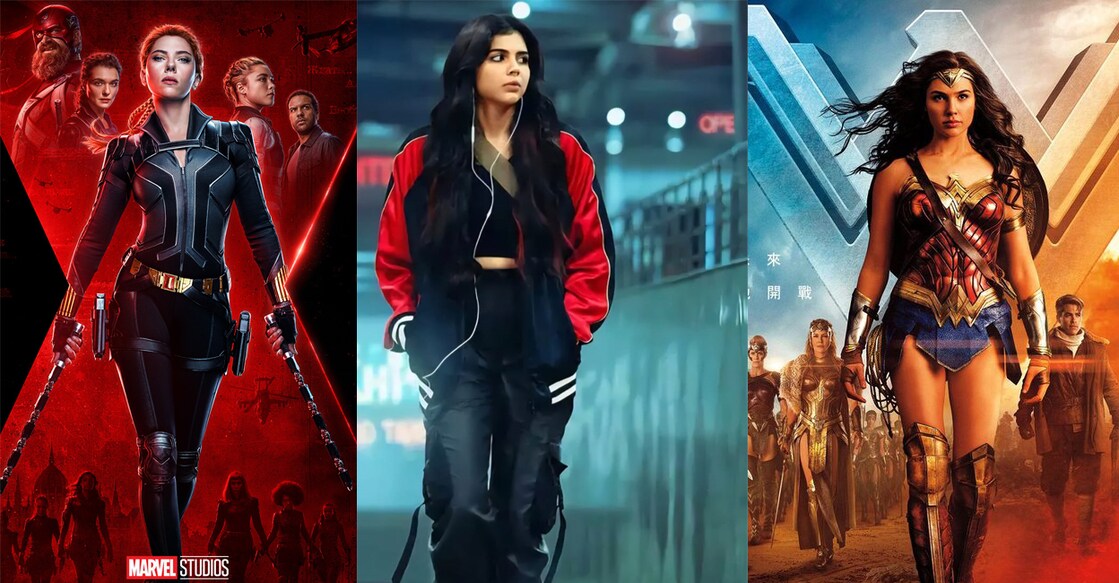
When you hear the term 'female superhero', a certain image instantly forms in your mind. It’s almost a template. A skin-tight suit, a perfectly sculpted body, and an aura of glamour that is just as important as the superpowers themselves. Think of Natasha Romanoff, better known as Black Widow in the Marvel Cinematic Universe. Or Catwoman from the Batman films. Or even Wonder Woman, with her iconic tiara and Lasso of Truth. These characters may differ in powers and personalities, but their presentation follows a pattern primarily shaped by decades of male writers and directors. In most cases, female superheroes have been imagined for the male gaze: beautiful, seductive, and often defined more by how they look than by what they actually do.

This is why Chandra, or Kalliyankattu Neeli, from the film ‘Lokah,’ feels like a refreshing break. Unlike her global counterparts, Chandra doesn’t strut around in latex costumes, stilettos, or plunging necklines. She appears in jackets, tops, and cargo pants, practical, everyday clothing that doesn’t scream spectacle. But more importantly, her character isn’t written as a glossy fantasy for viewers to admire.
From the very beginning of superhero storytelling, women were rarely allowed to be complex. Early female superheroes were either sidekicks, love interests, or symbols of unattainable beauty. Wonder Woman, for example, was once hailed as a feminist icon, yet much of her early narrative was shaped by how she looked in her skimpy costume or how her powers fit into male-centred stories. Catwoman, meanwhile, was often reduced to Batman’s dangerous love interest, sexualised in every incarnation from Michelle Pfeiffer’s whip-cracking femme fatale in ‘Batman Returns’ to Halle Berry’s leather-clad version in ‘Catwoman.’ Her morality and motivations took a backseat to how she fit into Batman’s orbit.
Black Widow’s portrayal in the MCU follows the same trajectory. Scarlett Johansson’s Natasha Romanoff is intelligent, resilient, and deeply skilled, yet her character design, from the figure-hugging tactical suits to the stylised fight choreography, was clearly shaped with visual appeal in mind. In fact, Johansson herself has spoken in interviews about how Natasha was often filmed through a sexualised lens, particularly in earlier films like ‘Iron Man 2.’ Natasha is written as a character with many shades. She wants to be loyal, she seeks redemption, and she has a strong instinct to protect. But time and again, her stories get pushed toward romance or situations where she ends up playing second to the men around her.
In the grand set-pieces of ‘The Avengers,’ Natasha is crucial, but the 'big hero moment' are reserved for Thor, Hulk, or Iron Man. She saves the day in smaller ways, but not with the same spectacle.
Chandra, on the other hand, avoids these cliches. She isn’t introduced as a glamorous spectacle, nor is she positioned as a sidekick or a love interest. Her presence is striking precisely because it is normal. The way Sunny (Naslen) and his friends look at her is telling. Their fascination isn’t about awe, intimidation, or unattainable fantasy. It’s the kind of everyday crush young people develop on someone they find cool, mysterious, or simply interesting. This humanises Chandra in a way that global superhero films often fail to do. She blends into her surroundings instead of dominating every frame with spectacle, making her more relatable and approachable.
Another notable difference is how Chandra’s power is positioned. In most superhero franchises, the female hero is often shown as “the weakest link” of the team. Black Widow, despite her combat skills, is frequently overshadowed by super-soldiers, gods, and billionaires in iron suits. Even during the Battle of New York in ‘The Avengers,’ she relies on Hawkeye for positioning and Captain America for tactical direction. Compare that to Chandra in ‘Lokah,’ who is written as equal to Chathan (played by Tovino Thomas). Their dynamic is not one of superiority and support but of parity.
The absence of sexualisation also allows Chandra to be defined by her choices, her actions, and her personality rather than her body. She’s not presented as an unattainable. She’s a warrior, but also someone with vulnerabilities, fears, and doubts. Although Chandra is a ghost, she is written with very human emotions. On the surface she may appear stoic, but beneath that she worries, overthinks, and feels the weight of loneliness. Her decision to attend Nigel’s party comes from a simple human desire to feel a sense of belonging, even if she knows it will not last. Chandra is allowed to be herself without carrying the burden of 'representing all women' or being a visual fantasy. She isn’t crafted for the gaze of male viewers, nor is she flattened into a symbol. In a cinematic world where female superheroes have too often been reduced to their costumes, bodies, or supporting roles, Chandra reminds us that there is another way. Female heroes don’t need to be latex-clad fantasies or decorative sidekicks. They can be human, powerful, flawed, and equal and perhaps that makes them more heroic than anything else.
 Add as a preferred source on Google