

‘The Elysian Field’ took 1.5 years to make: National Award-winning director Pradip Kurbah on solitude and cinema

Mail This Article


It took Pradip Kurbah a year and a half to make ‘The Elysian Field’, and that patience shows on screen. The Khasi film, screened in the International Competition section at the 30th International Film Festival of Kerala (IFFK), unfolds slowly, observing people, seasons, and silences with care. Kurbah waited through different seasons to get every moment right, determined to capture the passage of time and the subtle rhythms of a village slowly emptying out in the Khasi hills.
A National Award-winning filmmaker, Kurbah is one of the most important voices in Khasi cinema today. His major films, ‘Ri’ (2014), ‘Onaatah’ (2016), and ‘Iewduh’ (2019), have each won the National Award for Best Khasi Film, cementing his reputation for telling socially resonant stories that feel deeply rooted in place and tradition.
A future that feels present
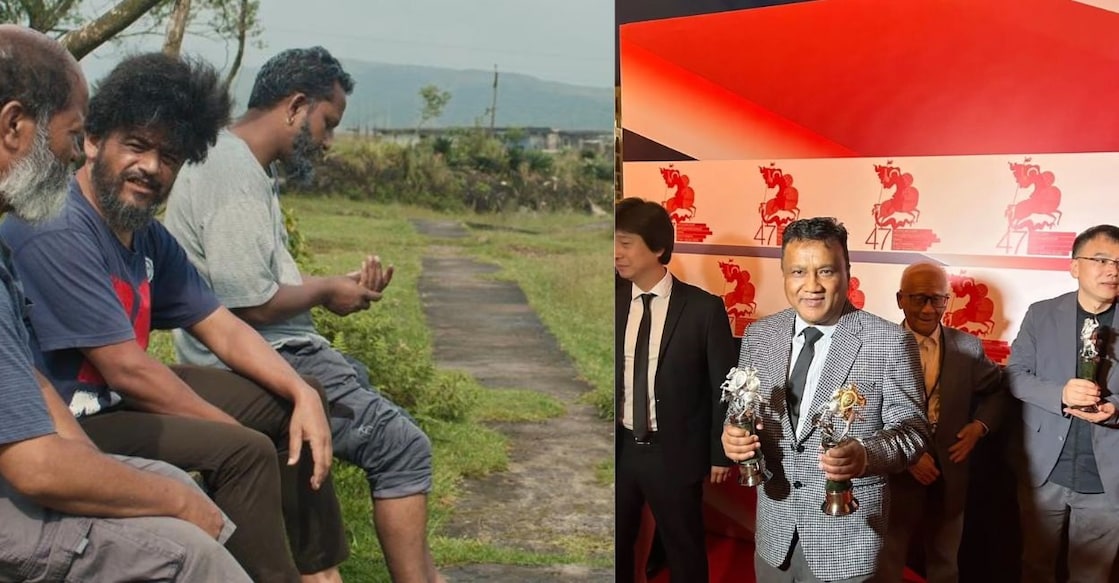
Set in 2047, a hundred years after Indian Independence, ‘The Elysian Field’ imagines a remote village with just six residents left behind. Everyone else has moved away. There is no spectacle, no conventional drama. What remains is quiet coexistence, where the villagers have only each other to rely on. Despite its futuristic setting, the film feels anchored in today’s anxieties.

For Kurbah, the future was never about predicting what will happen, but warning against what could. “I wanted to tell my people that what I am showing does not have to happen in 2047. We still have time to change,” he says. Watching younger generations drift away from their roots, communities, and even families unsettles him. ‘The Elysian Field’ becomes his gentle plea, inviting audiences to prove him wrong.
Loneliness and awareness
The abandoned village at the film’s heart is not drawn from one specific place in Meghalaya. Rather, it comes from a worry Kurbah feels is slowly becoming real everywhere. Loneliness, he observes, is no longer dramatic or rare—it creeps quietly into everyday life. People grow isolated even in the company of others. The thought of villages emptying out entirely no longer seems far-fetched. “I am scared that such a thing can happen,” he admits, noting that the film is as much a call to awareness as it is a story.
Yet, the film does not dwell solely on despair. There is a strange celebration in how the characters inhabit what remains, a quiet dignity in their coexistence. That balance has clearly struck a chord internationally. ‘The Elysian Field’ went on to win Best Film, Best Director, and the NETPAC Award at the 47th Moscow International Film Festival. Russian audiences, Kurbah explains, related strongly to the story. Like Meghalaya, many Russian villages face depopulation, leaving behind ageing communities in near solitude.
Even at IFFK, viewers approached him to share similar stories from Kerala. The film’s themes—migration, fractured communities, emotional distance—are universal, which, Kurbah believes, explains why it resonates far beyond Meghalaya.
Characters drawn from real life
The six central characters in ‘The Elysian Field’ are inspired by people Kurbah has met or stories he has heard over the years. Livingstone, for instance, is inspired by a man Kurbah knows who never married and cares for his mother. In the film, Livingstone is widowed, carrying a similar emotional weight.
None of the actors are professionals. One is a PRO officer at IIM, another runs a small business, another is a retired banker. Their inexperience becomes a strength, lending authenticity to the performances. Their commitment was unwavering. Because Kurbah wanted to capture all seasons authentically, shooting stretched over a year and a half. When one winter failed to provide the right conditions, he waited for the next. The actors stayed with the project throughout.
One memorable moment came by chance. A goat, intended for the climax, disappeared mid-shoot. With no replacement available, Kurbah rewrote the scene, folding the absence into the story. What began as a production hiccup ultimately strengthened the narrative.
Storytelling over recognition
Despite international acclaim, Kurbah insists that festivals and awards are secondary. “The responsibility is huge, but the story has to touch me first,” he says. If it does not move him, he sees no point in telling it.

Kurbah’s path into filmmaking was unconventional. He never had formal training, starting instead with independent films in the 1990s, learning through trial and error. In 1998, he directed ‘Ka Mon Bajwat’, the first Khasi commercial film, which ran for five months in theatres and marked a turning point. Travel and exposure have broadened his perspective, but his admiration for Malayalam cinema remains constant. He often says that if a Khasi film finds an audience in Kerala, it is a mark of achievement.
What’s next
Looking ahead, Kurbah is developing a psychological drama exploring the guilt and pain people carry silently. “We all have something we don’t share,” he says. “We keep it inside.”
Following the spirit of ‘The Elysian Field’, Kurbah’s upcoming story promises the same quiet, intimate humanity that marks his work.
 Add as a preferred source on Google