

Spa setting was never the plan, it just happened: Abrid Shine | Interview

Mail This Article


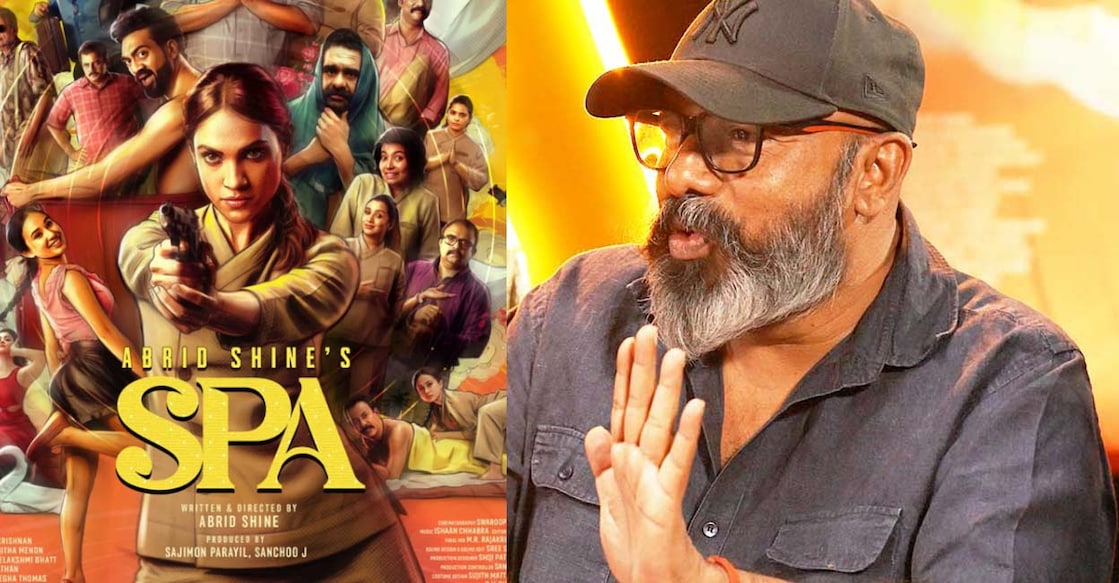
From shock to laughter, Abrid Shine’s latest movie ‘Spa’ brought out varied reactions from the audience. And the filmmaker is glad. “I am proud that people are having different conversations about the film – some good, some bad, but I am happy that I haven’t made anyone cringe with the kind of conversations in the film. We have used clean humour, though the film takes place in an unprofessional setup. The best part is everyone can relate to somebody who arrives at the spa,” he told Onmanorama.
Abrid, known for ‘1983’ and ‘Action Hero Biju’, admitted that he had never planned to set his story in a spa. Rather, the idea came to him when he wanted to explore a space where a man and a woman can interact by shedding their masks. “Of course, the kind of interaction that takes place in the movie cannot happen in a professional spa, where people mostly speak about the temperature of the room or their general health. The spa in my movie has a professional look, but of course, it is an unprofessional setup. That created the space for humour. The men who arrive there are desperately trying to fulfil their desires, but they cannot assert them. The way they almost beg or approach the topic of the happy ending delivers the scope for humour,” he said.
He also dismissed the comparisons between ‘Action Hero Biju’ and ‘Spa’. “I read about the comparisons, but I think it’s because both films have a lot of people arriving at a certain space. But if you watch Action Hero Biju, you know the centre point in the film is Biju, while Spa is space-centric and character-driven,” he said.
He also addressed criticisms of the film's structure and its climax. “Spa is a character-driven ecosystem satire. If you look for a straight line plot, it may seem that there is no conventional “story.” The film revolves around a shooting that takes place inside a spa, the characters who arrive there, and what unfolds there. You could say the screenplay moves in reverse to the story, or that the story is revealed through the structure of the screenplay,” he said.
“The film is about the collisions of morally double-faced individuals within a fictional space, and the internal tensions that accumulate there. In the end, that accumulated tension explodes in a kinetic release. The gunfire is the surface noise. The inner collapse is the real explosion. The final gunfire is not the resolution of the film’s central conflict. It is not a thriller climax. It is a structural crescendo,” he said.
He added that Mathan, played by Vineeth, was an integral part of the climax. “There were criticisms that Mathan is shown in a poor light towards the end of the movie. Mathan is an innocent man who arrives at the spa. His innocence to first touch to romantic illusion, guilt, obsession, possessiveness, and finally emotional breakdown was part of his journey. In the climax, while chaos unfolds outside, Mathan is crying for love inside. His emotion is real to him, even though the audience knows it is an illusion. Yet he does not stop crying. That contradiction is the climax,” he elaborated.
He added that people can’t expect Mathan to be the saviour or the hero, though he wanted to ‘rescue’ the girl working at the illegal spa. “I would be resorting to cliches if I had opted for the hero rescuing the damsel in distress. That is what we saw Dileep doing in 'Soothradaran', or Suresh Gopi in 'Rudraksham'. In Spa, the therapist does not see Mathan as a hero nor does she want to be rescued,” he said.
He added that he opted for the assassin angle to raise the tempo in the final movement. “They are not villains, nor are they treated as realistic character studies. Their entry has a distinct musical elevation and soundscape that itself signals their narrative function. They exist to create a musical and structural crescendo. Without the energy they generate in the climax, the collapse would not feel complete. This is not a hero-versus-villain film. It is an ecosystem collapse,” he said.
Abrid also spoke about the performances of all the actors, adding that the film happened because the actors trusted him. “The story may not be conventional, but none of the actors I approached was averse to the idea. Major Ravi was the only one who expressed a bit of apprehension in the beginning, but he got onboard with the project soon after,” he said
 Add as a preferred source on Google