

New balsam species discovered, named after St Berchaman's College and Kerala's revered botany professors
Mail This Article


Five new species of 'impatiens' (balsam) have been discovered in the southern parts of the Western Ghats.
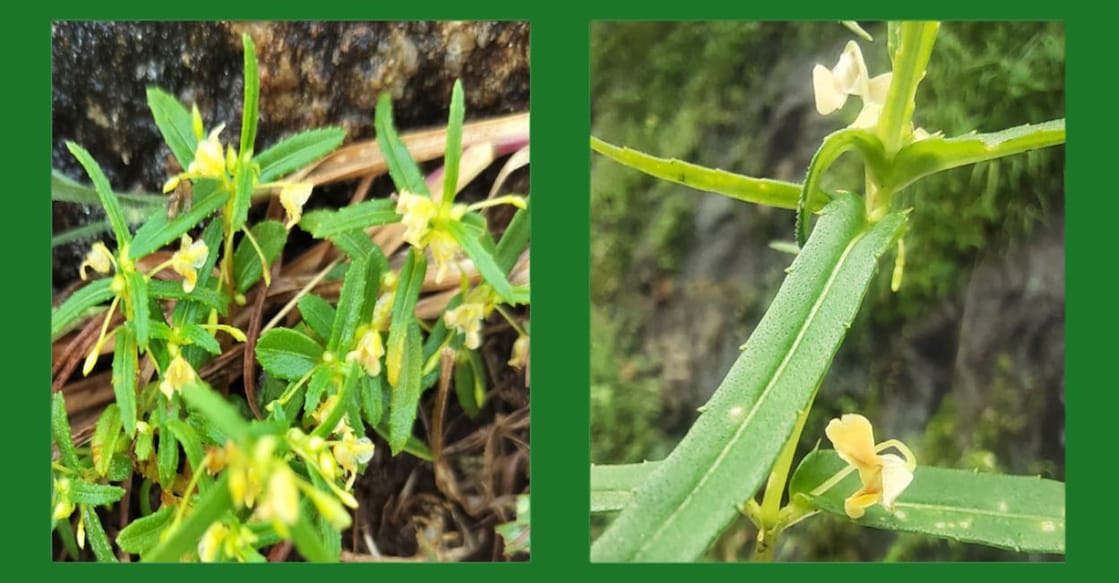
One of the new finds has been christened 'Impatiens berchmansiensis', in honour of one of Kerala's most reputed higher education institutes, St Berchman's College, Changanassery.
"This is a tribute to the contribution of the college to the science of botany," said Thomas Manuel, one of the four investigators of the project. The others are: Sindhu Arya (Travancore Institute of Biosciences Research), Thomas Salvy (St Berchman's College) and Thomas Plammoottil Rogimon (Kottayam CMS College). Manuel is an independent researcher.
This species, named after St Berchman's College, and discovered from the Wagamon area in Idukki district, is unique in that it has just one flower, and it is yellow in colour. Other have more than one flower.
Another find has been named Impatiens ninanii, and is named after Kerala University's former science faculty dean and Botany Department head professor C A Ninan. I. ninanii, discovered from Mangulam Viripara in Idukki district, has violet-blue flowers.

Impatiens filcyii is named after former botany professor of Kottayam CMS College Prof Filcy T Baby. This species, discovered from Mamalakkandam in Ernakulam, has pink-purple flowers.
In addition, the team had discovered two other balsam species: Impatiens flavispicata and Impatiens xanthopetala. I. flavispicata, like I. filcyii, was spotted in Mamalakkandam.
The white colour of the flower, yellow blotches on the throat, pollen surface, and shape of the spur (beard) are distinct characters of I. flavispicata.
I. xanthopetala was found in Pambanar of Idukki district. It has dark yellow petals like its name derived from the Greek word 'xanthos' suggests, and dark-brown 'bindi'-like blotches on its throat.
These were identified as different species after a close examination of their leaves, flowers, lateral sepals, lower sepals, dorsal petals, lateral united petals and pollen sizes.

Each is distinctly different from the others. If, for instance, I. flavispicata has an erect herb, I. berchmansiensis has an erect-suberect herb. If I. filcyii has three to six purple flowers, I. ninanii also has the same number of purple flowers (four to five), but the size of its pollen is considerably less than I. filcyii's.
The study was first published in the peer-reviewed open-access journal Phytokeys.
 Add as a preferred source on Google