

What a scholarly British judge said about Malayalis in 1840s

Mail This Article
Thomas Erskine Perry is a name that is long-forgotten in Bombay, a city where he served as the chief justice of its supreme court from 1847 to 1852. An erudite scholar, Perry lived in the subcontinent in two stints spanning three decades, including 21 years as a member of the Council of India.
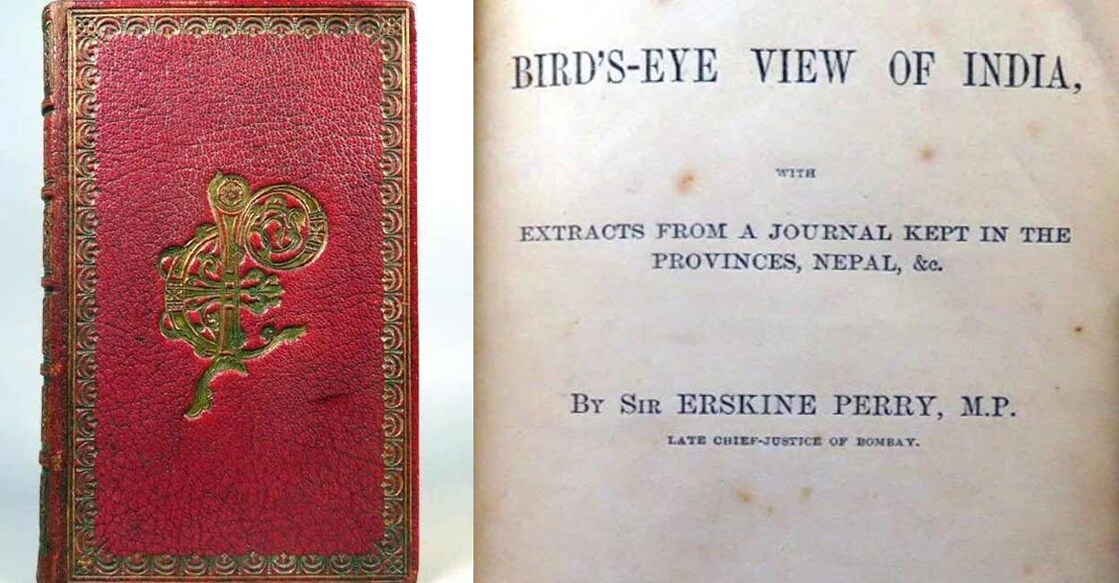
During his first stint in the country, Perry travelled extensively across India and took detailed notes, using them for lectures about the country back in Britain. These lectures and other writings were compiled and published in a 1855 book titled Birds’s-Eye View of India.
Perry was a member of the now-defunct Liberal Party in the UK and his writings suggested a genuine affection for India and Indians, although he was very much a proponent of the British Empire.
Not many advocates of the Empire would have given such a description of India at that time:
“One of the fairest regions of God’s earth, nearly equal in extent and population to Europe, - peopled by one hundred and sixty millions of no savage or uncultivated race, but heirs of a civilisation which extends to the remotest antiquity, - the birthplace of two religious which still number as their votaries the majority of mankind, - a land richer in productions, more blessed in climate, and higher endowed with grand natural features of mountain and of stream than any country in the world.”
Perry recommended a three to four month trip to India for English travellers, while speaking of his own personal privilege in travelling across the country. “An Indian judge, especially on the Bombay bench, has great facilities for seeing different parts of the country during the intervals between business; and by travelling light, I contrived to see most parts of India and Ceylon during my sojourn, extending over eleven years and a half in the East,” he wrote in the introduction of the book.
The judge seemed to have developed a particular interest for the Malabar Coast, calling it “a country where the richest gifts of nature spontaneously present themselves, and primeval forests, tenanted by wild elephants, and almost equally wild races of men, still cumber the earth, - a land of singular physical formation, and peopled by not less singular races, - Nairs, Bunts, Moplahs, Kolis, White Jews, Nestorian Christians.”
Perry came to the conclusion that Malayalam and Tulu were gradually on their way to extinction, fearing that Tamil would subsume the former and Kannada the latter. “Malayalam extends from Cape Comorin to the Chandragiri river, or, more strictly, perhaps, to Nileshwar (Nileswara), where a Nair Rajah, conquered by Haider, formerly ruled,” Perry wrote. “We have seen that a rude Tamil dialect is spoken on the tops of the Western ghats, from the great gap to Cape Comorin; and the language seems gaining upon and extirpating Malayalam, both to the north and south.”
The British judge said Tamil was spreading through the Palghat gap and moving West and replacing Malayalam. “...Palghat is more a Tamil than a Malayalam town,” Perry wrote.
He seemed to be under the impression that Malayalis were deeply introverted, if not insular, people. “The Malayali is said naturally to shrink from contact with foreigners, - even from people of his own caste - whilst the Tamilian is the least scrupulous of all Hindus,” Perry wrote. “Hence the Malayali retreats from the great roads, from cities and bazars, as eagerly as the Tamil flocks to them; and the former race are to be found isolated with their families in their high-walled parambus, even in parts where the lines and centres of communication are entirely occupied by their more enterprising eastern neighbours.”
A century later, 170 years to be exact, with the Malayali diaspora spread so far across the world that there are even jokes of Keralites beating Neil Armstrong to the moon, it’s hard to believe that the community was ever like that.
However, other accounts from the early 20th century Kerala do mention that some groups like landed Nairs did tend to choose self-isolation and to be rural, while others like some Muslim and Christian communities saw urbanisation as an opportunity.
The Malayalam language, thankfully, thrives in Kerala, although it is a different story when it comes to the well-spread out diaspora.
Perry seemed to be a proponent of protecting the subcontinent’s linguistic diversity and at the same time called for English to become its lingua franca and serve as a bridge between Britain and India.
He passionately pleaded his case for the English language in India: “It is not given to man to penetrate deeply the misty future, and it is impossible to predict what the connection of Europe with Asia may be some centuries hence; but as every Englishman who is jealous of the honour of his country must desire that the name of England as an enlightened benefactress, should be irrevocably blended with that of India, a British monument more useful, possibly more permanent, than the pyramids, may be left in the country, but it shall be altogether moral, and not composed of brick or marble.”
For Perry, this monument was the English language- something that continues to benefit the people of India even after several decades of independence.
(Ajay Kamalakaran is a multilingual writer, primarily based in Mumbai)
 Add as a preferred source on Google