

An anonymous Malayali writer’s critique of political reforms in British India

Mail This Article


One major effect of the spread of English education in Malabar, Cochin, and Travancore in the pre-independence era was the emergence of Malayali journalists and writers who were comfortable with the language of the Empire.
One fine writer was O U Krishnan, who self-published a lost classic, The Night Side of Bombay, in 1923. Other Malayalis were active participants in the Bombay journalism scene in the decades leading up to independence, with their ideological leanings spanning far and wide.
Given the highhandedness of the colonial authorities and their censorship and periodic clampdowns on the freedom of the press, some chose to write under pen names. One such journalist, who published a book critiquing the Montagu–Chelmsford Reforms that led to the Government of India Act, 1919, used the name “Kerala Putra.”
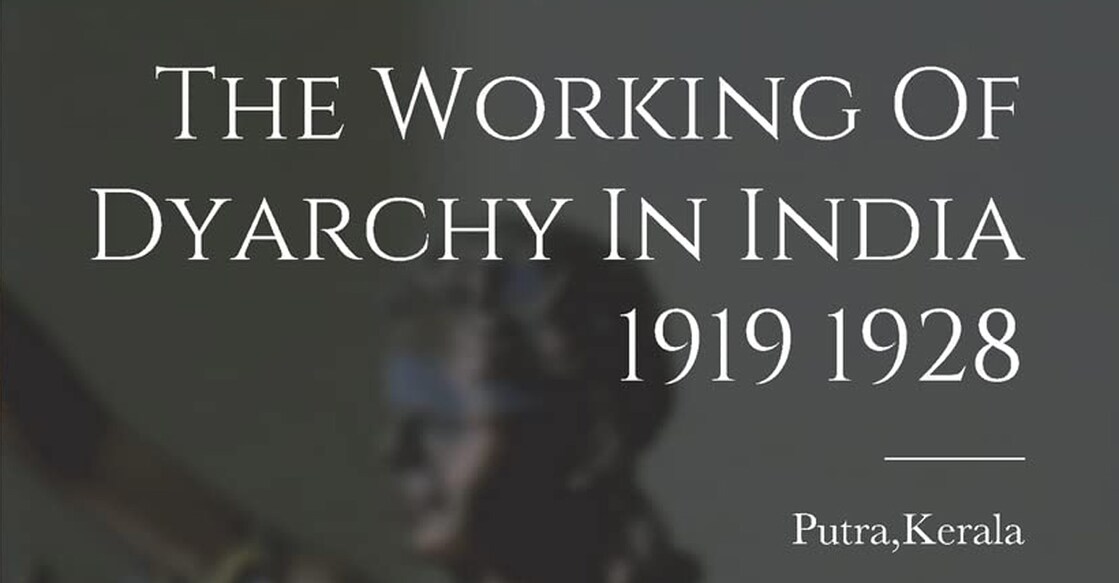
The book titled The Working of Dyarchy in India: 1919-1928 was published by D B Taraporevala Sons & Co, Bombay in 1928.
The 146-page book gives a balanced analysis of the reforms that were introduced in India by the British. The reforms brought about a system of dyarchy in the country, under which certain provincial subjects were reserved for the British, such as police, law and finance (the reserved category), while Indian elected representatives (the transferred category) were responsible for areas such as education and health.
British media outlets were impressed with Kerala Putra’s writing and ideas.
“‘Kerala Putra’ is quite the best writer and not the worst thinker among Indian publicists who stand outside the circle of active politicians,” the Guardian wrote in November 1928. “He sees India’s political problems from the standpoint of a highly educated Madras non-Brahmin Hindu with a special interest in the Indian States.”
It almost seems as if the author of the article knew the identity of Kerala Putra and dropped a clue to those familiar with the Bombay journalism scene, while protecting the Malayali journalist’s identity.
“The unnamed Indian journalist who has produced this study of the Montagu-Chelmsford reforms in practice writes with commendable moderation,” the Telegraph wrote in August 1928. “He maintains that, though dyarchy has failed, the political capacity of the elected Indian councils and of the Indian Ministers has been vindicated. He holds, therefore, that reforms should be extended to give British India responsible government without delay.”
Kerala Putra, however, was cautious about a full replication of British institutions in India, claiming that the country's atmosphere was not entirely ready for it.
“He makes detailed suggestions for a franchise on a partially communal basis, but he protests against the growing practice of appointing Indians to office on the strength of their religious views, rather than because of their efficiency,” The Telegraph added.
Kerala Putra called for a future constitution based on principles “which unite the past with the future and not separate them.” He praised the “Rule of Law and Parliamentary Government,” introduced by the British in India, while emphasising the need for “centralised administration” that “descended through ages from Chandra Gupta through Aurangzeb, Wellesley and Curzon” combined with limited local autonomy was the best way to govern India.
“It has often been said that India is not a nation or a country, but a continent inhabited by many nations,” Kerala Putra wrote in his conclusion. “Whatever be the truth in that statement, no one can deny that powerful unifying forces are at work, which compel even the most exclusive Ruling Indian Princes to accept in principle, the idea of collective association with the Government of India.”
Mahatma Gandhi was highly critical of the Montagu-Chelmsford reforms and said they would only further drain India of its wealth and prolong its subordination to the British.
The British press at that time did not waste any opportunity to attack the leader of the Indian independence movement for his views. In September 1920, the Glasgow edition of The Herald praised the reforms' changes in the administration of India. “With all these changes in progress, it is unfortunate that India, thanks to the subversive action of the extremists with Mr Gandhi at their head, remains unsettled,” the paper wrote.
The Malayali journalist pointed out the flaws in the reforms implemented in India, while praising Indian legislators. “It is certainly no fault of the Indian Ministers of the Indian Legislatures that the Devolution rules gave the Governors more authority than they possessed before, and made the Finance members the dictators alike of the Reserved as of the Transferred half,” he wrote. Kerala Putra did, however, concede that the reforms helped establish a “healthy relationship between the people and the Government.”
One can easily assume that some parts of Kerala Putra’s book, which portrayed the Raj in a somewhat positive light, may have annoyed Indian freedom fighters. This could have been one more reason for the journalist to use a pen name.
While recommending Kerala Putra’s work, The Telegraph wrote, “This book represents the programme of the more moderate Nationalists, and deserves attention.”
(Ajay Kamalakaran is a writer based in Mumbai. His latest book, 'Colombo- Port of Call', was published by Penguin Random House.)
 Add as a preferred source on Google