



How AI is redefining Indian retail landscape by 2030: Panellists at Techspectations
Mail This Article


Imagine a world where your favourite brand knows you’re looking for a new pair of running shoes before you’ve even typed a single letter into a search bar and then offers them to you exactly when the weather in Kochi clears up for a jog. This isn't a scene from a sci-fi film; it is the immediate future of Indian commerce.
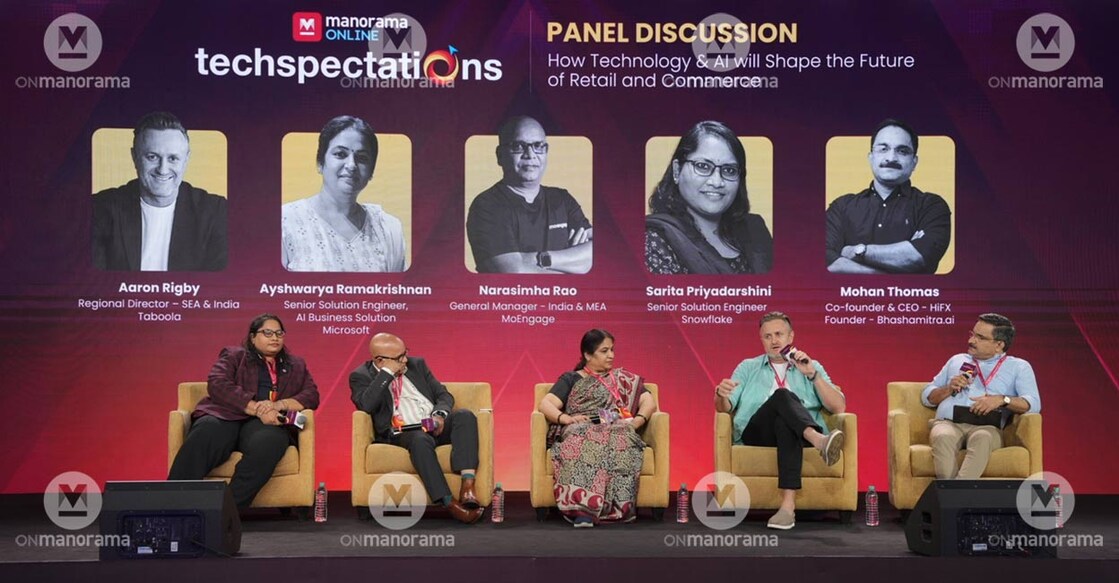
At Techspectations 2026, ManoramaOnline’s flagship digital summit, a panel of tech leaders gathered to dissect a “strange paradox” currently gripping the industry. Most brands have more data and tools than ever before, yet they are still failing to solve the ultimate mystery - why a customer chooses to stay or walk away.
“We are living through a massive transfer of power”, noted Mohan Thomas, Co-founder & CEO of HiFx and Founder of Bhashamitra.ai, who moderated the session on ‘How Technology & AI Will Shape the Future of Retail and Commerce’. “It’s no longer about the customer doing the work to find the product. It’s about the brand discovering the customer”.

The shift from intentional searching to ‘predictive discovery’ was the session's first major revelation. Aaron Rigby, Regional Director (SEA & India) for Taboola, explained that the old currency of “clicks” is officially bankrupt.
“Advertisers don’t just want traffic; they want outcomes. By analysing the digital footprints of 700 million users, AI can now surface products with uncanny timing. “I don’t want to spend three days finding a product; I’d love it to be in front of me now so I can get on with it”, Rigby said, emphasising that AI is now a decision-making agent for the modern shopper.
If discovery is the engine, data is the fuel. Sarita Priyadarshini, Senior Solution Engineer at Snowflake, introduced the APE Model - Access, Performance, and Empowerment - as the non-negotiable architecture for any retailer hoping to survive 2026.
She challenged the audience to look beyond “hyper-segmentation” (targeting groups) toward true “hyper-personalisation” (knowing an individual's specific wallet limit and lifestyle). However, she offered a silver lining for local, offline vendors.
“AI can do things easy, yes, but it cannot do things which are close to heart, yet. That personal human touch, handwritten notes and understanding a birthday is coming up, is something no one can take away,” Priyadarshini said.
Narasimha Rao, General Manager (India & MEA) for MoEngage, identified context as the single most critical capability for retailers today. He simplified a complex technical concept with a local reality.
“If I'm selling umbrellas in Kochi, I want to make an offer when it's raining and have that offer end the second the rain stops. That context, knowing the buyer's aspirations and their immediate environment, is the most important investment,” Rao said.

Rao also highlighted that Generative AI is finally cracking the “vernacular code” in India, allowing brands to maintain emotional context in languages like Malayalam, which is vital for building trust with the next 500 million shoppers.
As we enter the era of Agentic AI, where AI agents don't just recommend products but actually execute tasks like reordering stock or handling complex logistics, the issue of safety is no longer optional.
Ayshwarya Ramakrishnan, Senior Solution Engineer at Microsoft, provided a vital reality check on governance. “I see it as the ‘brakes’ on a vehicle, they don't just slow you down; they allow you to drive faster safely," she said.
Ramakrishnan emphasised the shift toward “Enterprise-grade” AI, where data remains private and secure under frameworks like the DPDP Act (2023), ensuring that a brand's proprietary intelligence doesn't end up training a competitor's public model.
"Data tells you who the customer is. Workflow lets you respond to them at the speed they expect. Discovery finds them before they find you. Solve one — you improve. Solve two — you compete. Solve all three together — you lead. That is the architecture of commerce in 2030. And the race to build it is already underway," said Mohan Thomas. "The customer of 2030 won't remember the brands that sold to them. They'll remember the ones that understood them," he added.
The session closed with a staggering outlook on the speed of business. While it used to take a decade to reach ₹100 crore in revenue, the panel suggested that by 2030, a well-optimised “AI-first” brand could achieve it in months.
Mohan Thomas left the audience with a three-step roadmap: “If you fix the data, you improve. If you fix the workflow, you’re competing. And if you fix all three - data, workflow, and discovery - you’re going to lead. By 2030, you must be able to discover your next customer before they even find you,” Thomas said.
 Add as a preferred source on Google