

Slowdown to rising inequality: Cost of Modi govt’s economic denial
Mail This Article


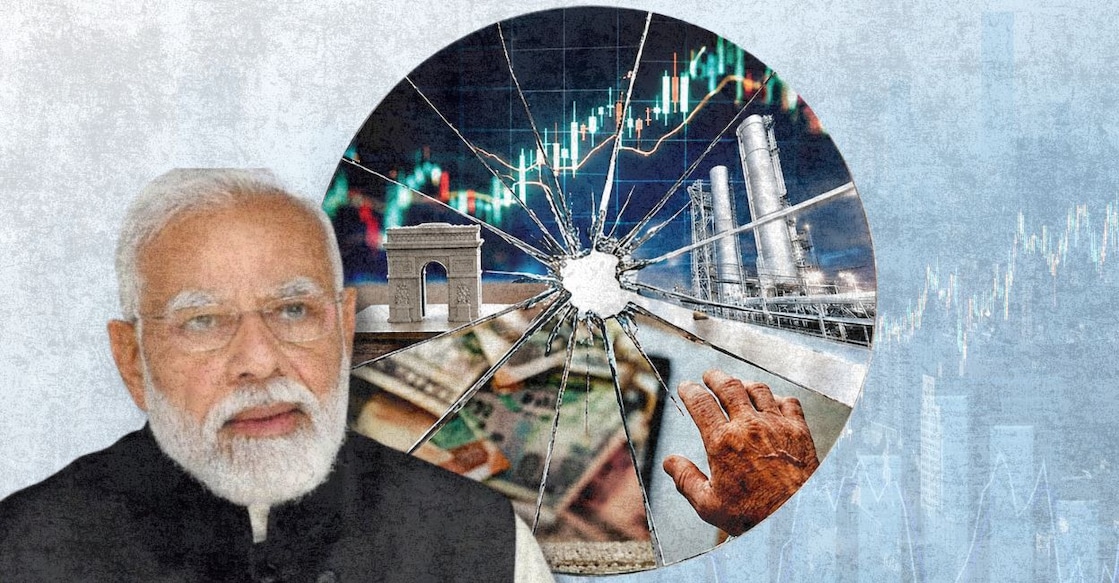
There are some stubbornly enduring features of the Modi dispensation in the economic domain. It is not able to shed them even well into its third consecutive term: Ad hoc-ism in policy making, reluctance to learn from past mistakes, denial of lived economic reality of the common people, massaging of data to present a rosy picture of the economy, believing its own propaganda (though it is initially meant for setting PR narratives), wrongly interpreting its electoral successes as an endorsement, if not an outcome, of its record of economic performance, are its defining features.
From what is publicly reported on the discussions in the recently held Prime Minister’s Economic Advisory Council (PMEAC) meeting, it is clear that the government remains resolute in sticking to the denial mode. The meet took little note of economic slowdown, the tapering off of capital inflows into the country, flight of capital from India, decline in the domestic private investment despite reduction in corporate taxes, the much-hyped Production Linked Incentive (PLI) scheme and ‘crowding in’ of public investment. The unorganised sector is largely in decline or in stagnation was no concern to it.
Instead, it seems to have spent time on ideating on how to ‘add more momentum to the reforms journey’, ensure ‘ease of living’ and ‘ease of doing business’.
Much of the credit offtake in the country is for consumption is not a concern for the Council. Rising cost of living especially for the poor and the marginalised, unacceptably high youth unemployment and unemployment among the educated did not matter to it. In fact, one of the high-profile members of the Council is on record saying that it was not the lack of opportunities but lack of aspiration that kept our young people out of work. Both the organised and unorganised sectors are unable to absorb the labour force. Rising economic inequality matters little to the dispensation. Its policy wonks even exhort us ‘not to lose sleep over inequality’.
The dispensation lacks appetite for an honest review of its past initiatives and for course correction. That demonetisation has done little to serve any objective, assuming it had even one, does not matter to it. That ghastly experience offered no lessons to it. Even the after-thought sort of objective of reducing cash transactions in the economy remains unserved nearly eight years after the measure. One glance at the disaggregated data of UPI transactions is enough to tell us that. The dispensation is unwilling to take note of the issues raised by even its friendly economists. They too are, for the first time, seeing red flags in the economy that has been anyway lumbering along for a long while.
It would be a mistake to think that the last twelve years have been bad for the country’s economic performance alone. That damage itself is difficult to undo. But what accompanied that damage is more serious: the institutional compromise that occurred and continues even today. The foremost is the compromise of our economic data infrastructure. Our national accounts estimates have become questionable. They are contestable not merely from the methodological and base-year points of view. Their integrity in collection, lazy proxying, reporting, analysing and computing has come under a cloud.
Our statistical architecture is now undependable. The Planning Commission was perhaps oversized and might not have been the most efficient institution. But at least it did not give the government of the day inaccurate data tailored to suit its political needs. Its replacement, the NITI Aayog, is yet to do anything worthwhile in the last twelve years other than that.
The Reserve Bank of India has been bleeding billions of dollars to protect the rupee’s value against the US dollar. However, its intervention could only prevent a sudden, steep fall, not arrest the currency’s slide. The government does not seem to have come to grips with the problems plaguing the rupee and figure out why it is the worst-performing Asian currency. It is in denial. It wants to look for reasons only in the global headwinds.
The present dispensation is genetically unfitted to getting the economy right. Its sole preoccupation is to recast the polity in a majoritarian mould. It has no economic project for the country.
(Parakala Prabhakar is a political economist and author of The Crooked Timber of New India.)
