

The Paradox of Modern Marketing: We know more about consumers than ever, yet understand them less than ever
Mail This Article


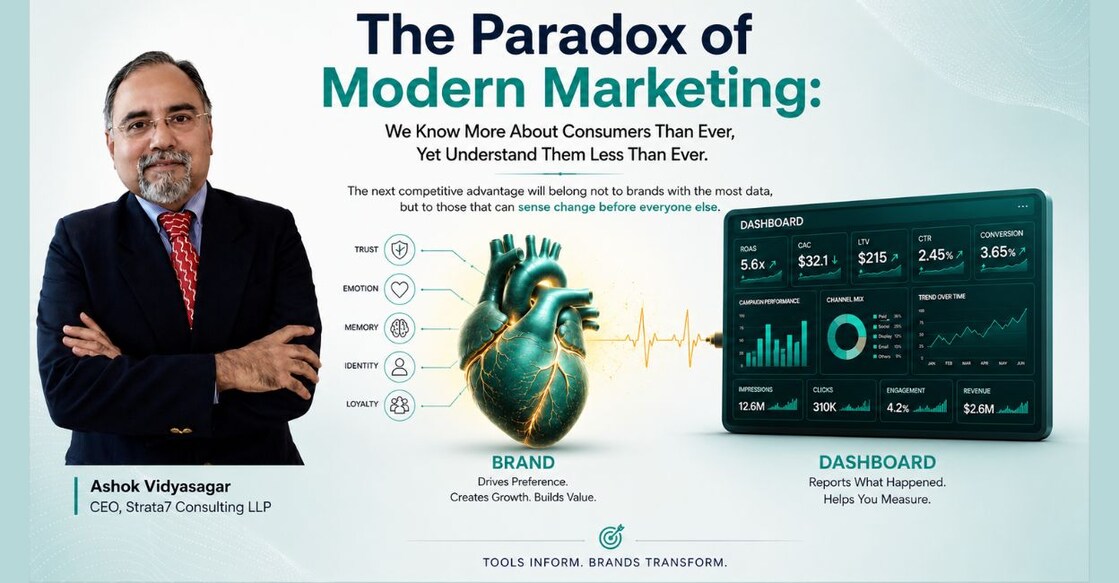
Never have marketers had this much information at their fingertips. Every click, swipe, scroll, purchase, abandonment, review, and search query can be captured. Every campaign is measured in real time. Every digital touchpoint feeds dashboards populated with thousands of metrics. On paper, this should have made marketing almost perfectly predictable. Instead, the opposite has happened. Brands are surprised by sudden shifts in consumer preferences. Entire categories are disrupted by newcomers. Viral products emerge from obscurity, while heavily researched launches fail to gain traction. Consumers who looked loyal yesterday defect overnight. The paradox is striking: marketing has become richer in data but poorer in understanding. The problem is not that companies lack information. It is that they often mistake observation for comprehension and measurement for foresight.
Kodak had data. It didn’t have direction.
One of the most famous business failures illustrates this distinction. Kodak possessed extraordinary knowledge about photography. Ironically, it was also home to one of the earliest digital camera prototypes. The company understood film sales, distribution, manufacturing, and consumer demand better than almost anyone. Yet it underestimated a deeper behavioral shift. Consumers were not attached to film. They were attached to preserving memories. Once technology offered a more convenient way to achieve that outcome, the underlying need stayed the same while the preferred solution changed completely. Kodak did not suffer from insufficient data. It suffered from misreading what consumers actually valued. The lesson extends well beyond photography. Markets rarely collapse because companies ignore spreadsheets. They collapse because companies misunderstand changing human behaviour.
Netflix was never in the streaming business
Netflix’s greatest competitive advantage was not bandwidth or content licensing. It was its obsession with understanding evolving consumer behaviour. Long before streaming became dominant, Netflix recognised that convenience would eventually outweigh ownership. Viewers wanted instant access rather than physical media, personalisation rather than schedules, and recommendations rather than endless browsing. Its recommendation engine became more than a technical feature—it became a behavioural sensing mechanism. Every pause, rewind, completion, or abandonment generated signals about taste and intent. Netflix did not simply collect viewing data. It continuously refined its understanding of why people watched what they watched. Many competitors had access to content. Far fewer developed an equivalent capability to interpret behaviour at scale.
The quick commerce revolution was never about speed alone
When quick-commerce platforms emerged in India, many observers believed consumers would use them only for emergencies. The evidence suggested otherwise. People increasingly began ordering milk, snacks, batteries, cosmetics, beverages, pet food, and household essentials in small, frequent baskets. The shift was psychological as much as logistical. Consumers were outsourcing planning itself. The insight was profound: convenience was no longer competing with supermarkets—it was competing with memory. Brands that interpreted quick commerce merely as another distribution channel missed the larger transformation. Those that recognised changing purchasing habits adapted packaging, promotions, assortment, and communication strategies accordingly. Again, the winners were not those with more data. They were those with better interpretation.
The Blinkit–Zepto revolution: A logistics story or a consumer psychology story?
When quick commerce first emerged in India, many industry observers viewed it as an operational innovation. The assumption was simple: consumers would pay for speed only in emergencies. The data initially seemed to support that hypothesis. But something more profound was happening beneath the surface. Consumers were not merely buying products faster—they were changing how they thought about buying altogether. Instead of planning weekly grocery trips, they became comfortable purchasing in small quantities, multiple times a week. Stocking up gave way to replenishing on demand. Shopping lists gave way to spontaneous decisions. In effect, quick commerce began competing not with supermarkets but with consumer memory. People no longer needed to remember to buy toothpaste, bread, or detergent days in advance because they trusted that these items could arrive within minutes. This subtle behavioural shift has significant implications for marketers.
Packaging strategies change when basket sizes shrink. Promotion strategies change when purchases become more frequent. Brand visibility changes when consumers search instead of browsing aisles. Impulse buying becomes algorithmically influenced rather than shelf-influenced. The companies that recognised this early redesigned assortments, media investments, and product portfolios for a world of instant fulfilment. Those who viewed quick commerce merely as another retail channel risked missing one of the most important changes in Indian consumer behaviour in decades. The lesson is universal: transformational opportunities often begin as weak behavioural signals before they become obvious business trends. By the time sales dashboards confirm the shift, market leaders may already have repositioned themselves. The real competitive advantage lies not in measuring demand after it appears, but in sensing the psychological changes that create demand in the first place.
Why traditional dashboards are becoming rear-view mirrors
The average enterprise dashboard is incredibly sophisticated. It can report customer acquisition cost, conversion rates, return on ad spend, engagement, impressions, market share, sentiment scores, and retention metrics. But almost every one of these numbers has something in common. They describe events that have already happened. Imagine trying to drive on a highway while looking exclusively through the rear-view mirror. You would know precisely where you had been but very little about the bend ahead. Many marketing organisations allocate billions in capital using exactly this approach. Sales reports explain yesterday. Consumers make decisions tomorrow. The competitive gap lies in between.
Consumers do not follow funnels anymore
The classic purchase funnel once offered reassuring simplicity: awareness, consideration, purchase, loyalty. Today’s consumer journey is radically different. A shopper might first encounter a product on Instagram, ignore it, later discover reviews on YouTube, ask an AI assistant for alternatives, compare prices on an e-commerce platform, read comments on Reddit, discuss options with friends on WhatsApp, and finally make a purchase through quick commerce or a physical retailer. The purchase is merely the last visible act in an invisible sequence of influences. Companies often measure the transaction while overlooking the journey that created it. That distinction is becoming strategically dangerous.
Apple rarely asks what customers want
There is a famous observation frequently attributed to Steve Jobs: customers often do not know what they want until they see it. Whether or not one accepts the wording, Apple’s history demonstrates the principle. The iPhone was not built because millions of consumers demanded a touchscreen smartphone with an app ecosystem. The market had not articulated that request. Apple succeeded by identifying latent frustrations with existing devices and imagining a better behavioural experience. The company looked beyond explicit customer feedback toward deeper patterns of human interaction. Great innovation often emerges not from listening harder but from understanding better.
AI is changing the economics of insight
Artificial intelligence has dramatically lowered the cost of processing information. It can summarise millions of reviews, cluster customer complaints, detect emerging themes, forecast demand, and identify anomalies in seconds. Yet AI creates another paradox. If every organisation has access to similar foundation models, similar cloud infrastructure, and similar datasets, then AI itself cannot be the enduring differentiator. The differentiator becomes the questions organisations ask. Do they use AI to automate yesterday’s reporting? Or do they use it to identify tomorrow’s opportunities? The companies that treat AI as an intelligence amplifier rather than a reporting engine will build a structural advantage that competitors may struggle to replicate.
Starbucks didn’t just sell coffee. It sold a ritual
For years, Starbucks competed successfully not because it served the cheapest coffee but because it understood the emotional role coffee played in consumers’ daily lives. The purchase represented routine, familiarity, comfort, identity, and a momentary pause between obligations. Competitors focusing solely on beverage attributes missed the broader behavioural context. This illustrates a recurring truth in marketing: consumers rarely purchase products in isolation. They purchase outcomes, identities, rituals, and experiences. Organisations that optimise only product attributes often fail to recognise the underlying human motivations driving demand.
The next generation of marketing needs sensors, not reports
Engineering solved uncertainty by deploying sensors. Aircraft continuously monitor pressure, temperature, altitude, vibration, and dozens of invisible variables. Modern manufacturing plants detect anomalies before machines fail. Autonomous vehicles interpret thousands of environmental signals every second. Marketing still relies disproportionately on lagging indicators. Imagine if organisations could continuously detect shifts in consumer confidence, emerging intent, advocacy patterns, search behaviour, pricing sensitivity, cultural momentum, or competitive substitution before they became visible in quarterly sales reports. The future belongs to companies that build such sensing capabilities. The race is no longer about measuring transactions more accurately. It is about detecting change earlier.
The future CMO will be a Chief Intelligence Officer
Marketing’s evolution has been remarkable. It began as communication. It evolved into brand management. Then into performance marketing. Now it is becoming enterprise intelligence. Tomorrow’s CMOs will increasingly advise CEOs and CFOs not merely on campaigns but on where markets are heading, how consumer psychology is changing, which weak signals deserve investment, and where capital should be allocated before consensus emerges. In that world, insight becomes a strategic asset rather than a research deliverable.
The ultimate competitive advantage
Electricity became commoditised. Computing became commoditised. Cloud infrastructure became commoditised. Artificial intelligence itself will likely become commoditised. What will remain scarce is the ability to transform fragmented behavioural signals into timely strategic judgment. The companies that dominate the next decade will not necessarily possess the biggest databases or the most sophisticated dashboards. They will possess something far more valuable: systems that convert observation into understanding and understanding into foresight. Perhaps that is the greatest irony of our profession. Just as technology has made consumers more measurable than at any point in history, it has also made genuine understanding more elusive—and more valuable—than ever before. The next era of marketing will not be won by brands that know the most. It will be won by brands that understand first. The next decade of marketing will not belong to the companies with the biggest data lakes. It will belong to the companies that can hear the faintest whispers of consumer change before everyone else hears the noise.
(The writer is the Founder & CEO of Strata7 Consulting LLP, a consulting firm which predicts marketing capital allocation for enterprise brands before investments are made)
