

India’s super-rich boom opens new business opportunities; investor Saurabh Mukherjea points to premium consumption, manufacturing
Mail This Article


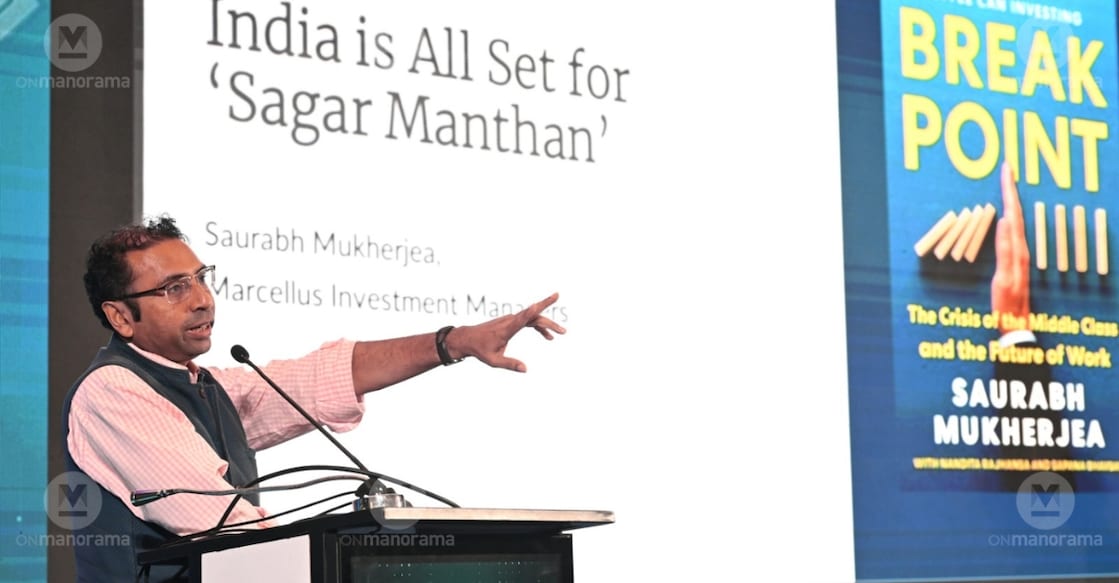
Kochi: India’s rapidly expanding class of wealthy consumers is creating lucrative opportunities for businesses in luxury goods, healthcare, education and other premium services, even as Artificial Intelligence threatens traditional middle-class jobs, investor, author and entrepreneur Saurabh Mukherjea has said.
Delivering the keynote address at the Malayala Manorama Sampadyam Kerala Business Summit 2026 in Kochi, the founder and chief investment officer of Marcellus Investment Managers identified three major opportunities for entrepreneurs: catering to the super-rich, filling gaps in essential services as the government retreats from their provision, and tapping the global shift towards manufacturing exports.
The number of income-tax filers reporting annual incomes of at least ₹1 crore rose from around 40,000 in 2013 to nearly five lakh in 2026, a twelvefold increase, according to figures cited by Mukherjea. The number of Indians earning at least ₹100 crore annually had increased fivefold in five years, he added.
Luxury brands, including Ferrari, Hermes and Louis Vuitton, were seeing strong growth in India, he said, pointing to the spending power of affluent consumers seeking high-quality products and services.
“More expensive the product is in India, the more it will sell,” Mukherjea said, arguing that businesses offering premium products and reliable services were well placed to benefit from the country’s changing consumption patterns.
He estimated that India had around one million super-rich families for whom price was less of a concern than quality and reliability. Entrepreneurs should focus on meeting their needs, he said.
The growing affluence of one section of society, however, contrasts with the mounting pressures on the middle class, Mukherjea said.
AI was accelerating the automation of entry-level office work, while companies were cutting recruitment of graduates. Citing data from Naukri, he said white-collar employment had grown at 11% annually in the decade to 2020 but had stagnated over the past three years.
He also argued that salaries were failing to keep pace with living costs. According to his analysis, typical middle-class earnings were growing at around 1% annually, against an estimated cost-of-living increase of 7% in Kerala and 7-9% in other parts of India.
“Middle class today is poorer by a third to 40%,” he said, referring to the decline in purchasing power over the past decade.
India produces around 80 lakh graduates annually, but the economy is not generating enough suitable jobs for them, he said. He also flagged household debt, claiming that debt-to-income ratios stood at 32% excluding housing loans, while a typical middle-class household spent 40% of its disposable income on equated monthly instalments.
Private services, exports offer scope
Mukherjea said the government’s declining role in providing essential services was creating opportunities for private businesses in education, healthcare and security. He pointed to rising private-school enrolment and private-sector participation in healthcare as signs of the shift.
He also identified manufacturing exports as a potential growth engine as AI reshapes India’s IT services industry.
A weaker rupee, improved trade access and global supply-chain diversification could help Indian manufacturers compete in textiles, auto components, engineering goods and pharmaceuticals, he said. Cities such as Coimbatore, Hosur, Surat, Ludhiana and the National Capital Region could benefit from the transition.
Globally, unprecedented capital expenditure in aerospace and defence, power infrastructure and AI was creating opportunities across industrial supply chains, Mukherjea said. He cited Airbus’s 16-year order book and Siemens Energy’s 12-year order book as examples of sustained global demand.
“The way to get ahead in India clearly is to be a business person,” he said, urging entrepreneurs to seize the opportunities emerging from the country’s economic transformation.
