

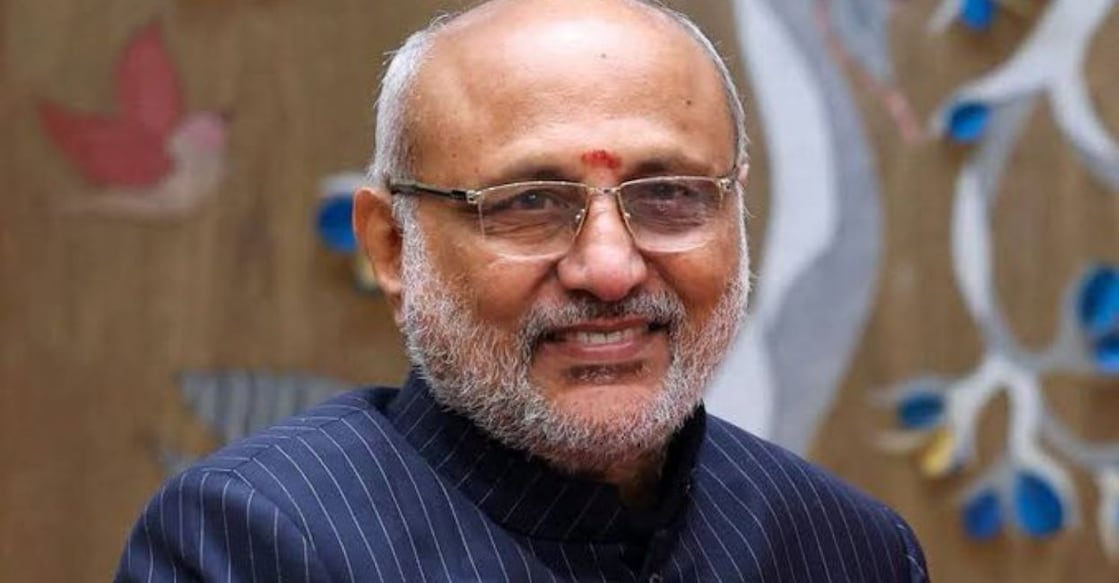
CP Radhakrishnan elected 15th Vice President of India
Mail This Article


New Delhi: NDA candidate Chandrapuram Ponnusamy Radhakrishnan, a veteran politician and former Governor of Maharashtra, was elected as the 15th Vice President of India on Tuesday. He secured the win with 452 votes, while Opposition nominee B Sudershan Reddy secured 300, reported PTI. At 67, the soft-spoken leader succeeds Jagdeep Dhankhar and will also serve as the ex-officio Chairperson of the Rajya Sabha. Radhakrishnan is the third leader from Tamil Nadu to hold the post.
A long-time member of the Rashtriya Swayamsevak Sangh (RSS) and the Bharatiya Janata Party (BJP), Radhakrishnan has held several key positions, including two terms as a Lok Sabha MP from Coimbatore and president of the Tamil Nadu BJP between 2003 and 2006. He has also served as Governor of Jharkhand, Telangana, Maharashtra and Puducherry.
Belonging to the Kongu Vellalar Gounder community, Radhakrishnan is the first OBC leader from South India to be elected Vice President. Prime Minister Narendra Modi lauded his legislative experience and governance record, highlighting his deep knowledge of parliamentary and constitutional matters.
Born on October 20, 1957, in Tiruppur, Tamil Nadu, Radhakrishnan has a Bachelor’s degree in Business Administration. An avid sportsman, he excelled in table tennis and long-distance running, and continues to follow cricket and volleyball. His political journey began as an RSS swayamsevak at age 16, later joining the Jan Sangh and using politics as a medium to serve the public.
Counting of votes for the vice-presidential election began at 6 pm on Tuesday, after more than 98 per cent of MPs cast their votes. The process was held in the new Parliament building under the supervision of Returning Officer P C Mody, Rajya Sabha Secretary General. The election was necessitated by the sudden resignation of the previous Vice President, Jagdeep Dhankhar, on July 21.
Prime Minister Narendra Modi was the first to cast his vote as polling began at 10 am in the new Parliament building. Lok Sabha Leader of Opposition Rahul Gandhi voted by noon. Polling concluded at 5 pm. MPs vote by secret ballot and are not bound by party whips. According to official sources, 96 per cent of the polling was recorded till 3 pm.
Modi, accompanied by Union Ministers Kiren Rijiju, Arjun Ram Meghwal, Jitendra Singh and L Murugan, cast his vote at the polling booth set up in Room No 101, Vasudha, in the Parliament building.
“Voted in the 2025 vice president election,” Modi posted on X before leaving for flood-hit Himachal Pradesh and Punjab.
Among the early voters were Union Ministers Rajnath Singh, Meghwal, and Pralhad Joshi, Rajya Sabha Deputy Chairperson Harivansh, former Prime Minister H D Deve Gowda, Congress leaders Sonia Gandhi, Jairam Ramesh, and Nasser Hussain, and SP leader Ram Gopal Yadav.
The 92-year-old Deve Gowda arrived in a wheelchair. Union Minister Nitin Gadkari and Congress president Mallikarjun Kharge were seen walking hand in hand to the booth.
Election procedure
The MPs were handed out ballot papers containing the names of the two contesting candidates and will have to mark their preference by writing the figure '1' opposite the name of the candidate of their choice.
"The figures may be marked in the international form of Indian numerals or in the Roman form or in the form used in any Indian language, but shall not be indicated in words," the rules of the vice presidential election state.
The electoral college for the vice presidential election comprises a total of 788 members - 245 from the Rajya Sabha and 543 from the Lok Sabha. The 12 nominated members of the Rajya Sabha are also eligible to vote in the election. With the BJP-led alliance claiming the support of 427 MPs in the 781-member electoral college, it enters the contest with a clear edge. The Opposition has 315 MPs. The majority mark is 391.
 Add as a preferred source on Google