

'Narcotics is a dirty business'. But what happened to Kerala's war on drugs
Mail This Article


On August 31, 2022, it looked like the Kerala Assembly had declared war against the growing use of psychotropic substances among the youth. Then, in response to an adjournment motion moved by Congress MLA P C Vishnunath, Chief Minister Pinarayi Vijayan laid down a series of measures to contain the drug menace, including ways to secure maximum punishment for the culprits.
Then, both the ruling side and the opposition seemed to echo what Mohanlal's character said in the movie 'Lucifer': "Narcotics is a dirty business."
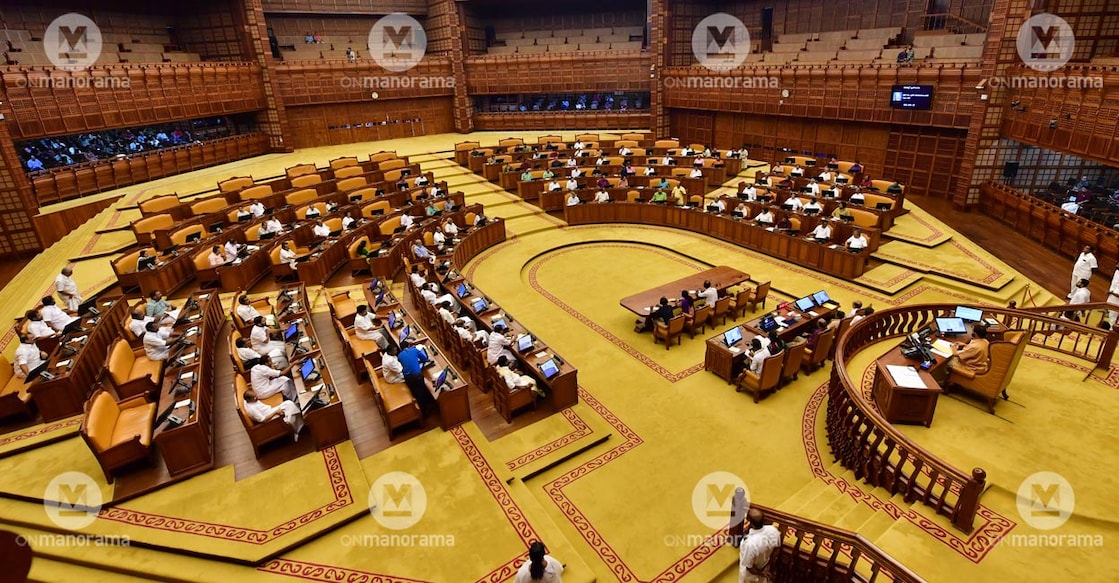
On Tuesday, February 11, nearly three years later, the very same MLA, P C Vishnunath, moved an adjournment motion on the very same issue. Excise minister M B Rajesh, to demonstrate the enormous importance the government has attached to the problem, agreed to temporarily halt the day's proceedings to discuss the issue. Members, cutting across political lines, spoke of the growing influence of new-age drugs on youth and the need to beef up enforcement.
Vishnunath gave examples of recent incidents where children murdered parents in the most gruesome manner. Even ruling side MLAs spoke of the need to modernise the Excise Department to take on these "anti-social elements".
The excise minister was not in doubt about the hold of drugs on the youth, but in the Assembly on February 11, he was concerned solely with establishing Kerala as the land where the drug menace was the least in the country. "If you ask me whether the menace has grown, it has. But that does not mean Kerala is the centre of India's drug trade," the minister said.
The excise minister cited the Magnitude of Substance Abuse in India Report, 2019, to prove Kerala as the state where substance abuse was the least. The minister then provided two numbers to suggest Kerala's strong anti-narcotics enforcement. The first was 24,517: the number of people arrested in Kerala in 2024 in narcotic-related cases, which also happens to be the highest in India; the number of arrests in Punjab, considered the country's drug capital, was only 9734.
The second was 98.9%: Kerala's conviction rate for narcotic cases; the national average was 78%. Rajesh said the significance of the large number of arrests and the high conviction rate would be revealed when it is also known that Kerala accounts for just Rs 60 crore of the Rs 16,000 crore worth of drugs seized in the country in 2023.
The use of school students as carriers by the drug mafia was an issue that most members flagged during the discussion.
Neither was the existence of such a phenomenon disputed, nor was the issue touched upon by the minister. Instead,d he reeled out a slew of anti-drug programmes the government had rolled out for school students, like 'Nervazhi', 'Nerkoottam' and 'Shraddha'. It was the effectiveness of these programmes that was questioned. But the minister seemed contented that such programmes existed.
In August 2022, Chief Minister Pinarayi Vijayan made significant anti-drug announcements in the Assembly. Curiously, the opposition did not bother to ask the minister whether these were implemented and, if so, how effective they were in preventing the use of drugs.
A major declaration was the need to change the way chargesheets were filed in drug cases. It was noticed that, while registering narcotic cases, the earlier crimes of the accused were not mentioned when a chargesheet was submitted before a court.
The CM had then said that this was necessary to secure maximum punishment for the accused under sections 31 and 31(A) of the Narcotic Drugs and Psychotropic Substances (NDPS) Act. Section 31(A) speaks of the death penalty for offences like the production, manufacture, export, import and even the possession beyond a certain quantity of drugs like heroin, cocaine, morphine, MDMA, LSD and hashish. It is not clear whether this has become a practice while dealing with drug cases. The excise minister did not say so.
Another 2022 resolve was that the Prevention of Illicit Traffic in Narcotic Drugs and Psychotropic Substances (PIT in NDPS) Act, 1988, would be invoked to keep habitual offenders in detention without trial for two years.
Under Section 3 of the Act, such a preventive detention order could be passed only by an officer not below the rank of a joint secretary.
In August 2022, the police and the excise were directed to furnish the necessary recommendations in this regard to the official concerned. It is not clear whether such recommendations were received. The opposition did not grill the minister on this.
Further, the CM said that the convicted person would be asked to compulsorily execute a bond, saying he would abstain from committing any offences under the NDPS Act. Whether this has been enforced, too, is not clear.
The CM also said that a data bank of all offenders, including first-timers, would be created for the state and updated in a timely fashion. He said the history sheets would be drawn up by police stations and excise range offices. He promised that these history sheeters would be under constant surveillance.
Whether this was implemented is also not known, as the minister did not mention this as one of the government's anti-drug initiatives. The opposition did not seem keen to know either.
 Add as a preferred source on Google