

Join Kerala's 'Aquaman' open varsity in Periyar for a free swimming 'PhD'
Mail This Article


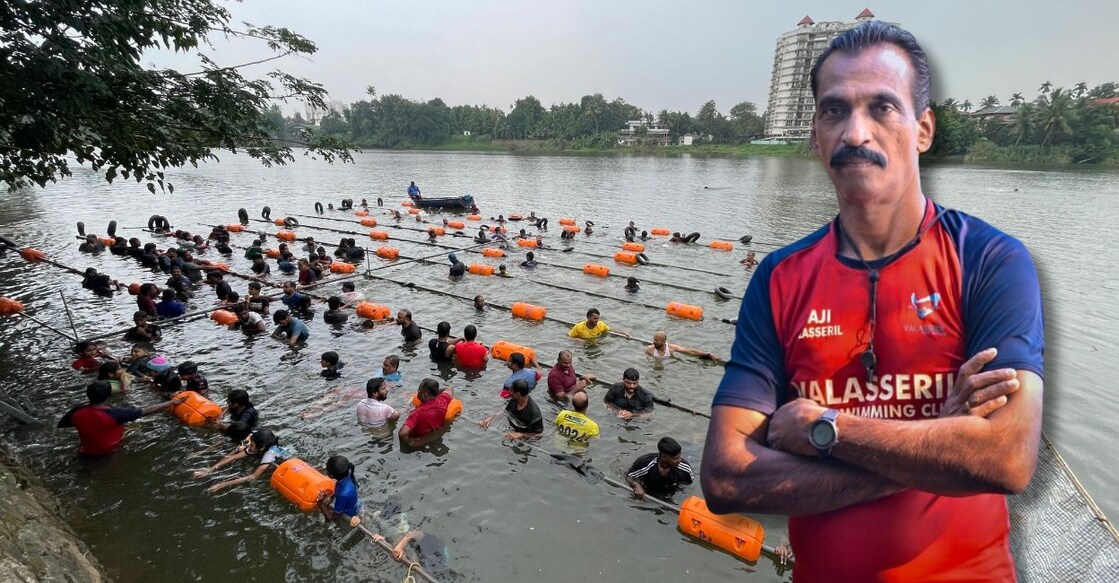
When the Periyar river glistens in the early morning rays, Manappuram Desom Kadavu breaks into a hubbub of activity. 61-year-old Saji Valasseril, watches over, as his students slowly wade into the water. A furniture shop owner in Aluva, Saji, has been giving free swimming classes in the Periyar river for the past 16 years. He has lost count of his students, but he presumes it could well be over 15,000.
What makes his system different is that each stage of training is given a name similar to school education levels. "Beginners start at the ‘Pre-KG’ stage by practising how to stay underwater, holding their breath for up to 60 seconds, though most can only manage 30 seconds initially. After about five days and a test, they move on to ‘LKG’, learning to float in a Superman-like position. Next comes ‘UKG’, where students use their legs to kick forward, followed by ‘Lower Primary’, where they add arm strokes to swim," Saji said.
Saji is driven by the simple belief that swimming is one of the most essential yet often overlooked life skills. He began his classes in 2009, deeply shaken by the Thekkady boat tragedy, in which 45 people died

As they advance, learners reach the ‘Upper Primary A’ and ‘Upper Primary B’ stages, where they practise side-breathing on alternate sides using a 1-2-3 count. At the ‘High School’ stage, they swim longer distances, covering up to a quarter of the river. The ‘HS Tube Test’ teaches them how to handle safety tubes and includes diving underwater to retrieve sand from the riverbed. In the ‘Plus One’ and ‘Plus Two’ stages, they build breathing capacity and practice swimming while holding a rescue tube with one hand to prepare for emergencies. At the ‘Degree’ stage, swimmers learn to tread water for an hour to simulate being stranded in the river, and in the ‘PG’ stage, they double that to two hours.
"Before attempting the final river crossing, every learner must complete the ‘PhD’ stage, swimming non-stop for one hour within a buoy-marked area. The final test, held at Mandapam Kadavu, is to cross the river, a total of 750 metres, reaching the midpoint and returning safely."
Saji learned to swim from his father when he was six. In 2007, he taught his children, Merin and Jerin, along with two other local children. When they successfully crossed the Periyar River, word spread quickly, and more people approached him to learn. Over the years, what began as a small effort grew into a structured programme that now trains around 1,000 learners each day in two batches starting as early as 4.30 am. Each session lasts about 45 minutes, using training frames designed by Saji to help students build confidence in the water.

Saji encourages a spirit of responsibility among his students. Those who finish training often take on roles as group leaders, supervising newcomers and ensuring safety. The classes are open to everyone. "Parents, too, have shared that the classes have unexpected benefits: children spend less time on their phones because they wake up early to attend, which naturally leads them to sleep earlier at night," he said.
For safety, boys must bring a local guardian, and women and children must be accompanied by parents. Facilities have been arranged with help from well-wishers, including toilets sponsored by a donor from Malayattoor and change rooms so people can go directly to school or work afterwards. Though the classes are completely free, a voluntary contribution of ₹100 per month is accepted to help cover costs. Based on a suggestion from a DySP, an ambulance and a local boatman’s support are arranged daily, with the Valasseril River Swimming Club covering the ₹300 fee for each.
Over the years, Saji’s dedication has touched many lives. Differently-abled children from Tripunithura also train here. "This year, 11 such students attended, and one, Aroosh, successfully crossed the Periyar," Saji said. Others, like Aseem from Kozhikode, even stayed at Saji’s home near the temple to train. Some students have practised swimming blindfolded or with their hands and legs tied, learning to handle emergencies calmly.
 Add as a preferred source on Google