

Alappuzha youths quit Gulf jobs, tour China & Dubai to perform Pookavadi dance
Mail This Article


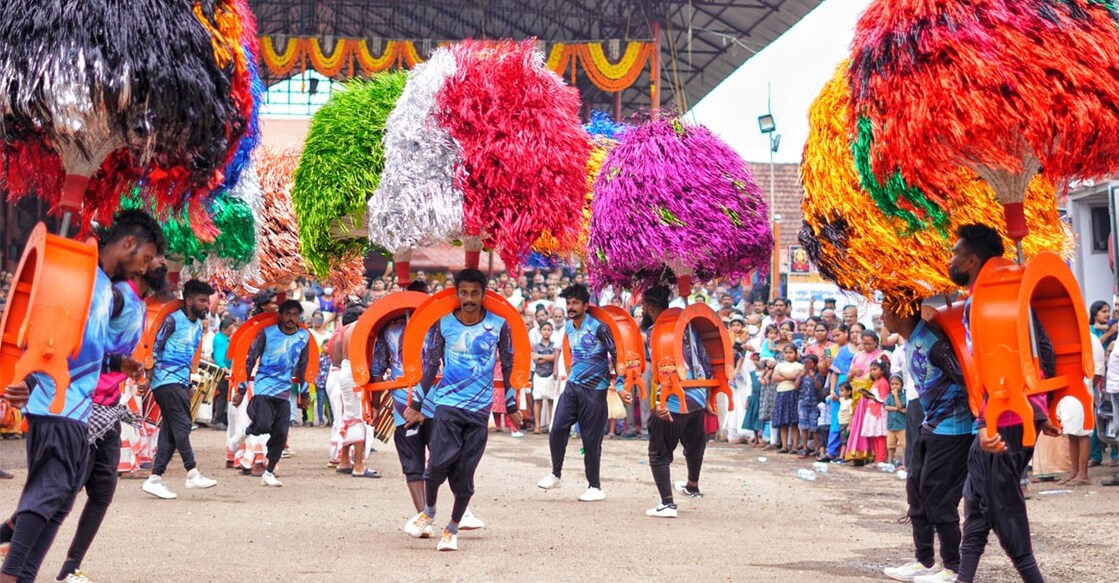
Chineese streets and destination weddings are the new venues for a group of youths in Alappuzha who stage Pookavadi, a colourful dance form where the performers swivel around to rhythmic beats, balancing decked up tall frames. With a dash of energy and innovation, they are taking the art form from temple processions to pompous gatherings.
Pookavadi typically involves carrying a layered, tower-shaped structure—rising as high as 8 feet and weighing around 15 kilograms—on the back and shoulders, supported by both hands. Sree Brahma Kalasamithi, near Chakkulathukavu Sree Bhagavathi Temple, sticks to the usual with colourful artificial flowers, coordinated costumes, synchronised rotating dance movements, and tops it with a playful innovation: filling the kavadi with colourful paper chits that scatter through the air during spins, creating a festive visual spectacle. Set to popular Malayalam film songs, their performances are an energetic blend of tradition and showmanship.
The group began performing in local temple festivals, slowly gaining traction through videos posted on social media. Their breakthrough came when a Kerala-based event planner invited them to perform at a North Indian destination wedding in Kochi during the off-season. The team’s spectacular performance while welcoming the bride and groom went viral, quickly catapulting them into the spotlight.
“That video changed everything,” says Sachin V S, one of the early members. “Until then, we never imagined Pookavadi could be part of weddings or events outside Kerala. But suddenly, calls started coming in from all over India.”
Today, the group has grown to around 50 members, with 25 actively involved in Pookavadi and others performing as deities or Malabar characters (Malabar Veshangal) in temple festivities. Members range from 18 to 30 years old, including college students and professionals who have left other careers for this full-time commitment. Two of the original members, Bharat and Ananthu, even returned from jobs in the UAE to rejoin the troupe.

“This gave us not just creative satisfaction, but also financial security,” says Vishnu. On average, each member earns around ₹50,000 per month, even during off-season months, mainly through wedding bookings in northern states.
They have performed in over 15 states. The team usually travels in a mini-van that accommodates both equipment and sleeping arrangements, with a bit of modification. For longer journeys or last-minute shows, they travel by train or flight. Transporting their massive kavadis by air was initially a challenge, but they overcame it by redesigning the structures into foldable, four-part units. “It took us a month of trials, but now we can pack them into small boxes that are flight-friendly,” explains Sachin.
Their biggest moment came when an Italian event company, International Show Parade, discovered them online and selected them to perform at the Chinese New Year celebrations in Macau, hosted by the local government. Sree Brahma Kalasamithi was the only Indian group among a range of international performers.
“We performed in a stadium, on the road, and at a community hall—all packed events. And we used only Malayalam songs, except for one Chinese song they requested. The crowd absolutely loved it," Sachin adds.
They have also taken their art to Dubai for a Tamil wedding and are now preparing for a European tour. A planned show in France was postponed due to visa issues, but the team remains hopeful about future global appearances. Their growing popularity has also brought them into the world of Malayalam cinema and television, with several appearances in music video shoots and variety shows.
Each kavadi costs about ₹30,000 and is durable enough for six months of performances—around 150 shows. They purchase the base frames from a manufacturer in Thrissur and handle all customisations and repairs in-house. Every year, the designs are refreshed to suit current trends or client preferences.
“For haldi events, we go with yellow themes,” says Sachin. “Some clients have their own colour schemes in mind, and we create accordingly.”
Despite the appeal and visibility, the physical demands of the performance are significant. Back, shoulder, and knee pain are common—especially during the busy season from December to May. “We don’t have strict diets or gym routines,” Sachin laughs. “This is more than enough exercise! But yes, once we’re in the middle of 20 shows a month, the body starts complaining.”
While wedding gigs in North India are financially more rewarding—with payments ranging between ₹7,000 to ₹8,000 per performer for one-hour events—programmes in Kerala usually pay less, around ₹2,000 per head for much longer shows. Still, the team values their performances at home.
 Add as a preferred source on Google