

Analysis | Read the fine print, Tharoor not gunning for Indira, but Modi in his PS article

Mail This Article


That Shashi Tharoor has criticised the 'Emergency' and Indira Gandhi is no news. In Tharoor's 'The Great Indian Novel', his 1989 Salman Rushdie-like satire on Indian democracy, he has named the chapter on Emergency as 'The Reign of Error'.
And Indira Gandhi's alter ego in the novel is named Priya Duryodhini, after Mahabharat's main villain. Draupadi Mokrasi is the illegitimate daughter of Dhritharashtra (stand in for Jawaharlal Nehru ) and Lady Drewpad (Edwina Mountbatten) in the novel. In fact, the lady is better known as D Mokrasi. This illegitimate child, Duryodhani's step sister, you guessed it, embodies Democracy.
The visual metaphor Tharoor uses for the suspension of civil liberties by Indira Gandhi in 1975 is the public disrobing of D Mokrasi. "In the land of dharma, justice went into exile while the queen ruled unchallenged," Tharoor writes in the Great Indian Novel.
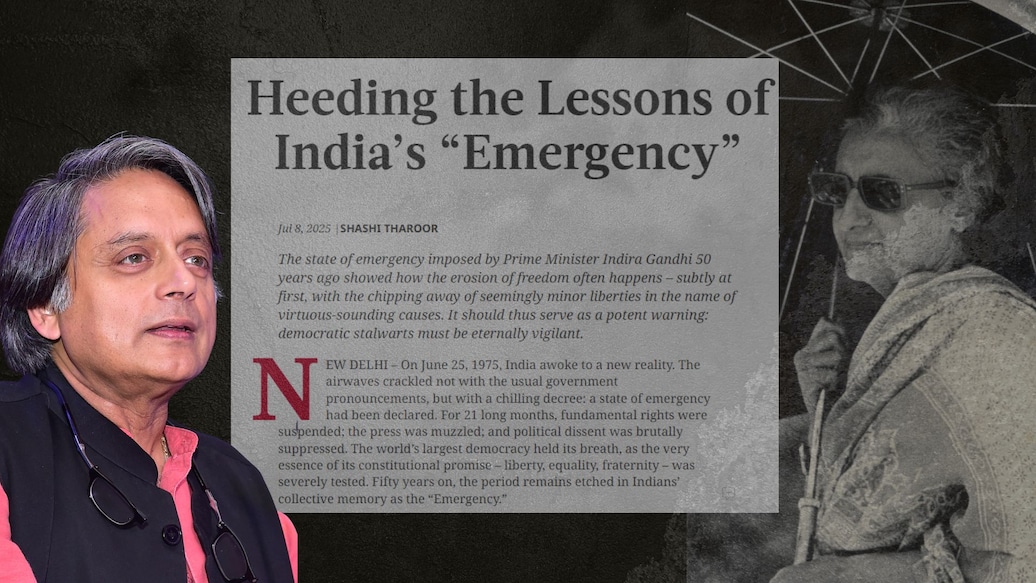
Compared to the stinging but fantastical prose of ‘The Great Indian Novel’, Tharoor's references to Indira Gandhi and the Emergency in his latest piece in Project Syndicate (PS), 'Heeding the Lessons of India's "Emergency", is a tame affair.
Tharoor does make some harsh observations, particularly about Sanjay Gandhi's forced sterilisation project. "In fact, the quest for "discipline" and "order" often translated into unspeakable cruelty, exemplified by the forced vasectomy campaigns led by Gandhi's son, Sanjay, and concentrated in poorer and rural areas, where coercion and violence were used to meet arbitrary targets," Tharoor writes.
However, a close reading of Tharoor's piece reveals that it was not intended as an inquisition of Indira Gandhi, which he has already done way back in 1989 in his post-modernist debut, but as a warning against the approaching footsteps of authoritarianism. By speaking against Indira, Tharoor was actually warning the country against Narendra Modi.
"It (Emergency) reminded us that a government can lose its moral compass and sense of accountability to the people it purports to serve. And it showed how the erosion of freedom often happens: subtly at first, with the chipping away of seemingly minor liberties in the name of virtuous-sounding causes, until "family planning" and "urban renewal" become forced sterilizations and arbitrary home demolitions," Tharoor writes.

In the Modi era, there are more "virtuous-sounding" causes: 'quick citizenship for suffering minorities from neighbouring Islamic countries', 'fight against black money' and 'modernisation of farming'. Is anyone under the illusion that a crafty writer like Tharoor was innocent of the instant connection to 'bulldozer justice' that readers would make when he speaks of "arbitrary home demolitions"?
During the Emergency, the press was muffled. It is not much different under Modi. In the 2025 World Press Freedom Index, India is ranked 151st (140 in 2013) out of 180 countries.
Listen to Tharoor. "Freedom of information and an independent press are of paramount importance. When the fourth estate is besieged, the public is deprived of the information it needs to hold political leaders accountable. That said, the cravenness of many media outlets in the face of intimidation remains inexcusable."
Like Indira Gandhi, Modi too had enjoyed brute majority. "An overweening executive, backed by a legislative majority, can pose a grave danger to democracy, especially when that executive is convinced of its own infallibility and impatient with the checks and balances that are essential to democratic systems".
If this was true for Indira, it can be said that Tharoor was merely rephrasing in sparkling prose what the Congress party repeatedly says about the way power is handled under Modi.
He then serves the warning. "The Emergency was possible precisely because power was centralized to an unprecedented degree, and dissent was equated with disloyalty," Tharoor writes. Though Tharoor has left it unsaid, it is an indisputable fact that after Indira, no ruler has centralised power the way Modi has.
Tharoor makes a feeble attempt to mask his Modi thrashing. "The India of today is not the India of 1975. We are a more confident, more prosperous, and, in many ways, a more robust democracy," he writes, sounding like the man who valorised India's 'Operation Sindoor' all over the world.
But his tendency to indulge in velvet-lined outspokenness cannot be held in check for long. "Yet the lessons of the Emergency remain alarmingly relevant. The temptation to centralize power, to silence critics, and to bypass constitutional safeguards can emerge in many forms, often cloaked in the rhetoric of national interest or stability," he writes.
No one, not even Indira's Congress, has used the terms "national interest" or "stability" like a sorcerer's wand to bring the country under its spell like Modi's BJP.
When Tharoor asks - "Are we sufficiently attuned to the subtle erosion of democratic values?" or "Could we recognize, let alone resist, the advent of strongman rule?" or "Are we doing enough to protect the institutions, from the press to the judiciary to civil society, that safeguard our freedoms?" - who is he telling the readers to rise up against? A Prime Minister who was assassinated on October 31, 1984, and a party that has been out of power for more than a decade?
Just like Draupadi Mokrasi could be confusing at first, Tharoor's latest article, if read again and again, will come across as more a cunning indictment of the Modi dispensation than an attack on Indira and the dark days of Emergency.
 Add as a preferred source on Google