

'We're not leaving Chooralmala': Diocese wants to shift St Sebastian Church out, parishioners split
Mail This Article


Chooralmala, Wayanad: A year after the deadly landslide tore through Chooralmala and neighbouring Mundakkai, killing nine parishioners of St Sebastian Church, the Catholic community here is divided between the safety promised by resettlement and the deep roots they’ve laid in these hills.
The Syro-Malabar Diocese of Mananthavady is constructing 50 houses in Vazhavatta, approximately 25 km away, comprising 37 for families from Chooralmala's parish and 13 for beneficiaries from other communities. The project, spearheaded by the diocese's Wayanad Social Service Society (WSSS), is intended to shift the entire parish out of what the Church considers a fragile, disaster-prone terrain. "Chooralmala is no longer safe. People will eventually have to be moved to a secure place," said Sebastian Palamparambil, vice-president of WSSS. While most of the Church's beneficiaries are not on the government list, Palamparambil said all were "deserving families", scarred by the natural disaster.
The landslide of July 30 last year still casts a long shadow on the small parish. Among the victims were Johnny Chittalapally (50), a tea estate worker; his sons Anugrah (14) and Abhinav (15); Sheeba (45), wife of Johnny’s brother Francis; their son Shisin (18); and three others from School Road -- parish trustee Joy Thekkilakattil, his wife Leelamma, and a young mother named Neethu Jojo.
Johnny's wife Regina was found four km downstream with severe head injuries. She underwent surgery and was hospitalised for two months. Though her house remains intact, it's now inaccessible. She isn’t on the government's beneficiary list because her home lies just outside the 50-metre buffer zone demarcated by the committee led by Earth scientist John Mathai. "So we're building her a house," said Palamparambil. Neethu's husband, Jojo, now a single father to a three-year-old boy, also isn't recognised by the state for a house. While Jojo's father Manuel is getting a house at Kalpetta under the government's scheme, Jojo will receive one through the Church.
The plan to relocate the entire parish to Vazhavatta near Karapuzha Dam -- where a larger church also named after St Sebastian already exists -- has caused friction among parishioners. Of the 37 families, six or seven live in the no-go zone. Another 20 live in what is considered the 'safe zone'. "But none of them are really safe when it rains," said Palamparambil.
Still, many say the decision to relocate was made without adequate consultation. "No such discussion happened in the parish," said Johnson Kappukuzhi (44), a trustee. "We asked for homes only for the affected, and a shelter home for the rest to use during the monsoon." Johnson, honoured as the Best Young Farmer by Meppadi panchayat last year, has agreed to accept one of the Church's houses but only to stay in during the rains. Others, like fellow trustee Sebastian Kaduvakuzhi, are more categorical. "I've built a beautiful house here. I’m not leaving."
Some have no choice but to go. "We’re moving because it's now hard to send children to school," said Catechism teacher Molly Shaji Kottanelloor, whose children are in Class 4 and UKG. With the local schools in Chooralmala and Mundakkai destroyed, children now travel 13 km to Meppadi every day, said Molly, whose house stands on Chooralmala’s Village Road -- the stretch where scores of bodies were recovered after the landslide.
Robin, Sebastian Kaduvakuzhi's son, said the village is deteriorating fast. "After people from Punchimattom and Mundakai left, wild animals have taken over. In my 40 years, I’ve never seen elephants near our house. And now they are here."
Robin, a jeep driver at 900 Kandi glass bridge, said he used to get four to five trips every day before the landslide. "We earned Rs 1,250 per trip. Now I get one trip in four to five days," he said, when asked if tourists are back. Yet, Robin and his father Sebastian Kaduvakuzhi find it hard to leave as they have 10.5 acres of farmland in Chooralmala, near the church.
A Church Raised by Sweat
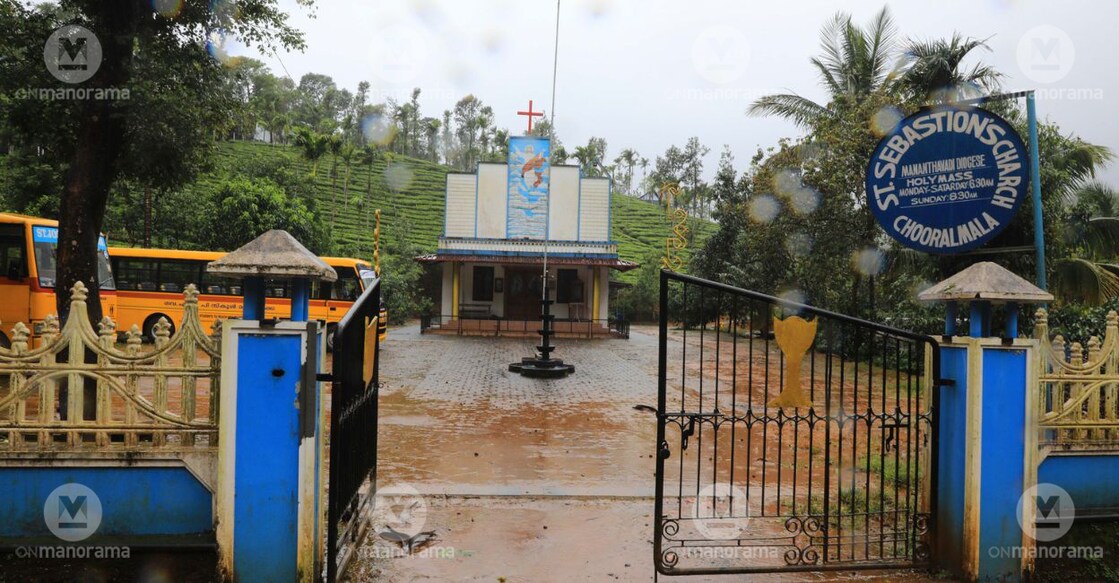
St Sebastian Church in Chooralmala was built in 1978 when Xavier Kaduvakuzhi and his brothers bought seven acres for ₹30,000. "There were just 40 families then," said Sebastian. The church has a tea plantation of four acres and areca plantations in the rest. "We struggled to build this church year by year. Only one year and a half ago did we get a resident vicar and daily Mass," he said. The parishioners also recently built an auditorium, which fetched additional income.
The landslide reversed that progress. Now, Mass is only on Sundays, and the vicar travels from Nedumbala parish, 17 km away. Letting go of the church is hard. Letting go of the farmland is harder, said Johnson Kappukuzhi, who grows coffee, cardamom, pepper, and vegetables on his four-acre plot.
The uncertainty isn't just emotional, it's economic too. Johnson, who recently closed a ₹4.25 lakh farm loan, was denied a fresh one. "The bank said no new loans can be sanctioned for Chooralmala residents," he said.
Unlike Mundakai and Puncharimattom, 375 families still live in Chooralmala. "If the government considers the place a safe zone, the people should be allowed to lead a normal life," he said.
"On one hand, the government withdrew the ₹9,000 monthly benefit and on the other hand, the banks deny us loans and the Forest Department denies us permission to fell trees," he said.
Palamparambil, the Church official overseeing the relocation, acknowledged the state's inconsistencies. He pointed to Lijo Chooralmala's case: a displaced father of two living with his wife, children, and divorced sister in a rented house. "The government stopped his livelihood support of ₹ 9,000, saying he landed himself a job in the tea estate. But it went ahead and stopped his rent support of ₹6,000 too. The family's rent is Rs 9,000," he said. The government's action does not add up.
Despite the government's harsh hand, families are refusing to leave. "We want support to live here. But we never said we’d leave," said Johnson.
 Add as a preferred source on Google