

Through the Western Ghats: Wayanad twin tunnel project set to take off after 3 decades
Mail This Article


Kalpetta: Drilling a twin tunnel through the Western Ghats at a depth of 800 feet to connect two villages at the foothills sounded like a wild dream three decades ago. But today, it is on the verge of becoming a reality.
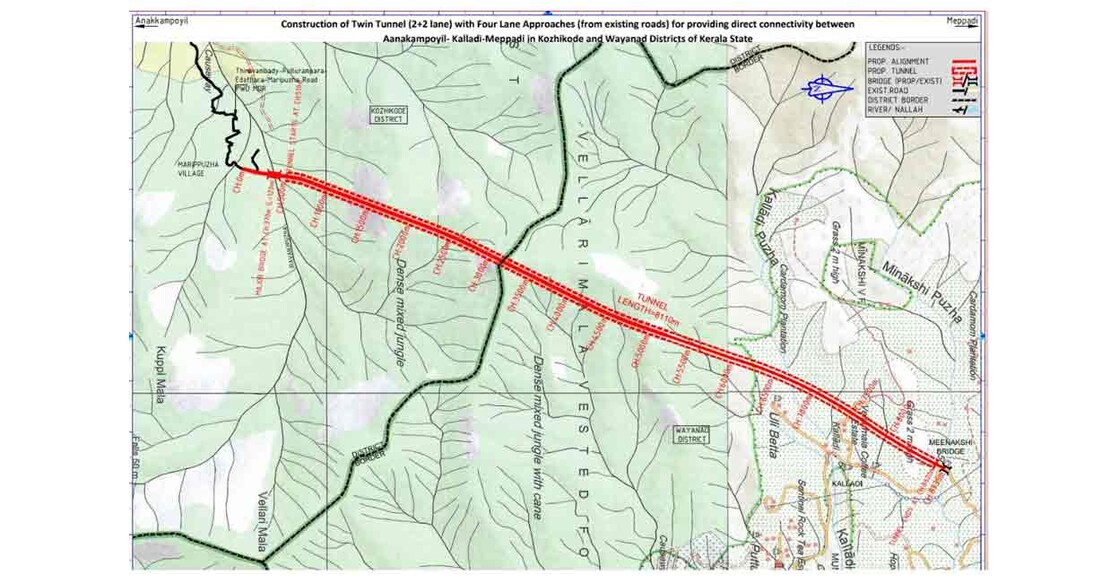
The Anakkampoyil–Kalladi twin tunnel four-lane road project, linking Thiruvambadi panchayat in Kozhikode district with Meppadi panchayat in Wayanad district, is expected to be completed in a few years.
When discussions on the Kozhikode–Wayanad tunnel road began in the late 1990s, many dismissed it as impractical or anti-environmental. At the time, few believed such a mega project through one of the most fragile stretches of the Ghats would ever materialise.
Thirty years later, the project is finally taking shape. Kerala Chief Minister Pinarayi Vijayan will inaugurate its construction at St Mary’s School Ground, Anakkampoyil, Kozhikode, on Sunday.
Estimated to cost ₹2,134.5 crore, the project spans 8.73 km—5.58 km in Wayanad and 3.15 km in Kozhikode. Of this, 8.1 km will be a twin-tube tunnel with four-lane traffic. Hyderabad-based Dilip Buildcon Pvt Ltd won the construction bid, while approach roads will be built by Royal Infrastructure Company. Konkan Railway Corporation Ltd (KRCL) is the implementing agency and KITCO Ltd is the project consultant. Once completed, the distance between Anakkampoyil and Meppadi will be reduced to 22 km, down from the current 42 km. A tripartite agreement was signed between KRCL, the Kerala PWD, and the Kerala Infrastructure Investment Fund Board (KIIFB) for execution.
A dream road linking 2 districts
The idea of the Anakkampoyil–Kalladi road through forest terrain dates back to the 1990s. The late CPM MLA Mathayi Chacko first pushed the proposal, but he passed away in 2006. His successor, CPM MLA George M Thomas, revived the plan by campaigning for a tunnel road instead of a forest road, highlighting its potential for the development of his Thiruvambadi constituency.
The UDF government initially floated the project, with then Finance Minister KM Mani allocating ₹2 crore.
George M Thomas recalls the turning point as a meeting with “Metro Man” E Sreedharan, who had studied the region’s topography during the Nilambur–Nanjangud rail survey. “Once E Sreedharan promised full support, the mission was half won,” said Thomas. Another milestone came when Thomas, accompanied by Thamarassery Bishop Remigius Inchananiyil, met Chief Minister Pinarayi Vijayan during his first tenure. With PWD Minister G Sudhakaran and Finance Minister Thomas Isaac backing the project, procedural hurdles were cleared under the CM’s direct monitoring.
In Pinarayi’s second tenure, the tunnel was listed among the 100 priority projects of the state government.
Modern engineering features
The twin tunnel will be equipped with state-of-the-art systems, including ventilation, firefighting mechanisms, tunnel radio, telephone lines, escape-route lighting, traffic signals, CCTV, and an emergency call system.
Ecological concerns
Environmental worries remain, especially after the devastating Mundakkai–Chooralmala landslide last year.
The Wayanad Prakrithi Samrakshana Samithy (WPSS) has approached the High Court with a PIL, arguing that the tunnel passes through ecologically sensitive Western Ghats zones marked as “red zones” by both the Gadgil and Kasturirangan committees.
WPSS president N Badusha told Onmanorama that the tunnel ends at Kalladi, the very area that witnessed major landslides—at Puthumala in 2019 and Mundakkai–Chooralmala in 2024.
“Blasting and tunnelling can have unknown seismic impacts on the geological layers. Nobody can guarantee safety,” he said. “This project is suicidal at a time when nature’s fury is already threatening our survival.”
Boost to tourism
Beyond easing traffic on the congested Thamarassery Ghat road, the project is also expected to give a major boost to Wayanad’s tourism sector.
According to Sunil Kumar MJ, president of the Wayanad Tourism Organization, the tunnel will open new opportunities. “A major benefit will be an alternative to the ghat road, which is already choked with heavy traffic,” he said.
Both Anakkampoyil, the starting point, and Kalladi near Meppadi, where the tunnel ends, are scenic spots already popular among tourists. “There is concern about delays, which is common in Kerala,” he added, but expressed confidence in KRCL’s track record, citing the enduring stability of tunnels along the Konkan rail route.
 Add as a preferred source on Google