

Rare white squirrel spotted by TVM birder on Kerala-TN border

Mail This Article


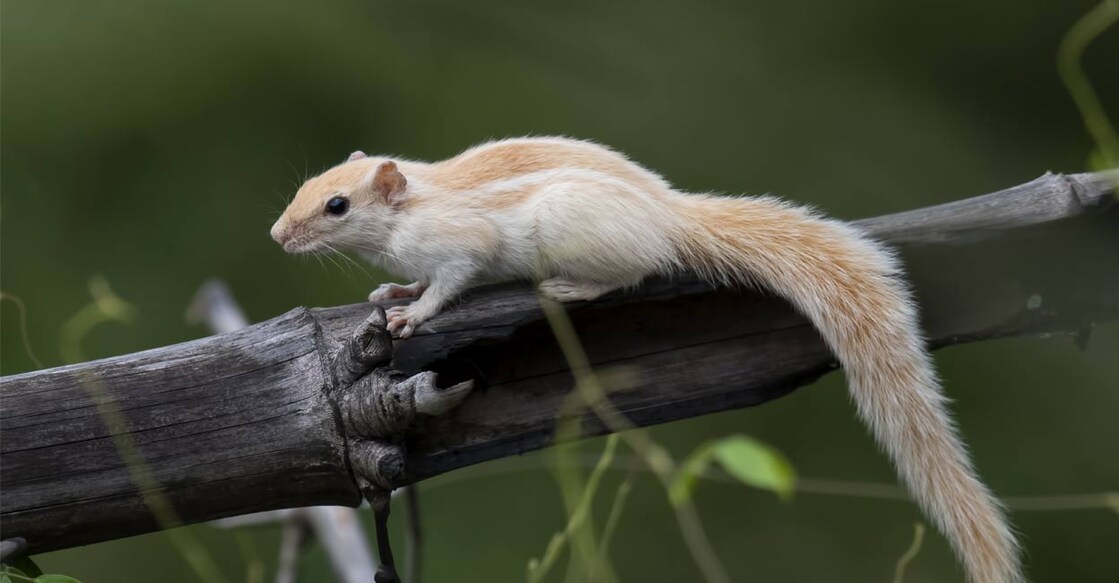
In a rare occurrence, a white squirrel was recently spotted at Netta on the border of Kerala and Tamil Nadu. The squirrel appears white because of a condition called leucism, a phenomenon characterised by a partial loss of pigmentation in an animal. This leads to pale, white or patchy pigmentation of its features. However, unlike albinism, variations are not present in the colour of its eyes, according to an article on Leucism in the three-striped palm squirrel by Arockianathan Samson.
The squirrel was sighted by Sumesh Vellarada, who is employed as a teacher at the Mudavanmugal government school. He is also a bird photographer. It was during his visit as part of a bird-watching that he saw the squirrel. However, the photographs captured were not clear enough to be conclusive to experts. So he returned to the spot on the following days, and through continuous observation, he finally photographed the creature.
Sumesh, a member of the Shola Nature Society, submitted the photographs, which were later confirmed to be a specimen of a partially leucistic squirrel by Dr Sandeep Das, a known herpetologist. Sumesh says that leucism significantly hinders the survival of the creature as its distinct colour and features impact its ability to camouflage and escape predators. “They are not usually found on tree branches or open spaces. They often hide under rocks to avoid predators,” adds Sumesh.
The article by Samson also notes that due to this susceptibility to predators, leucism is rare in smaller mammals, as they have lower survival rates. These conditions make spotting leucistic animals difficult and rare, limiting sightings in the country to a handful. Sumesh says that the creature makes its rare appearances when it's out in search of food, which may have led to the encounter.
Leucism is recognised to be an isolated occurrence, but it is linked to environmental factors and pollution, which are on the rise. In an article titled “A Record on leucism in three-striped palm squirrels” published in 2021, the authors Arockianathan Samson and J Leona Princy note that animal populations living close to human settlements are often isolated, and the resulting inbreeding may lead to higher occurrences of leucism.
The connection between leucism and climate change cannot be ruled out either, as the article points out how environmental alterations, habitat fragmentation, low-quality diet and follicular damage are linked to its occurrence, and these are likely to be impacted by climate change.
In 2021, Anoop Palode, another Thiruvananthapuram-based bird watcher, had recorded a sighting of a white coloured Indian Spot-Billed duck near the wetlands in Attingal.
 Add as a preferred source on Google