

Ashraf's tale of scuba diving to break barriers
Mail This Article


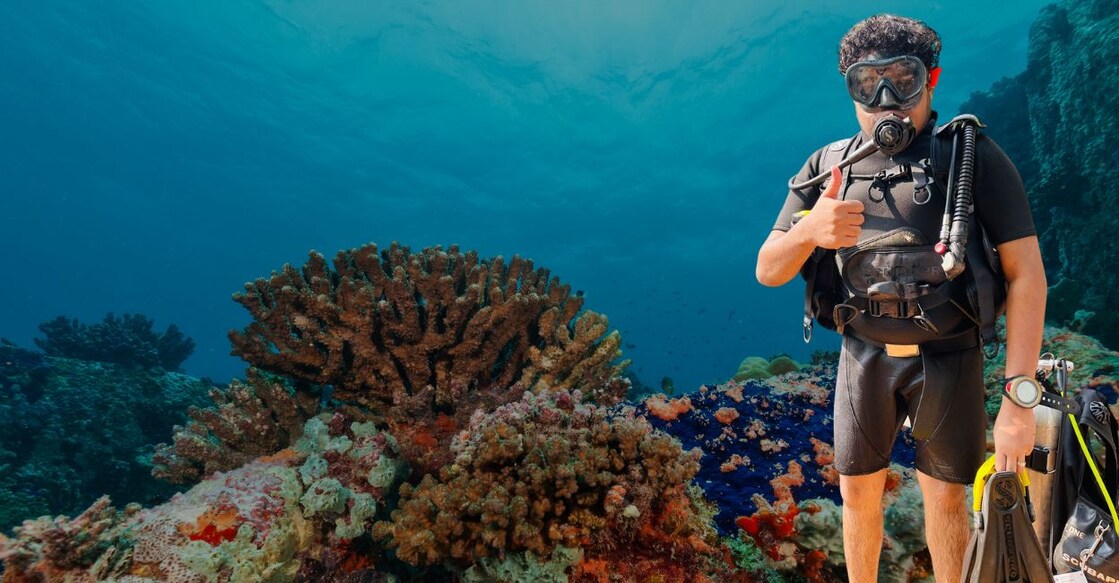
Between ledgers and dusty files in his father’s office, 24-year-old Mohammed Ashraf Aboobacker dreamt of another world. He dreamt of slipping into the warm waters of Kerala, where judgment dissolved. Born with a disability, Ashraf had been measured by what others thought he could not do. And, this was long before they asked what he wanted to achieve. His answer was clear: he wanted to pursue scuba diving.
In January, Ashraf moved to Kochi from Dubai and enrolled at the Interdive Adventure Sports Centre. Under the mentorship of Maxi Joe Jaison, he refused the specially tailored programme offered to students with disabilities and signed up for the general one. Within months, he had become a certified dive master. He eventually went on to help train the Kerala Police in rescue diving. The hardest stage, he recalls, was learning to balance swimming with giving breath to the rescued diver. “That was where I struggled. But with practice, I mastered it,” he says.

Jaison remembers not the difficulty but the determination. “Ashraf had an admirable willpower. Even when he faced challenges, he kept at it until he got it right,” he says.
That resilience was hard won. At school events, Ashraf was often pushed to the margins. He was placed at the back of the line because of his disability. His eldest sister, Sana, remembers his disappointment. But Ashraf learned to mute the noise around him and picked up martial arts and other pursuits as he grew older.
Behind him stood a family unwilling to let fear dictate his future. His father, Chembirikka Ashraf Aboobacker, and mother, Najma, insisted their children chase their passions. The result is visible in Ashraf’s youngest sister, 14-year-old Ayshath Nuzha, who shares his disability but not society’s hesitation. Inspired by him, she took up judo and, after initial doubts, clinched second place in a district championship. “My parents told me that if I wanted to learn, I should just do it,” she says.

For Ashraf, Sana is more than a sister. He calls her his “second mother.” She is blunt about what holds people like her brother back. “The disability is not the obstacle. It is the mindset of those who tell them they cannot,” she says.
Even today, barriers persist. Sana recalls how Nuzha was once turned away by a school management that suggested a “special school” instead. Only after persistent persuasion was she admitted. Ashraf believes this is where change must begin. Parents, he argues, often clip their children’s wings out of care. By this they reinforce the limitations instead of nurturing possibilities, he says.
Ashraf has no appetite for sympathy. “I don’t like it when people feel sorry for me,” he says firmly. For him, the only thing heavier than water’s pressure is pity’s weight. In the ocean, he feels freed of both. He has learned to dive in and this is not away from the world but deeper into it.
 Add as a preferred source on Google