

Chronicle of 2 blind women; Kottayam school students’ Braille article touches hearts
Mail This Article


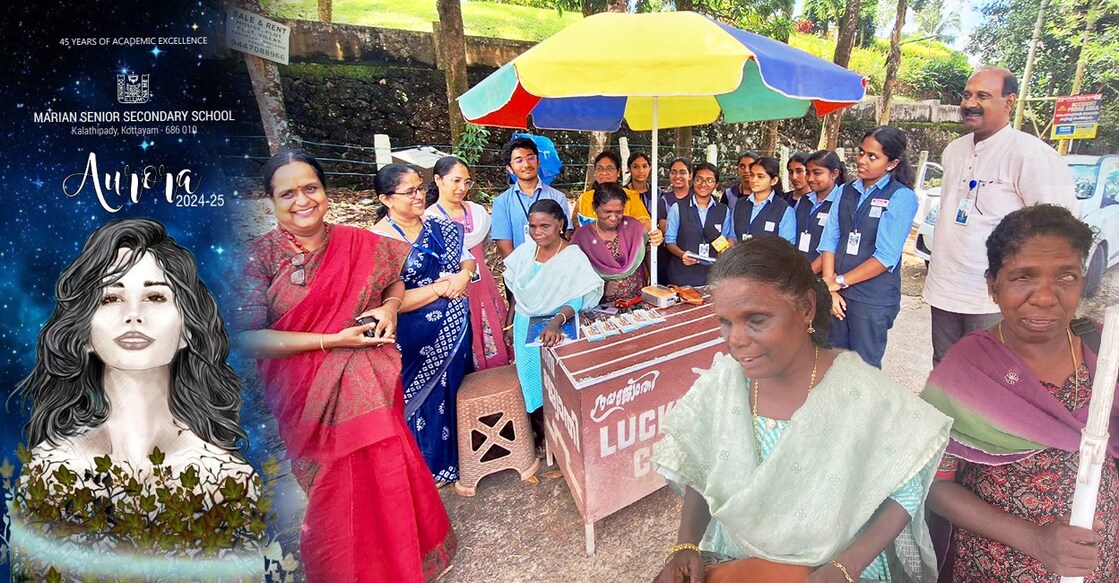
When the students from Marian Senior Secondary School,Kottayam handed two blind women, Rosamma and Sudha, a magazine article, their fingers slowly traced the words. The lines unfurled a tale, which was close to their hearts. It was the story of their lives - an uncelebrated, simple life story which spoke volumes of their character and resilience.
The article carefully transcribed into Braille by a blind teacher captured not only their daily routines but their companionship, and independence they have built together.
The article, titled Kannadi Vilkkunnavar (People Who Sell Mirrors) was created as part of the Sahodaya Competition 2025. Reeba Eugine, the magazine’s editor and a teacher at Marian, remembers the day vividly. “What started as a story for students became an experience none of us had expected. In an age where friendships are fragile, seeing these two women supporting each other naturally left everyone speechless,” she says.
Rosamma, 46, lost her eyesight at the age of three, while Sudha, 49, became blind when she was thirteen. Though they grew up in different towns, Rosamma in Erumely, Sudha in Ernakulam, they first met at Sisubhavan in Aluva, studying together from class one to eight. Life separated them after school, but they reunited years later at a training centre in Muvattupuzha, where they learned bookbinding, chair-making, and other skills. They also received training in Braille, which helps them stay independent and connected to the world. Determined to live independently and not be a burden on anyone, they decided to make a home together.
For Sudha, life has often been challenging. After her mother’s death and the breakdown of her marriage, she could have been left completely alone. But Rosamma became her anchor. “It is not because we don’t have anyone to take care of us, or that we are alone. Our only thought behind working and staying together is we didn’t want to be a burden in anyone’s life,” Rosamma explains. Affectionately, she calls Sudha “Vave,” and Sudha responds with a warm smile, the two sharing an unspoken understanding that years of friendship have built.
Their home is modest but full of life. Each day, they leave at 7 am, selling lottery tickets until around 3:30 pm. Neighbours often check in with food or small gestures of help, and a local autorickshaw driver ensures they can travel safely to and from their selling spot. “We have made food at home; we are fine,” Sudha says. Their days are shaped by routine, but each action is done with care, efficiency, and a deep awareness of each other’s needs.
It was this everyday life that inspired the Marian students. Having noticed the women near their school, they wanted to capture their story for the magazine. Once the article was written, the students faced a question: how could the women experience it themselves? Reeba reached out to a blind teacher who knew Braille, and he transcribed the article so Sudha and Rosamma could read it with their own hands.
The students were fascinated not just by routines but by the women’s philosophy. Last year, when thieves stole Rosamma’s lottery tickets, neighbours helped set up pen cameras to catch the culprits. When asked why she hadn’t filed a case, Rosamma replied simply, “It’s easy to punish someone, but difficult to rectify their mistakes.” For the students, it was a powerful lesson- understanding life does not always require sight.
Reeba explains the magazine’s title: “They are mirrors to each other. They have no fights, and they are like close sisters.” In a world dominated by fleeting online connections, these two blind women have chosen a life together grounded in trust, care, and independence.
Their upbringing shaped their determination differently. Rosamma’s father encouraged her to be confident and strong from a young age, turning her blindness into a source of motivation. Sudha, growing up with less support, struggled with self-confidence. Today, Rosamma provides that encouragement, helping Sudha meet the world with courage.
For the Marian students, the experience was transformative. Principal Shins Mathew notes, “What started as a simple school article became a meaningful encounter, giving students insight into lives shaped by resilience, care, and courage beyond textbooks.”
 Add as a preferred source on Google