

No more lungi dance or wardrobe malfunction, CITU men to don trousers & badge

Mail This Article


“Maybe we are poor, coolies, trolley pullers... but we are not beggars!” When actor Jayan thundered those words in the Malayalam film ‘Angadi’ (1980), wearing his dusty, sweat-soaked red vest and brown lungi, he was not just speaking for a film character. He gave voice to an entire class of workers who formed the muscle of Kerala’s markets.
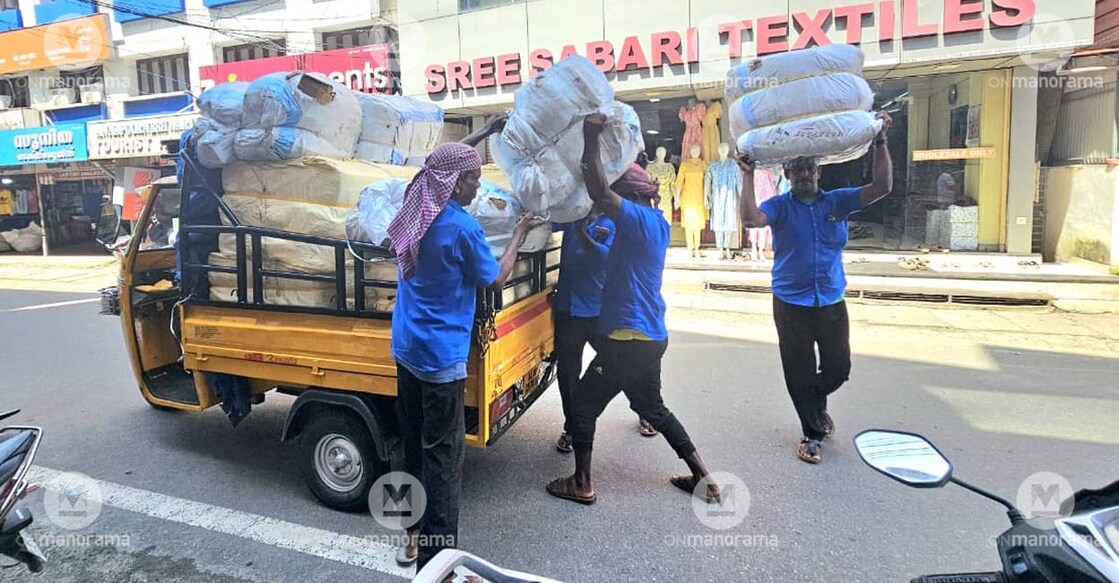
Now, forty-five years later, in the narrow lanes of bustling Ernakulam market, the headload workers have found their own way to echo Jayan’s words not through rebellion, but through a sartorial reinvention. Their trademark lungis have made way for black trousers and name badges, as Kerala’s most recognisable workforce steps into a new era – confident, organised, and unmistakably professional.
The Centre of Indian Trade Unions (CITU)-affiliated Kerala Headload and General Workers Union in Ernakulam has replaced its 50-year-old trademark of blue shirts and lungis with blue shirts and black pants, marking a major shift for nearly 50,000 workers across the state. Each worker now also wears a name badge displaying their names, registration number and union branch, a small but significant symbol of professionalism.

At the Ernakulam Market, the headload workers are embracing the change with enthusiasm. “The CITU is adapting to the times. Even the RSS changed its uniform. Switching to pants makes our work easier and more comfortable,” said KM Ashraf, Ernakulam District General Secretary of the Kerala Headload and General Workers Union (CITU).
Ashraf said that the decision came after years of discussions about comfort, safety, and public perception, which are issues that matter just as much as wages and welfare in modern labour movements.
For Navas AK, a headload worker and executive member of the union’s Ernakulam City Branch, the uniform change is more than a dress code; it’s a statement. “People used to look down on us. There is even that line everyone uses – ‘Onninum Kollillel Poyi Valla Chumadeduthu Jeevikkada…’ (If you’re good at nothing, go be a headload worker). That’s how society viewed us. But every job has dignity. Now, when we wear shirts and pants, people see us with respect,” Navas said.
He added that the new look challenges the old stereotype of the “rowdy” labourer, a bare-chested, muscular man in a lungi and vest with a fuming beedi on his lips. “Now people are not afraid to talk to us. They see us as professionals, not thugs. And we hope that helps us get more work, too,” Navas said.

Beyond image, the new attire has made their everyday work easier. “With lungis, we always had to fold them up to work, especially lifting heavy things, which was uncomfortable and sometimes embarrassing. They would get wet in the rain, and we had to keep adjusting them while lifting cargo. Pants solve all those problems,” said SS Madhu, another headload worker at Ernakulam market.
According to Madhu, the most awkward part was climbing heights like atop a cargo truck or a building with their lungis folded up. “Women and girls often felt uncomfortable, and it was embarrassing for us, too. Many workers have even lost balance while trying to adjust their lungis mid-work. With pants, all those problems are gone.”
Women working in the market agree with Madhu. “It is not like they wanted to make us uncomfortable. Their job demanded it. Pants are just more practical and respectful for everyone,” said Renuka Alby, a staffer at a textile shop.
Even cloth merchants felt the impact. “When the rule came, black pants went out of stock because each worker bought at least four pairs, mostly track pants, because they are durable,” said Shanavas, a cloth trader in Ernakulam Broadway’s Cloth Bazaar.
For senior worker Hamsa Abdul Rahman, pockets are the highlight. “Finally, we can keep our phones and wallets safe. No need for extra waist bags or makeshift pouches,” he said while lifting a sack of vegetables.
The blue shirt has been a CITU symbol since 1975, when the union decided to create a distinct identity for its workers, setting them apart from other federations like INTUC and AITUC. The lungi remained an emblem of the grassroots until now.
But after half a century, modernisation and a push from within made the change inevitable. “It was time to evolve, and we did it,” said Ashraf.
The Red Brigade initiative
The new uniform idea grew out of CITU’s ‘Red Brigade’ initiative, a special team of headload workers trained to assist during emergencies like fires, floods, and accidents.
“For the Red Brigade volunteers, wearing lungis was impractical. We gave them blue shirts and black pants with red jackets and reflectors. Then we realised we can extend this to everyone else as they all wanted it for a long time,” Ashraf said.
The Red Brigade’s district launch took place on October 2, and the state-level event will follow in December, led by Chief Minister Vijayan.
For many workers, the new uniform also reflects a larger cultural transformation within the union. “There was a time when some workers would get drunk after work and waste their wages. Now, anyone caught working under the influence loses their registration. We’ve become disciplined. The new dress reflects that discipline. Even our kids are happy. They say we look smarter now,” said Rahim, joint secretary of the union’s City Branch.
 Add as a preferred source on Google