

At 91, Kerala Congress man runs campaign for party candidates in Kottayam

Mail This Article


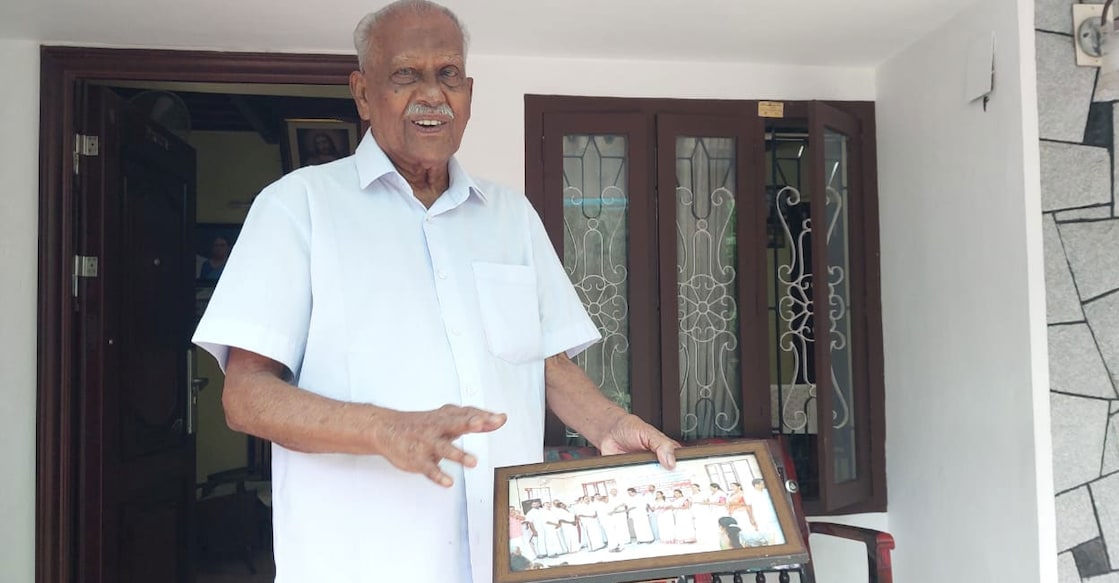
Kottayam: P M Eapen, a Kerala Congress veteran, trudges along the rugged landscape of Mannackanad and Marangatupally. As he moves along, he pauses to greet families and drops by at houses he has known for generations. He leads a much younger pack campaigning for Kerala Congress (M) candidate Alex K K at Marangatupally panchayat. It's a live demo of 'watch and learn' for others. They walk in tow with a man who has witnessed firsthand the evolution of Kerala Congress party.
Eapen's political journey began in 1956 as a young Congress worker. But his political future was set to be moulded by a childhood bond with a boy who would grow into one of Kerala's most influential leaders- K M Mani.
When the Kerala Congress was formed in 1964, Eapen moved with Mani to the new party. He became a member of the party's Assembly Committee at its very inception, a position he has held for more than 60 years, making him one of the longest-serving functionaries in the party's history.

"I have stood with Mani throughout my political life," he says, reflecting on the warm affection he showered to party workers. "Mani sir genuinely loved his co-workers." Eapen also treasures memories of a lifetime.
Eapen remembers a memorable incident when Mani was serving as the state's Finance Minister.
"It was a Saturday, and he was scheduled to attend a meeting in Kozhikode. Usually, he informed party workers in advance if he wouldn’t be at home on a Saturday. Somehow, I didn’t know about it. I went early in the morning and waited outside his house in Pala. The security told me that he and Kuttiyamma had gone to church."
It was a misty morning and hard to see even beyond five metres. Eapen saw Mani and his wife walking back home from the verandah of their house. "He couldn’t see me clearly, but he knew someone was sitting in front. Mani sir went to the back of the house, and the security told me he had to leave urgently for Kozhikode and that I should wait."
After some time, Mani returned and realised who was waiting. "He looked genuinely surprised and asked, ‘Eapacha, was it you? I couldn’t recognise you clearly! Eapen recalled with a smile.
But what troubled the leader more was that he had eaten breakfast while Eapen sat outside. "He told me how bad he felt that he and Kuttiyamma had eaten breakfast inside while I was waiting outside," Eapen recalled. Mani then took Eapen by the hand and brought him to the dining table and insisted he should have breakfast. "He even asked Kuttiyamma to make sure I ate properly," Eapen said. "Only after that did he leave hurriedly for Kozhikode," he added, reflecting on the humility of the leader.
Eapen, who has witnessed the evolution of Kerala’s political history, remembers a very different political landscape. Recalling earlier days of campaigning, he noted how limited resources once shaped political outreach.
"There were no telephones or good roads back then. We had to endure tough conditions to meet people. But those hardships created strong bonds. I knew every person by name," Eapen said.
Eapen laughed as he recalled an episode from one of Mani's early Assembly campaigns. The team began house visits at 5 pm and continued through the night, returning only at 5 am. "When we returned around 5 am the next morning, one of our team members was missing," he said. "We later realised he had fallen asleep at one of the houses we visited."
Eapen said Mani’s energetic and meticulous style of campaigning often meant long hours on the road. "Mani sir would stop at every house and talk to every member of the family. We had nothing to do while he spoke, so most of us would doze off. After he finished, he would wake each one of us up, and we would continue our journey," he said. Eventually, they found the missing team member and wrapped up the campaign trail with breakfast at a hotel in Pala.
Eapen contested the panchayat elections in 1980 from the newly formed Marangatupally panchayat, which had been carved out of Elackad. Long before his candidacy was officially announced, he knew that he would get a seat. Working as an LIC field agent at the time, he used the nature of his job to deepen his grassroots connections.
"I couldn't disclose then that I was likely to be a candidate. But as an LIC agent, I could visit people freely and talk to them about anything beyond work. That helped me build genuine relationships," he said.
Eapen believes it is precisely this kind of personal connection that today's political generation lacks. "People could approach us anytime. Now, everything is rushed. A phone call ends the conversation in seconds. That warmth is missing," he said.
Eapen said his tenure as a ward member was marked by resolving land disputes, settling police cases and repairing roads. "At that time, panchayats received very limited funds. Only a small amount was available for road works, and we had to divide it carefully. It was impossible to cover every area due to the shortage of funds," he said.
He also fondly recalled how Marangatupally secured its homoeo clinic under his initiative. "When Mani sir was Finance Minister before the ’80s, he allotted funds for a homoeo clinic in Elackad panchayat. But suitable land could not be identified," Eapen said.
"When I became a member, we took the initiative to locate land. The NSS donated 20 cents, and a few individuals contributed the remaining 5 cents, helping us reach the required 25 cents," he added. However, the allocated funds were insufficient to construct the building. "We then raised the remaining amount collectively. We had to collect money daily to pay the workers," he recalled.
However, after each passing day, things became very difficult and they approached Mani. "We explained the situation to him, and he immediately sanctioned the additional funds. That is how the homoeo hospital was finally built," Eapen said.
Eapen contested the panchayat elections only once in his life. He then shifted his focus to cooperative movements — a space where he believed real community change could be effected. He was elected to the Marangatupally Cooperative Bank and served as a board member for two terms, first in 1976 and again in 1992.
In 1986, driven by the need to create stable jobs for rural youth, Eapen co-founded the Gandhigram Industrial Cooperative Society in Kuravilangad. He served on its board for nearly a decade.
Even today, he maintains a disciplined life. Eapen walks 3–4 km every day, a habit he credits for his good health at 91. His diet is simple: he avoids chicken and fish. He doesn’t eat anything after 4 pm, and his next meal is breakfast the following morning.
A loyalist who stood by KCM through every split and merger, Eapen was recently honoured by party chairman Jose K Mani for his decades of service. And while new factions, new leaders and new styles of politics have come and gone, Eapen remains a familiar constant. Candidates still call him for guidance, and he never hesitates to step onto the ground — just as he did in the early days of the party, when he and Mani, along with Mani’s close associates, held secret meetings away from the watchful eyes of the Congress.
 Add as a preferred source on Google