

Kerala geoscientists put Bekal, Varkala, Thumba, Periyar on Mars, and how!

Mail This Article


Kasaragod: When Neil Armstrong took that first step on the Moon, the long-running Malayali joke was that he’d find someone from Kerala already there -- selling tea, of course. If humans ever make it to the Red Planet, that punchline may finally get real with a ‘Mars Malayali Aano?’ twist.
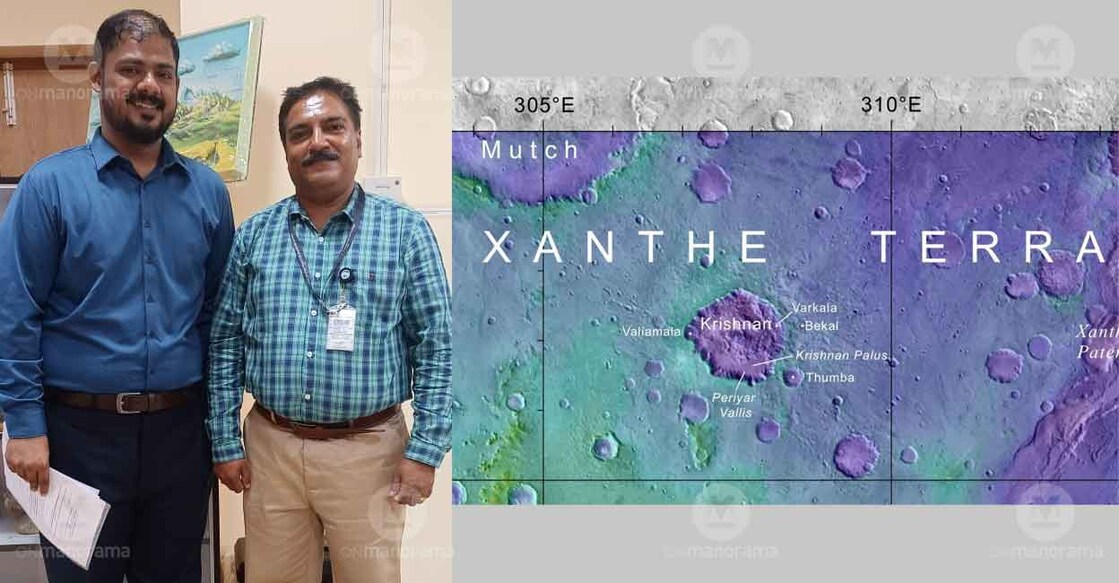
An assistant professor from Kasaragod Government College, Dr Asif Iqbal Kakkassery, along with his PhD guide, Prof V J Rajesh of the Indian Institute of Space Science and Technology (IIST), has managed to put four places and a river from Kerala on the Martian map. On November 24, the International Astronomical Union (IAU) Working Group for Planetary System Nomenclature approved the names of Bekal, Varkala, Thumba, Valiamala, and the Periyar River for six features on Mars.
These landmark craters and valleys sit inside and along the rim of a mammoth 70-km crater -- at least 3.5 billion years old -- which the two geologists have named after M S Krishnan, the pioneering Indian geologist and the first director of the Geological Survey of India.
“It is the first time Martian landforms have been given names from Kerala. Before this, I have come across not more than four or five Indian names on Mars,” said Kakkassery, who has been studying the plant for the past seven years.
For his PhD at IIST, Kakkassery studied how the surface of Mars has changed in the middle and lower latitudes by using satellite data from NASA and ISRO. “I focused on Xanthe Terra considering its future habitability,” he said. Xanthe Terra is an elevated plateau located just north of the Martian equator and is geologically important because it shows strong evidence of ancient water activity, including channels, gullies, and sediment deposits shaped by flowing water billions of years ago.
While studying Xanthe Terra, Kakkassery spotted the 70-km-diameter crater, which was not studied before, and also identified smaller craters triggered by landslides inside the mammoth crater. Kakkassery also discovered a plain area and a valley with evidence of ancient water flow inside the Krishnan Crater. The findings and features of these craters, ancient glacial flow and plains were published in the ‘Meteoritics & Planetary Science’ journal. “In my PhD, these areas are called big crater and small crater, and valley and plain. But from now on, they will be known by the names we gave,” he said.
IAU nomenclature rules allow naming big craters (50 km or more in diameter) after scientists, and smaller craters after places with a population below 1 lakh. “Initially, we proposed the name of A P J Abdul Kalam for the big crater. But it was rejected because he became the President. Then we proposed the name of M S Krishnan, and it was accepted,” he said.
For the smaller craters, they proposed Kochi, Kakkassery’s home village, Puthiyakavu in Thrissur’s Mathilakam grama panchayat, and his guide’s hometown, Palkulangara in Thiruvananthapuram city. They also proposed Valiamala, the home of IIST, and Vidyanagar, where Kasaragod Government College is located.
Kochi was rejected because its population was more than 1 lakh; Puthiyakavu, Palkulangara, Vidyanagar and Valiamala were rejected because they were not easy to pronounce. “IAU prefers a three-syllable word,” he said
But Kakkassery and Rajesh persisted with Valiamala because it was closer to them. They then picked Thumba because it is India’s first rocket launching station; Bekal was chosen for having Kerala’s largest fort, and Varkala for its geological monument, the Varkala Cliff, and Periyar for being Kerala’s largest river.
The valley inside Krishnan crater was named Periyar Vallis. “I wanted to name it Kasargaod’s Madhuvahini River in Mogral. But the name was too long,” he said. The plain area inside the Krishnan crater was named Krishnan Palus, said Kakkassery, who has now picked astrobiology as his area of research.
 Add as a preferred source on Google