
John Brittas key link in PM-SHRI deal, Samagra Shiksha funds tied to NEP compliance: Union Education Minister
Mail This Article


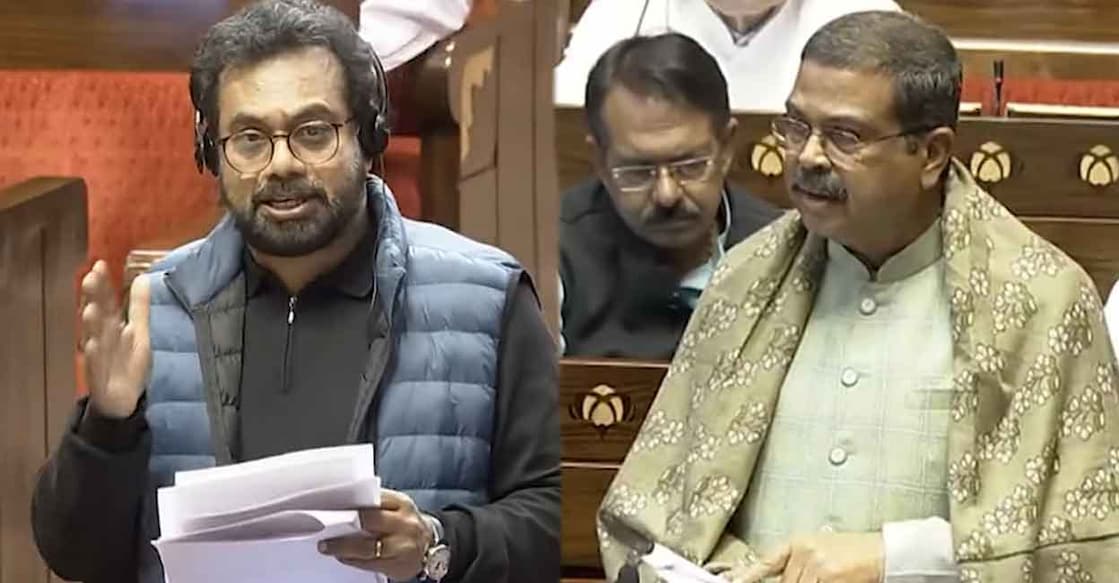
Union Education Minister Dharmendra Pradhan on Wednesday told the Rajya Sabha that CPM MP John Brittas served as an important link between the Centre and the Kerala government on matters related to the PM-SHRI scheme, and congratulated him for his role.
Brittas had raised a query seeking detailed state-wise data on Samagra Shiksha funding. He asked the Minister to clarify the total central allocation approved, disbursed or withheld over the past three years, the committed share for each state, and the reasons for delays in releasing funds. He also criticised the Centre for allegedly making PM-SHRI signing a precondition for the release of Samagra Shiksha funds.
“Samagra Shiksha, launched in 2018, should not be linked to other schemes launched subsequently. Is this part of a politically motivated strategy to deny resources to states?” he asked.
Pradhan rejected the charge. “It is not a partisan policy by the government. Let me cite some non-BJP-ruled states: Himachal Pradesh, Karnataka, Punjab, Telangana — please see how much allocation they get and how much is released. They are getting funds,” he said.
Brittas pressed further, saying: “Will you delink PM-SHRI from Samagra Shiksha? Also, only ₹92.41 crore was released to Kerala for 2025–26. My request is: please release the remaining amount.”
Pradhan responded that the Centre was ready to release Kerala’s entitlement of ₹452 crore this year, subject to conditions of NEP implementation the state had earlier agreed to.
While responding to supplementary questions, the Minister shifted focus to Kerala’s controversial entry and eventual withdrawal from the PM-SHRI scheme. He said the Kerala government had initially signed the memorandum of understanding with full consensus, and that State Education Minister V Sivankutty had personally conveyed the state’s willingness to join.
“I do not know what happened thereafter,” Pradhan said, indicating that internal issues within the state government led to the withdrawal. He accused the state of creating “confusion” around the scheme despite initially approving it.
Reacting to the Minister’s remarks, Brittas cautioned against misinterpreting Pradhan’s statement. He said he had accompanied Sivankutty on a few occasions on matters related to the state but had no role in government decisions. “Pradhan’s statement should not be twisted,” he said.
In his written reply to Brittas’ question, Pradhan said the Department of School Education and Literacy implements Samagra Shiksha in partnership with all states and Union Territories. Annual plans are prepared by states based on their priorities, appraised by the Project Approval Board, and approved according to scheme norms. Fund release, he said, depends on utilisation certificates, audit reports, progress updates, state contributions, and compliance with guidelines. State-wise details of allocations and releases over the past three years were placed before the House.
State-wise Allocations
According to the data placed before the House by the Minister, Kerala’s Samagra Shiksha funding trend shows a steep decline in releases over the past four years. In 2022–23, the Centre approved ₹348.47 crore and released 51.13 per cent. In 2023–24, ₹343.34 crore was approved, but the release dropped to 41.26 per cent. The situation worsened in 2024–25, when ₹428.89 crore was approved but not a single rupee was released. For 2025–26, the Centre approved ₹452.05 crore, of which only 20.44 per cent has been released so far.
Data shows that many non-BJP-ruled states have received substantial Samagra Shiksha releases, supporting the Minister’s claim. In Karnataka, 85.73 per cent of funds were released in 2022–23 and 86.76 per cent in 2023–24, rising to 92.71 per cent in 2024–25, though releases have dropped to 46.92 per cent so far in 2025–26. Himachal Pradesh shows moderate but steadily declining levels, from 74.73 per cent in 2022–23 to 70.75 per cent in 2023–24 and 68.79 per cent in 2024–25. Only 25 per cent was released in 2025–26. Punjab displays significant fluctuation, with 84.14 per cent released in 2022–23, a drop to 46.07 per cent in 2023–24, a sharp rebound to 95.68 per cent in 2024–25 and a fall again to 40.25 per cent in 2025–26. Telangana maintains one of the strongest overall records, releasing 99.88 per cent in 2022–23, 78.94 per cent in 2023–24 and 85.04 per cent in 2024–25. Only 24.72 per cent of funds were released to the state in 2025–26. Tamil Nadu, which has decided to stay away from PM SHRI, mirrors Kerala’s pattern of disruption: while releases stood at 99.51 per cent in 2022–23 and 88.18 per cent in 2023–24, no funds were released in 2024–25 and only 24.39 per cent has been released so far in 2025–26.
Kerala, which had long maintained it would stay out of the PM-SHRI programme, informed the Centre in early October that it would join the scheme. The decision triggered protests within the ruling LDF, particularly from the CPI, the second-largest partner, which objected to the MoU being signed without consultation within the Left Front or the cabinet.
Following these objections, the state government wrote to the Centre requesting that all procedures under PM-SHRI be halted. Reports later revealed that the Education Department had signed the MoU without discussions within the LDF or the cabinet, causing friction between the CPI and CPM. Sivankutty later defended the move, saying the department had signed the agreement solely to secure central financial assistance, while reiterating that Kerala would not implement the National Education Policy.
 Add as a preferred source on Google