

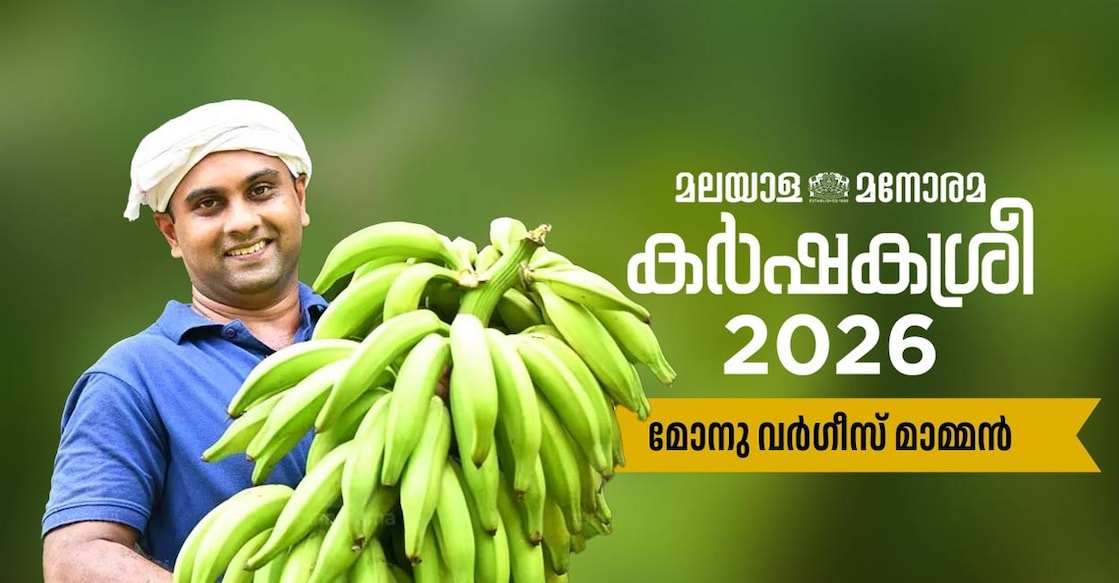
Monu Varghese Mammen wins Malayala Manorama Karshakashri Award 2026
Mail This Article


Kochi: Monu Varghese Mammen, a 38-year-old farmer of Veliyathumalil at Elanji in Ernakulam, has been selected for the prestigious Malayala Manorama Karshakashri Award 2026, one of Kerala’s most respected honours recognising excellence in farming.
The biennial award, instituted by Karshakasree, the agricultural magazine of Malayala Manorama, carries a cash prize of ₹3 lakh, a certificate and a gold medallion. The award will be conferred on Monu during the Karshakasree Farm Fest to be held in Thrissur in February 2026, Malayala Manorama Managing Editor Jacob Mathew announced.
Monu is the 18th recipient of the Karshakashri award. A total of 117 nominations were received this year. After preliminary scrutiny, 19 farmers were shortlisted for field inspection. Following primary evaluation by a team comprising an agriculture expert and members of the Karshakasree editorial board, five candidates were selected as finalists.
The other finalists were MK Purushothaman of Sultan Bathery in Wayanad, K Saseendran of Vengappally in Wayanad, TV Rajanarayanan of Thiruvilwamala in Thrissur and CD Raveendran Nair of Vandanmedu in Idukki. The expert panel revisited the shortlisted farms, prepared detailed video reports and made final observations before submitting them to the jury.
The five-member jury, headed by former Union Agriculture Secretary and former Chairman of NDDB and Spices Board T Nandakumar, unanimously selected Monu as the winner. The other jury members were P Indiradevi, former Director of Research, Kerala Agricultural University; Madhura Swaminathan, professor, Economic Analysis Unit, Indian Statistical Institute, Bengaluru; B Ashok, State Agriculture Production Commissioner; and Jacob Mathew, Managing Editor, Malayala Manorama.
The jury cited Monu’s “innovative and consistent efforts to enhance productivity and profitability” and noted that he has successfully integrated technology, marketing, financial management and diversification to make farming economically viable.
During the crash in natural rubber prices, Monu, along with his mother Valsa, began diversifying their 20-acre rubber plantation. In 2019, he established a dairy unit that soon evolved into a model enterprise, adopting technology-driven milking systems, low-cost climate-controlled cattle sheds and mechanised farm management practices. He also developed his own formula for a total balanced ration and effectively reduced the inter-calving period, significantly boosting income and productivity through scientific breeding and management.
Monu later ventured into the value addition of farm produce, exceeding expectations. By involving his wife, Niss, and sister, Meenu, in an ice cream business, he also created a successful example of women-led entrepreneurship. Over the years, the family farm has been revitalised through the introduction of new crops, diversified cropping systems and modern technologies. The jury also highlighted initiatives such as establishing a poultry farm within rubber plantations and efforts to minimise urea usage in paddy cultivation.
“He stands as an example for young, educated farmers willing to adopt technology for sustainable and profitable agriculture,” the jury observed.
 Add as a preferred source on Google