

Analysis | What happens when a BJP enclave emerges dangerously close to CPM's command centre

Mail This Article


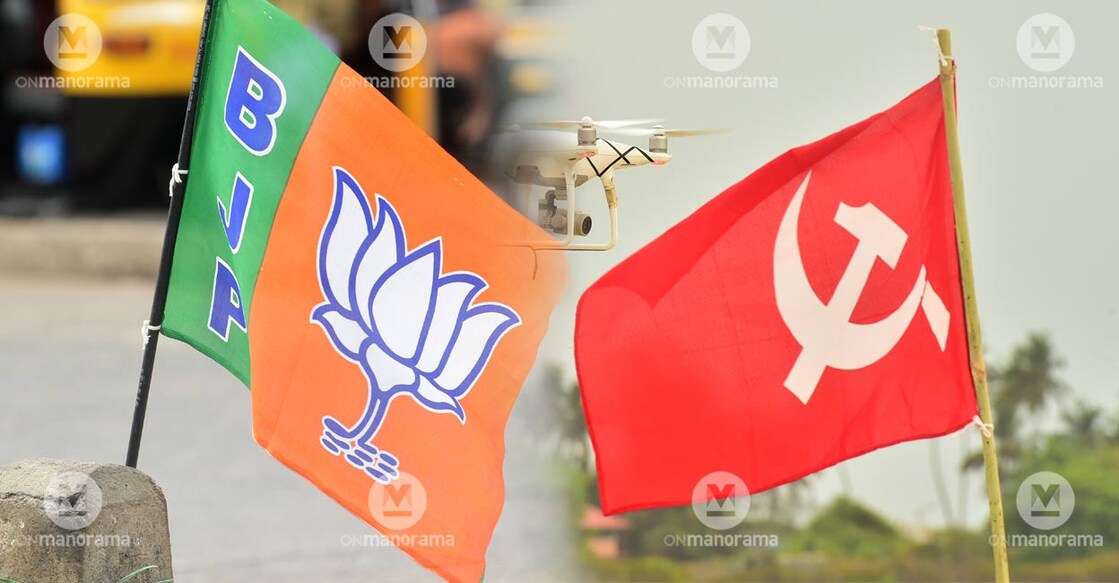
With the BJP in power for the first time in the Thiruvananthapuram Corporation, forming a hostile zone within the LDF-ruled administrative capital of Kerala, what had seemed the acceptable political decor all this while is no longer so.
The first sign of disruption was felt inside a room rented out by the corporation. For over a decade, CPM's Vattiyoorkavu MLA and former mayor V K Prashanth had occupied without any hassle a spacious area in a corporation space that also strained to accommodate the office of the Sasthamangalam ward councillor. The councillor's office looking like the MLA's personal assistant's room.
Forget wanting to change the PA status, the new BJP ward councillor, former DGP R Sreelekha, wanted to be the only boss. She wanted the entire corporation space to herself. Sreelekha asked the MLA, though in polite terms, to find another place. The CPM was rattled.
The party was served its next shocker out in the streets. Transport minister K B Ganesh Kumar's management of electric buses meant for the corporation was questioned. The BJP Mayor, V V Rajesh, has asked the corporation authorities to check if the e-buses are operated as per the 2023 tripartite agreement the corporation had entered into with KSRTC's Swift company and Smart City Thiruvananthapuram (an entity formed under the Centre's Smart Cities Mission 2015).

The Mayor's sense was that some 30-odd buses were operating outside the corporation limits, some even in other districts. Rajesh is also displeased that the KSRTC is not sharing the e-bus profits with the corporation as mandated in the tripartite agreement.
For the LDF transport minister such a corporation audit is unheard of, and therefore, startling. In fact, the previous corporation led by the CPM, too, had formally complained to the LDF government that KSRTC was violating the conditions of the tripartite agreement. Nothing had come of it.
Ganesh Kumar sounded so miffed and confused by the BJP-led corporation's move that he mocked the very spirit of decentralisation and also the environmental concerns of his own government that drove the e-bus project.
He said it was wrong to say that the 113 e-buses were purchased using the corporation's money. "They were bought mostly using the state government's money," the transport minister said.
Both the Centre and the state had contributed ₹500 crore each and the corporation had shelled out ₹135.70 crore. "The state's and the corporation's shares go from the state's kitty. This means that nearly 60 per cent of the money was spent from the state government's pocket," Ganesh Kumar said.
He made it seem as if the funds transferred to the local bodies were state government charity and not legal entitlement. "When you say it is the corporation's money, it means the state government's. It could be the corporation's own fund or plan fund, but these come from the state's coffers," the minister said.
Later in the day, while responding to the minister's remarks, the Mayor quoted from a 2024 Facebook post of his predecessor, CPM's Arya Rajendran. In her post, Arya says that the buses were purchased by the corporation and then handed over to KSRTC Swift.
When the transport minister ridiculed the e-bus project as a big drain on the KSRTC's finances, he was in effect questioning the electric vehicle policy of the LDF government. Fact is, 'Carbon Neutral Ananthapuri' was the declared policy of the previous CPM-led corporation council.
"Please don't speak of these e-buses as something out of the world. It is a loss-making enterprise," Ganesh said. He said that each e-bus cost ₹1 crore and every five years its battery had to be replaced for ₹25-28 lakh. The maintenance cost of these buses, too, is prohibitively high, he said.
In contrast, the minster said that a mini-diesel bus could be purchased for just ₹28 lakh. "The earnings per kilometre of these diesel mini-buses we had purchased is ₹52," he said. That of the e-buses, he said, was only Rs 42.
It was lost on Ganesh that granting profitability primacy over public welfare militated against Left principles.
In a confrontational tone, he said that the Mayor only had to give a request in writing for the KSRTC to return all the 113 buses. "They can keep these buses wherever they want but not in our depots," Ganesh said. In their place, the minister said that KSRTC would purchase 150 mini-diesel buses.
The Mayor responded to this with a barely concealed smile. Rajesh said the corporation had enough vacant lots to park these vehicles but offered 'no thanks' to the minister's readiness to return the buses. "We have no plan to call back the buses," he said.
"Reason is, these buses have run their course and it is time to replace their batteries. Battery consumes 70 per cent of the purchase cost," he said, hinting that he had seen through Ganesh's sly move to load the entire burden of these e-buses on the corporation.
There is a rare meeting of minds here. Both the minister and the Mayor are not in the least enthusiastic about electric vehicles.
 Add as a preferred source on Google