

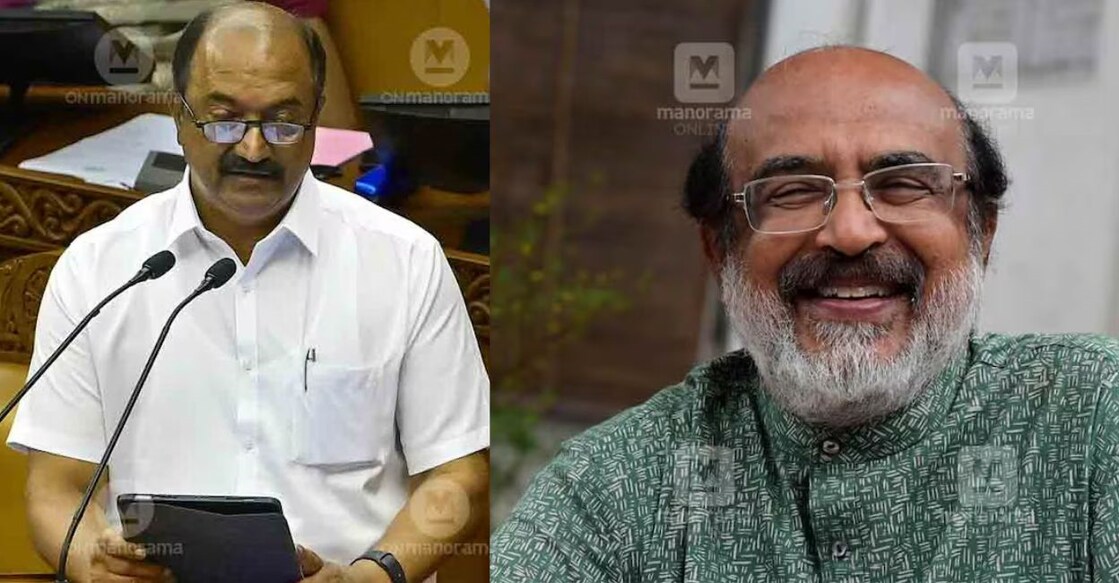
Analysis | Balagopal's 'top secret' an insult to Thomas Isaac, his Budget reveals crisis not strength

Mail This Article


The LDF government's 'satyagraha' in Thiruvananthapuram against the Centre's fiscal authoritarianism on January 12 was projected as a declaration of both triumph and defiance.
"You smothered us with all your might and now see how we have fought back," was Pinarayi Vijayan government's message to the BJP-led Centre on 'satyagraha' day. The bloodied-victor posturing was actually meant for the voter.
The swagger was on show on Budget day, too. "The Central Government's neglect towards Kerala reached its zenith during the tenure of this government," finance minister K N Balagopal said at the start of his nearly three-hour speech in the Assembly.
Like any mass hero who in the climax of a movie recalls the taunts of his adversaries, Balagopal said: "We were mocked at by saying the treasury will be scrubbed clean of cash that cats would find it the ideal nest to give birth. When this did not happen they said we were slashing development and welfare expenditure and borrowing excessively. But even these charges are no more heard."
Then in quite a dramatic tone Balagopal said that there was a "top-secret" behind Kerala's whistle-worthy fight back. Here's the secret. "We have been able to generate an additional revenue of around ₹1,27,747 crore in terms of own tax revenue," Balagopal said.
This was not the total collected but the extra collected in the last five fiscals of Balagopal's rule. Though it might sound impressive, it is utterly misleading. One, it is a comparative figure that means nothing other than an insult to Balagopal's predecessor T M Thomas Isaac.
The difference between the average own tax revenue during Isaac’s five-year tenure and that of Balagopal stands at ₹1,27,747 crore. During Isaac's five years, when the pandemic and two major floods battered the Kerala economy like never before, the average own tax earning was ₹47,453 crore.
During Balagopal's disaster-free term, the average own tax collection bettered to ₹73,002 crore. Essentially, Balagopal was saying he collected ₹1.27 lakh crore more than Isaac. The "top-secret" that Balagopal boasted about has no other significance.
To know whether Balagopal has really done well, as the minister would like his voters to believe, one has to look at the annual growth in the state's own tax revenue (SOTR). The main sources of the SOTR are GST, sales tax and VAT, taxes on vehicles, stamps and registration, excise and land revenue.
Right from his first budget speech, Balagopal has estimated an over-optimistic rate of growth in SOTR. He got lucky in the first fiscal, the period between 2021-22 and 2022-23, which happened to be the first post-Covid bounce-back fiscal. The own tax revenue shot up by 23 per cent.
Ever since, there was virtual stagnation. In 2023-24, though Balagopal estimated a growth of nearly 20 per cent, the actual growth was a stunted 3.3 percent. In 2024-25, Balagopal had estimated a growth of over 14 per cent. His revised estimates had lowered expectations to below 10 per cent. But when the final audited figures were revealed in the latest Budget, it was 3.1 per cent, worse than even the previous fiscal.
For 2025-26, Balagopal once again estimated a more than 12 per cent growth. Today, when the revised figures were out, it moderated to 9.25 per cent. Experts say the final audited figure would be in the usual 3-4 per cent range. Unmindful of the trend, Balagopal has yet again estimated that own tax revenue for 2026-27 will grow at over 12 per cent.
A mere 3-4 per cent growth in own tax collection is widely seen as a sign of fiscal crisis. Either there is a demand slump or the tax administration is inefficient. The high inflation in Kerala, the worst in the country, is sign that there is high demand for goods and services. So the problem of stagnant own tax growth boils down to inefficient tax administration, a state subject.

Fiscal crisis looms
Balagopal's latest Budget, his sixth and the last for this ministry, has more proof of Kerala's fiscal crisis. Revenue and fiscal deficits have gone badly out of control. The 15th Finance Commission has stipulated that Kerala should achieve a revenue surplus of 2.50 per cent of the Gross Domestic State Product (GSDP) by 2024-25.
Balagopal, in his speech, had attempted to keep the revenue deficit (RD) as low as possible and estimated that, rather than a surplus, it would be a deficit of 1.90 per cent. He sounded realistic.
When the 'satyagraha' was staged, Onmanorama had warned that it was not a show of triumph but just an attempt to mislead the voter, to dress up failure as victimhood.
Onmanorama had predicted that the RD could spiral to 2.50 per cent of the GSDP, a mirror image of the Finance Commission target of surplus 2.50 per cent. Now, the revised figure is worse, minus 2.58 per cent. When the final accounts are submitted, the RD figure could be even more unsettling.
Revenue deficit/surplus is the difference between revenue receipts (tax revenue + non-tax revenue + grants-in-aid) and revenue expenditure (on interest, salary, pension and subsidy). A deficit means the state spends more than what it earns.
Balagopal had no luck monitoring fiscal deficit (FD), too. The 15th Finance Commission's FD target for 2024-25 was 3 per cent of the GSDP. Balagopal, in his speech said he would hold it at 3.16 per cent. Now, his revised figures show it has bloated to 3.78 per cent. The true extent of the fiscal devastation would be revealed only when the Controller and Auditor General releases the final accounts later in the year. (The FD is the difference between the total expenditure and total non-debt receipts of the state government.)
Stagnant capital expenditure
A more distressing fact is that the deficits look alarming even after Balagopal adopted an extremely conservative strategy. For instance, he virtually kept even the effective capital expenditure, the spending required to create long term assets and jobs, stagnant this fiscal. What was ₹24,151.58 crore in 2024-25 is ₹25,005.67 crore in 2025-26, a mere ₹845 crore increase. Though he had been a conservative finance minister, he had upped effective capital expenditure by nearly ₹3500 crore in 2024-25.
Various critical social services components have witnessed not stagnation but a fall in expenditure this fiscal. Health and family welfare (2024-25: ₹2947 crore. 2025-26: ₹2568 crore). Welfare of SC/ST/0BC & minorities (₹1747 crore to ₹1300 crore). Social welfare and nutrition (₹1520 crore to ₹1480 crore). Even these cuts could not save Balagopal's deficits. The state's fiscal management was a mixture of poor revenue mobilisation and unsound expenditure control.
Given that his budgeted figures have always gone way off the mark, Balagopal's estimated RD (2.12%) and FD (3.40%) figures for 2026-27 also look doubtful.
This time Balagopal is hoping to keep his deficits in check on the basis of two assumptions that could go terribly wrong. One, a 12 per cent or more growth in own tax revenue; this is highly unlikely as the growth during his tenure was stuck in the 3-4 per cent range. Two, central government transfers, a component Balagopal has been relentlessly complaining was drying up, would double. If it is ₹34,599.93 crore during the 2025-26 fiscal, Balagopal assumes it would be ₹68,613.86 crore. He is betting on the 16th Finance Commission, which has already submitted its report, to come to Kerala's aid. Kerala economy is in tatters and the next government will have lot of tidying up to do.
 Add as a preferred source on Google