

Tech jumbos enter Kerala temples, may help curb cruelty to elephants

Mail This Article


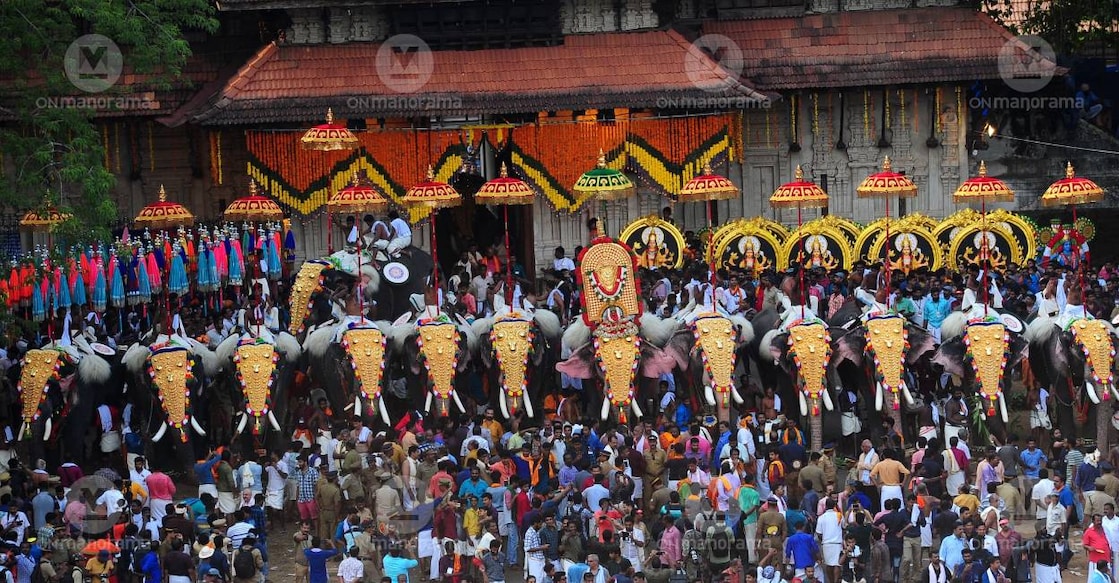
Captive elephants have long been at the heart of temple festivals in Kerala. The scale of a celebration is often measured by the number of tuskers lined up in ceremonial splendour.
Elephants are often forced to stand for hours on scorching ground, often with untreated and festering wounds, in the midst of deafening percussion, fireworks, and surging crowds. They endure physical pain and psychological stress and flinch at the threat of the mahout’s bullhook (ankush).
As festival season doubles up as the peak earning period for elephant owners, animals are frequently moved from one event to another. When stressed elephants run amok, the consequences are often fatal. Over the years, several human and animal lives have been lost in such incidents.

Even as jumbo parades, ‘anayoottu’ (ritual feeding of elephants) and ‘anayottam’ (elephant races) continue unabated in the name of tradition and symbolism, a quiet but significant shift is taking place across Kerala’s temples. Increasingly, temple committees are exploring mechanical or robotic elephants as a humane alternative to live animals.
Once ridiculed as an affront to tradition, mechanical elephants are again being discussed as the festival season begins. This is definitely driven by growing awareness of animal cruelty and safety concerns.
A turning point
On January 25, Bollywood actor Sonakshi Sinha, in association with People for the Ethical Treatment of Animals (PETA) India, donated a life-size mechanical elephant to Pallipuram Sreekrishna Temple in Thrissur. The three-metre-tall elephant, weighing around 500 kg, has been named ‘Pallipuram Unnikrishnan.’
Until 2024, the temple regularly paraded three to five captive elephants during festivals. With the introduction of Unnikrishnan, the temple committee announced that it would no longer parade live elephants.
The roots of this movement go back over a decade. PETA launched its campaign in 2013 following a series of fatal incidents involving captive elephants in temple festivals.
V K Venkitachalam, founder of the Heritage Animal Task Force in Thrissur, a voluntary group dedicated to preventing cruelty towards elephants, recalls one incident that brought global attention to the issue.
“On January 27, 2013, three people were killed and over 50 were injured after ‘Thechikottukavu Ramachandran,’ the most celebrated captive elephant in Kerala, ran amok at a temple in Perumbavoor, Ernakulam. The temple committee and police had to destroy a wall on the temple compound to rescue the people,” he said.
“Following this, national and global media showed interest in studying and reporting on the plight of elephants in Kerala. The New York Times published an article on August 14, 2013, in connection with World Elephant Day. This article was a real eye-opener about the torture the poor giant creatures suffer,” Venkitachalam said.
He added that PETA subsequently proposed replacing captive elephants with mechanical ones. “Though the efforts started years ago, it came into reality only in 2023,” he said.
Irinjadappilly Sri Krishna Temple in Thrissur district became the first temple in Kerala to use a life-size mechanical elephant for rituals. PETA India, with support from Malayalam actor Parvathy Thiruvothu, gifted the elephant to the temple on February 26, 2023. Named ‘Irinjadappilly Raman,’ the mechanical elephant stands 10.5 feet tall and weighs around 800 kg.
Following this, actors Priya Mani, Adah Sharma, Vedhika, Jackie Shroff, Bhumi Pednekar, and Sonakshi Sinha; cricketer K L Rahul; and sitarist Anoushka Shankar donated mechanical elephants to select temples as part of PETA’s initiative.
Apart from PETA, Voice for Asian Elephants Society (VFAES) has also taken up the mission to end cruelty towards captive elephants. In February 2024, VFAES donated its first robotic elephant, ‘Sri Sivasankara Hariharan,’ to Sree Sankaran Kovil in Gudalur, located on the Kerala-Tamil Nadu border. In 2025, the organisation sponsored another mechanical elephant, ‘Shiva Shakthi,’ to the Chakkamparambu Bhagavathy Temple in Thrissur.
Under the rules of the robotic elephant sponsorship project, temples that own elephants must hand them over to the sponsoring organisations, which then transfer the animals to hospice centres. Temples that previously hired elephants must pledge never to parade live animals in the future.
“PETA aims to donate 360 robotic elephants,” Venkitachalam said. “But there are campaigns against the movement and the artists who are making these life-size replicas. Currently, two workshops in Chalakudy and Paravur are involved in this work,” he said.
Venkitachalam, a former teacher, said he reached out to his former students who now head temple committees under organisations such as SNDP Yogam, Yoga Kshema Sabha, and some trusts.
“When PETA successfully created the first mechanical elephant, the next challenge was convincing temple committees to adopt it. I contacted a few of my former students, and it worked. Now, applications are piling up on my WhatsApp,” he said.
Artists behind the jumbos
Prasanth Prakashan, from Chalakudy in Thrissur district, along with three friends, is among the artists building mechanical elephants. The first life-size robotic elephant sponsored by PETA was constructed at their workshop in Potta.
“An elephant will cost ₹5.25 lakh, including GST. We use fibre, rubber, an iron frame, and metal pipes to make an elephant. Five motors are fixed inside its ‘stomach’ to operate it. Its eyes, trunk, and ears move,” Prasanth said.
He added that the elephants can be operated using a generator, are mounted on wheels for transport, and can seat four to five people.
“We can make around four elephants in a month. So far, we have made around 20 elephants in different sizes, from three to 11 feet tall, for PETA,” he said.
Prasanth’s team also built the first life-size mechanical elephant for Dubai Pooram, a re-creation of Thrissur Pooram for Malayali expatriates in the UAE. “Four elephants constructed at our workshop are being used in Spain for circuses. The Rambo Circus group is also using our product as they realised that using real animals would land them in legal troubles,” he said.
While the innovation has gained acceptance, Prasanth acknowledged resistance from purists and ardent supporters of captive elephant parades.
Calmer festivals, fewer fears
Thrissur district currently leads in the adoption of mechanical elephants. Eight temples, namely, the Irinjidappally Sree Krishna Temple, Peringottukara Vishnumaya Devasthanam, Kombara Sreekrishna Swami Temple, Pallippuram Sreekrishna Temple, Chakkamparambu Sree Bhagavathy Temple, Nediyathali Sri Siva Temple, Sree Padmanabhapuram Mahavishnu Kheeram Temple near Guruvayur, and Cherukunnu Sree Subhramanya Swami Temple, have adopted the innovation.
C D Sreenath, president of the Chakkamparambu Bhagavathy Temple committee, said devotees welcomed the use of the mechanical elephant ‘Shiva Shakthi.’
“We felt more confident about conducting the temple festival without any untoward incidents,” he said.
Sethumadhavan, president of Cherukunnu Sree Subhramanya Swami Temple, said the robotic elephant, ‘Cherukunnu Karthikeyan,’ donated by actor Bhumi Pednekar and PETA India, was a sacred addition to the temple.
Temple committees are also allowed to rent out the mechanical elephants for other events and use the income for charitable activities, Venkitachalam said.
According to Venkitachalam, Kerala currently had around 301 captive elephants. Many of the animals may not survive beyond the next 10 to 15 years.
“Some temple committees lure wealthy NRI devotees into sponsoring captive elephants by convincing them that they will be blessed with lifelong prosperity. There is a big scam behind parading captive elephants in temples,” he said.
He pointed out that elephant owners earn lakhs of rupees by renting animals to temples and private events. Some temples, especially those under various Devaswom Boards, remain hesitant to adopt mechanical alternatives.
As safety norms continue to be violated and tragedies recur, technology has offered an alternative. Whether this quiet revolution succeeds, experts say, depends on society’s willingness to place compassion above spectacle.
(Temple committees interested in replacing captive elephants with robotic ones may contact the Heritage Animal Task Force at 9495712811 or 8700935202).
