
Rare ‘Kayampoo’ bloom in Kozhikode man’s courtyard draws crowds
Mail This Article


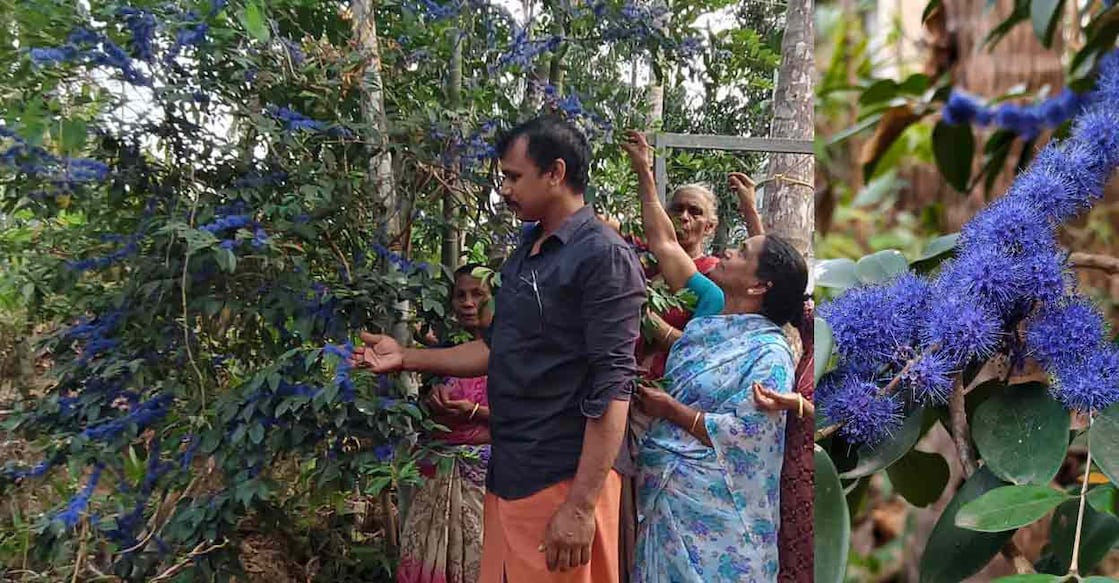
Kayampoo (Ironwood / Memecylon umbellatum) has been the leitmotif in many Malayalam songs; it mostly remained an enigmatic flower species for Keralites who preferred to romanticise it. That is the reason why the plant in full bloom in the courtyard of K M Binu's house in Vatakara in Kozhikode recently generated a widespread curiosity.
Binu had no clear idea of how long the plant had been there in the courtyard. He noticed it when it bloomed four years ago. "The plant flowered once every year since then. But knew about its significance in terms of its medicinal properties only recently," Binu, who works as a mason, says.
The plant and its flowers went viral after a video of them was posted on social media. People in large numbers have also started visiting the place to see it or to get its seeds or flowers. "Till recently, I used to get only two calls a day, mostly. One in the morning to hire me for work, and the other in the evening to inform me about the payment made in my bank account. But now my phone receives a barrage of calls every day from people across places to know more about it or to know the location to make a visit," he says.
Though ironwood is generally considered a rare, endangered species, it's a ubiquitous sight across Kerala for botanical researchers. According to Sujana K A, Scientist, Botanical Survey of India, the Ironwood plant was a common shrub in the open fields, sacred groves and forest areas. "Now that the open fields and yards are fast receding, the population of the plant species is also dwindling," she says, "But the plant is still very common in Kannur, Kochi, Kozhikode and Pathanamthitta. The species may not easily catch the attention of common people, but for us, they instantly grab our attention."
"That could be true, but one cannot miss its uncanny attribute of mystery," one of the visitors to Binu's courtyard says and adds that he has never seen Kayampoo in his life before. "Apart from several medicinal properties of the plant, its leaves are sweet and are said to be useful for diabetes," he says.
Binu, who lives with his mother, enjoys the 'celebrity' status in the region lent to him by the plant, and is never irked by the frequent phone calls and attends to most of the calls. "I take the calls, or else they would think I have become haughty after the fame earned by the plant and its flowers," he laughs.
 Add as a preferred source on Google