

LDF releases election manifesto in Kerala, promises jobs, women empowerment & poverty eradication
Mail This Article


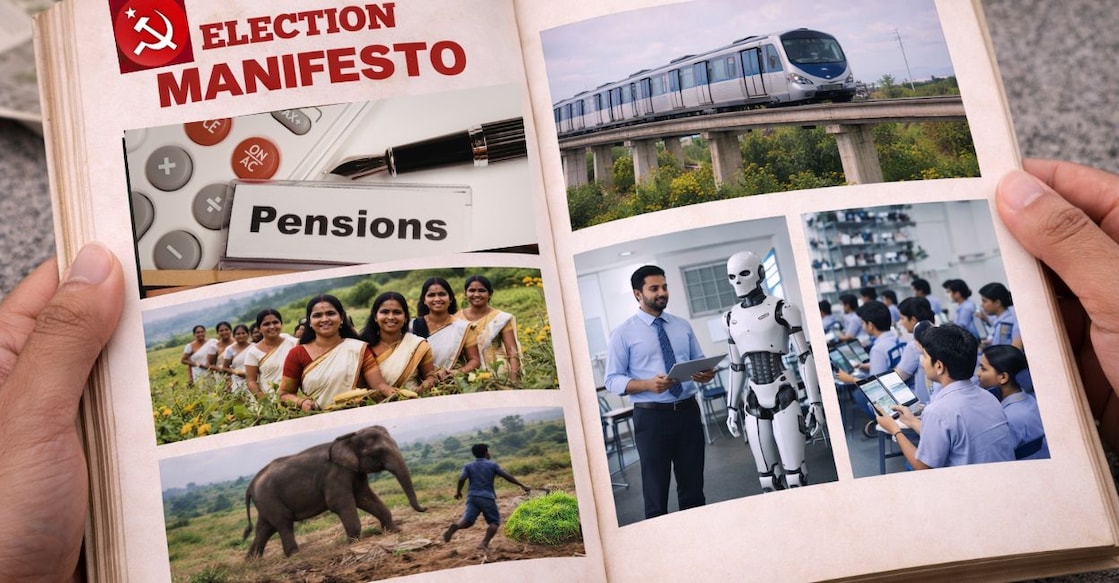
Kozhikode: The Left Democratic Front (LDF) on Thursday released its election manifesto ahead of the Assembly polls. Chief Minister Pinarayi Vijayan launched the document in Kozhikode. The manifesto has been published in two volumes, with 60 points outlined in the first and detailed explanations provided in the second. Speaking at the event, the Chief Minister said Kerala had effectively tackled the 2018 floods, monsoon-related challenges, Covid-19 and Nipah outbreaks due to the LDF government’s clear direction.
The Chief Minister further said that the party would continue to prioritise women’s empowerment, highlighting the role of Kudumbashree. Women’s workforce participation, he said, rose from 26.6 per cent in 2016–17 to 36.4 per cent in 2023–24. Initiatives such as financial assistance for homemakers, support for entrepreneurs and increased participation of women in the service sector have contributed to the state’s growth, he said.
In this regard, the LDF manifesto further targets the rise of women's workforce participation to 50 per cent with institutional support, while the 'Back to Campus' programme aims to strengthen employability through institution-linked training. The manifesto further outlines a broad welfare and development agenda, including a promise to eliminate poverty by uplifting around five lakh of the poorest families and introducing a comprehensive care model for the elderly and bedridden. It proposes assured campus placements and expanded skill training for students, alongside interest-free loans and incubation support to boost youth entrepreneurship and create jobs through the expansion of Global Capability Centres.

The manifesto has also pledged to resist changes to the Mahatma Gandhi National Rural Employment Guarantee Scheme and ensure its continuation with additional state funding. Under “Mission 100,000,” the LDF plans to scale up one lakh nano and micro enterprises into units with ₹1 crore annual turnover, while a parallel mission will support 1,000 small enterprises to grow into ₹100 crore companies. Existing MSME support systems will be continued and expanded.
In agriculture, the focus is on raising productivity to national standards through precision farming, mechanisation and disease-resistant hybrid seeds. The manifesto proposes setting up local primary markets in every panchayat and strengthening Farmer Producer Companies (FPCs), cooperatives and self-help groups. A plantation mission with replanting and climate-resilient practices is also planned, alongside measures such as micro-irrigation and fertigation systems.
On infrastructure, the LDF aims to make Kerala a power-surplus state by expanding renewable capacity to 5,000 MW, while opposing privatisation in the sector. Road infrastructure will be upgraded to BM&BC (Bituminous Macadam and Bituminous Concrete) standards, and the state targets becoming railway level crossing-free. Major transport projects include a continued push for the SilverLine semi-high-speed rail, metro expansions in Thiruvananthapuram and Kozhikode, and expansion of the Kochi Water Metro. Port-led development will continue with Vizhinjam Phase II, alongside proposals for new airstrips in Idukki and Wayanad.
In education and upskilling, the manifesto proposes four high education centres in Thiruvananthapuram, Kochi, Thrissur and Kozhikode, and advanced training infrastructure in AI, robotics, 3D printing and semiconductor fabrication across ITIs and polytechnics.
The welfare agenda includes LIFE Mission 2.0 to achieve universal housing, the Jeevajalam project to ensure access to drinking water for all households, and the expansion of the Karunya health scheme by removing the ₹5 lakh cap. The LDF also proposes ISO certification for all local self-government offices and aims for 100% scientific waste processing, including liquid waste management.
Women-centric initiatives include expanding Kudumbashree bank linkages to ₹20,000 crore, local employment generation and schemes such as ‘Work Near Home’. Youth-focused measures include funding for clubs and campaigns against drug abuse and cyberbullying, while sports infrastructure will be strengthened through “30-minute fitness circles” within accessible distances.
The manifesto also outlines “Shop@Door”, a Kudumbashree-led last-mile delivery platform, and proposes Metropolitan Planning Committees to manage urbanisation. Governance reforms include 100% e-governance using free software, an assured pension scheme, and implementation of the 12th Pay Commission recommendations.

Environmental commitments include Mission Eco-Restoration to restore natural forests, protection of wetlands and mangroves, and promotion of electric vehicles. Disaster management systems will be restructured with stronger community participation. According to the manifesto, legal changes will be made to better deal with human-wildlife conflict.
Additionally, the government will ensure water and food are available inside forests so that animals stay within their habitats and do not enter residential areas. Protective measures such as trenches, electric fencing, walls, crop-based buffer zones and bee fences will be set up along forest borders with the help of local bodies.
More funds will be provided from the Chief Minister’s Distress Relief Fund to ensure fair compensation for crop damage and loss of life. Special packages will continue for Idukki, Wayanad and Kasaragod, while projects such as the Sabarimala Masterplan and Clean Pamba initiative are also highlighted. The manifesto reiterates its commitment to strengthening the cooperative sector, protecting secular values, and balancing welfare spending with capital investment despite fiscal constraints.
 Add as a preferred source on Google