

The art of letting grow in Elsie’s ever-evolving garden in Thrissur
Mail This Article


The Kalan family of Nellayi in Thrissur has long been at the forefront of Kerala’s traditional healthcare products market. Among its members, Antony’s home stands apart in both design and setting, carving out a striking presence in the Nellayi region.
Set within a beautifully maintained 12 cent garden, the house derives much of its allure from the lush greenery that envelops it. Though over 30 years old, both the home and the garden have held on to their original grace, a reflection of the care and dedication of Antony’s wife, Elsie. It is not merely the variety of ornamental plants that draws the eye, but their vitality and elegance that animate the space.
Elsie’s passion for plants did not begin recently. In the early years after settling into the house, she was drawn to roses, euphorbia and orchids. But over time, recurring setbacks began to take their toll, with diseases creeping into the roses, the sap related problems of euphorbia and relentless snail infestations that preyed on her orchids.

With every monsoon, the garden would turn into a thriving haven for snails of every shape and size, often threatening to undo months of careful tending. It was this persistent challenge that pushed Elsie to rethink her choices and seek out plants that could flourish without inviting these unwelcome visitors.
Realising that foliage plants, especially ornamental varieties from the colocasia family, were far less prone to snail attacks, she began to shape her garden around them.Gradually, plants such as aglaonema, philodendron, alocasia, schefflera, cryptanthus, ornamental ferns, jungle geranium (chethi), adenium, sea plant, snake plant and begonia all found a place in her garden.
In its early days, the lawn had been laid out with Mexican grass, which spread generously across different sections and gave the garden a neat, expansive sweep. But with the monsoon came stubborn fungal infections, and the summer brought its share of persistent pest troubles. As upkeep grew increasingly demanding, she began searching for an alternative. It was around this time that she noticed mondo grass at a relative’s home and brought some back to nurture in her own garden.
Mondo grass, a modest plant that thrives in both sunlight and partial shade, and spreads effortlessly through offshoots, was first introduced on a trial basis in a small patch of the garden. When it proved its worth, she gradually replaced the entire lawn with it. Today, in place of a conventional grass lawn, a soft, spreading carpet of mondo grass plants stretches across the garden.
The plant demands only minimal care, with attention to ensuring that water does not stagnate at the roots during the rains, adequate watering through the summer to prevent leaf scorch and the prompt removal of weeds as they appear.
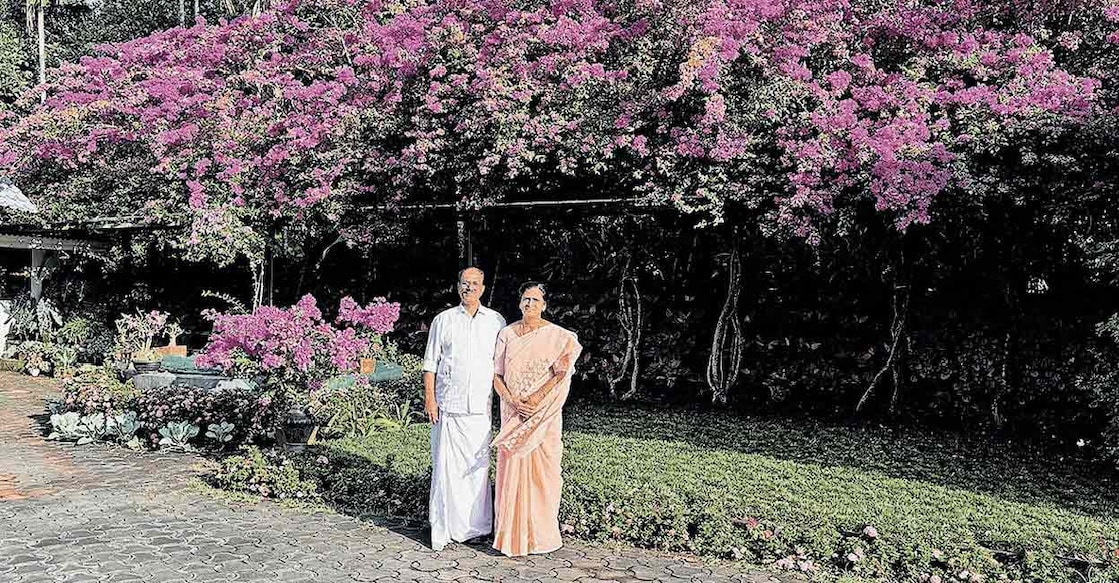
In its early years, the garden featured a long, shaded structure crafted with polycarbonate sheets, created to nurture orchids. But when relentless snail attacks made their cultivation untenable, the sheets were eventually removed. The supporting trellis, however, was retained and reimagined, with bougainvillea trained to climb over it. Today, the entire framework is awash with vibrant blooms, as bougainvillea spills across it in full, resplendent glory.
The cement platforms once intended for orchids have since found a new purpose as a haven for aglaonema. Arranged in earthen and plastic pots, each about a foot in size, nearly a hundred plants across three to four varieties fill the space. Lush and thriving, every pot overflows with growth, each plant standing out with its own distinct beauty and vitality.

Along one side of the driveway leading to the house, schefflera plants rise in a dense sweep, almost veiling the boundary wall in a blend of green and yellow. Planted in large earthen pots, they are allowed to grow into their full form, their naturally climbing habit guided along wire trellises. Elsie observes that when older, leaf shedding branches are pruned, the plants respond with fresh, vigorous shoots. Even with minimal attention, schefflera continues to grow with quiet strength.
In another section, rows of begonia plants, arranged in pots along the wall and on the ground, spill over in cascades and spread across the earth. Thriving in partial shade, these plants are propagated by Elsie from leaf cuttings, gradually enriching her collection. Adding a touch of charm to the garden is a small pond where pink water lilies bloom and ornamental fish glide beneath the surface, offering Elsie and her grandchildren a delightful space to watch, feed and enjoy.
All the plants in the garden, including the mondo grass, are grown in a potting mixture prepared at home by blending compost with red soil, with compost making up nearly three fourths of the mix.
The compost itself is prepared using a blend of residues from medicinal herbs such as gooseberry, Indian Indigo (neelamari), False Daisy (kayyunni), Balloon Vine (uzhinja), and Indian Sarsaparilla (naruneendi), along with coconut cake and organic waste, including fallen leaves from the garden. When the compost is made during the monsoon, neem cake is also added to enrich the mixture.
Perhaps it is the presence of these herbal residues in the compost that keeps diseases and pest attacks to a minimum in the garden, allowing the plants to thrive in both health and beauty. A striking example is the dark pink variety of cryptanthus, typically a partial shade plant, which flourishes here even in direct sunlight with remarkable vigour.Apart from the compost mixed into the potting medium and the annual replenishment of the soil in pots with a fresh mix, no additional fertilizers are used. Another notable feature is that most of the plants are nurtured in terracotta, or earthen pots.
For Elsie, watering the plants is an integral part of her daily routine, a task she carries out using well water. It is only in the days leading up to the monsoon, when all the pots are emptied and refreshed with a new potting mix, that she turns to outside help.
Beyond overseeing the preparation of products such as lemon and date pickles and kannankaya powder (raw banana powder) under the Kalan’s Food India brand, Elsie spends her leisure hours immersed in sari kutch work and tending to her plants. For the family, the garden serves as a space to unwind and savour moments of relaxation together.
 Add as a preferred source on Google